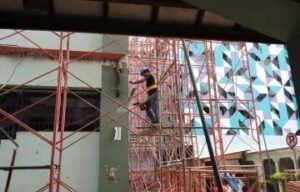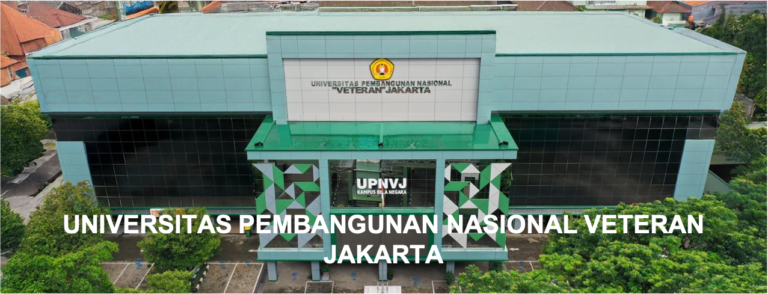





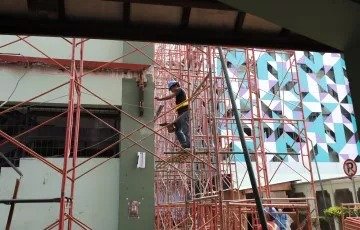
EduAsiaNews, Jakarta – Universitas Pembangunan Nasional “Veteran” Jakarta (UPNVJ) is continuing to improve its campus facilities and infrastructure through an exterior beautification project for the M.H. Thamrin Building of the Faculty of Economics and Business (FEB) at the Pondok Labu Campus. The project, marked by the signing of a Work Order (SPK) on August 14, 2026, is targeted for completion on December 11, 2026. The improvement work involves installing a façade covering to refresh the building’s appearance while creating greater visual harmony across the campus area.
UPNVJ Commitment-Making Officer (PPK) for Capital Expenditure and Buildings, Hugeng Budianto, S.E., said that the project is a continuation of the campus exterior renewal program previously implemented on several UPNVJ buildings.
“This has become part of the university’s policy and program to improve and enhance facilities and infrastructure at UPN Veteran Jakarta,” Hugeng said.
According to him, the renewal is not solely focused on improving the appearance of the buildings. The project is also intended to establish visual consistency among buildings, making the UPNVJ campus look more modern, orderly, and representative.
“The objective is beautification—to make the campus look fresh and attractive again. The appearance of one building will also be coordinated with that of other buildings so that the overall campus environment is more eye-catching,” he said.
The exterior renewal is considered necessary given that some UPNVJ buildings have been in use for a considerable period. Through façade improvements, the buildings can continue to serve their primary function as educational facilities while providing a more comfortable learning environment.
Improvements Implemented in Stages
Hugeng explained that the building beautification program is being implemented in stages, taking into account priority needs and the university’s budgetary capacity. The project is financed through Non-Tax State Revenue (PNBP), including revenue from Single Tuition Fees (UKT), rather than Pure Rupiah (RM) funding from the state budget.
“We are using our own financial resources, in this case the UKT revenue we receive. So it does not come entirely from the government, or RM. In the budget, there are RM funding sources as well as PNBP funding sources,” he explained.
Consequently, the renewal work is not being carried out simultaneously across all buildings. UPNVJ has prepared plans for the development of the Pondok Labu and Limo Campuses, including exterior improvements to several buildings.
“At FISIP, FH, and FIK, the designs have already been prepared. The exterior appearance has been planned. Other buildings may follow as the program progresses,” Hugeng said.
The improvement of the campus area is also being carried out alongside the development of supporting academic facilities. In the FEB and FISIP areas, for example, several other construction projects are currently being undertaken concurrently.
Building Access Regulated During Construction
To maintain the safety and security of the academic community, several access points around the M.H. Thamrin Building have been temporarily closed during construction. Before the work began, the PPK coordinated with the contractor, supervising team, and the FEB and FISIP management.
Based on the coordination, access on the western, eastern, and northern sides of the building has been restricted. The area beneath the new skybridge has also been temporarily closed to lecturers and students. These arrangements take into account several other construction projects being carried out simultaneously in the FEB and FISIP areas.
“The work also overlaps with the FEB canteen construction project, which has already begun. Meanwhile, construction of the FISIP canteen and the FISIP multipurpose room on the third or fourth floor has also started,” Hugeng said.
In the FEB area, a semi-open canteen is being constructed on the upper corridor of the new building. The facility is designed to include tenant spaces and a multipurpose area above it. Meanwhile, construction of a semi-open canteen and supporting facilities is also underway in the FISIP area. Several of these projects are targeted for completion in December 2026.
Noisy Construction Work Scheduled Outside Lecture Hours
The beautification project was initially planned to begin during the semester break. However, the schedule shifted due to the preparation of design documents and the tender process, resulting in some construction work taking place after academic activities had resumed.
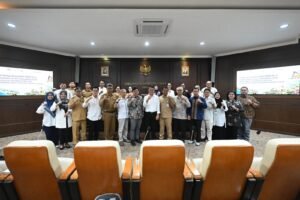
To minimize disruption to learning activities, UPNVJ coordinated with the Vice Dean for General and Financial Affairs (Vice Dean II) of FEB and the Head of the FEB General Affairs Division. Work expected to generate significant noise is scheduled, where possible, after 4:00 p.m. Western Indonesia Time (WIB) or on holidays. Material mobilization is also regulated to prevent disruption to academic activities.
“Major sources of noise are scheduled to be addressed outside learning hours. However, it is not possible to avoid the impact completely,” Hugeng said.
He apologized to students and members of the academic community for any inconvenience that may still occur during the construction period. Mitigation measures continue to be implemented while maintaining the target completion date of December 11, 2026.
Optimization of Limo Campus Facilities
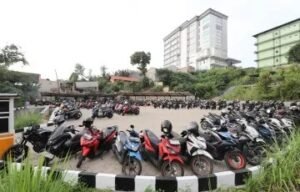
In addition to improvements at the Pondok Labu Campus, UPNVJ is continuing to optimize facilities at the Limo Campus, including the completion of a student parking area. The entrance to the parking area has been adjusted to make vehicle access safer and provide better maneuvering space.
“Students who want to use the lower parking area will not have to turn immediately. Instead, they can move slightly forward because the road has a slight incline,” Hugeng explained.
The main access improvements were completed before academic activities resumed. Several supporting facilities, including an awning along the parking area, are still being finalized.
The development of the Limo Campus parking area has been carried out in stages over the past several years, beginning with land preparation, followed by the construction of fences and access roads, and the paving of the parking area. The optimization is intended to improve safety, comfort, and service capacity for students.(www.upnvj.ac.id)