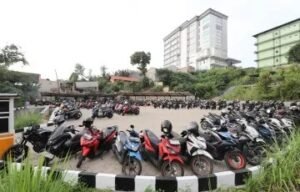





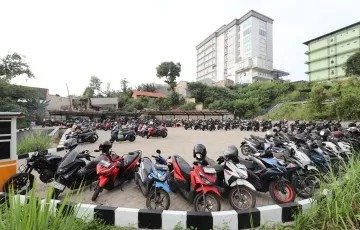
EduAsiaNews, Jakarta – Universitas Pembangunan Nasional “Veteran” Jakarta (UPNVJ) has entered the final stage of construction of a new parking area at its Limo Campus, with physical progress reaching approximately 95 percent. The facility is being developed to centralize student vehicles while improving security, safety, and mobility comfort across the campus. Construction has been carried out in stages, including land preparation, the construction of fences and roads, the provision of parking spaces, and improvements to vehicle access and pedestrian pathways.
The development of the Limo Campus parking area forms part of UPNVJ’s efforts to optimize university assets and land in order to improve the quality of facilities and infrastructure services for the academic community. The area has been developed in several stages over approximately three years.
Commitment-Making Officer (PPK) for Capital Expenditure and Buildings at UPNVJ, Hugeng Budianto, S.E., explained that the initial stage of development involved leveling and clearing the land. The work was subsequently followed by the construction of boundary fences, access roads, and a parking area paved with concrete paving blocks.
“Approximately three years ago, we began preparing and clearing the land. Then, about two years ago, we constructed the road and fence to improve security and establish the land boundary. Last year, the parking area was also developed using concrete paving blocks,” Hugeng said.
Entrance Access Redesigned to Improve Safety
In addition to preparing the parking area, UPNVJ has improved the vehicle entrance, which has a relatively steep incline. The access route was redesigned to be straighter, providing drivers with sufficient space to maneuver before entering the lower parking area.
Previously, vehicles had to make a turn along a route located close to the incline. This condition was one of the considerations behind the redesign of the access route, aimed at reducing the risk of vehicles losing control while improving student safety.
“That is why we made improvements. We made the access route somewhat straighter to provide additional space. So, students who want to park in the lower area do not have to turn immediately, but can move slightly forward first because the road has a slight incline,” Hugeng said.
The improvements to the access route were completed before academic activities resumed. With these changes, vehicles now have more adequate space when entering and leaving the parking area.
Canopy and Pedestrian Pathway Enhance Student Comfort
UPNVJ has also prepared facilities for students walking from the parking area to the academic buildings. One of these is a canopy (awning) along the pedestrian pathway to provide protection from the sun and rain.
“If students park in the lower area and it rains, there is an awning where they can walk or wait. The stairs have also been completed,” Hugeng said.
With physical progress reaching approximately 95 percent, the main parking facilities are essentially in place. The remaining work is focused on completing supporting components and final improvements before the facility is fully operational.
The new parking area is projected to become one of the main designated parking zones for students at the Limo Campus. Centralizing student parking is expected to help reduce vehicle congestion around academic buildings while creating more orderly internal traffic flows across the campus.
“That is why we are preparing this facility. We are maximizing the resources and land we have to improve campus services,” Hugeng said.
The technical management of the facility’s construction is coordinated by the UPNVJ Commitment-Making Officer (PPK) for Capital Expenditure and Buildings. The mechanism for the subsequent use and management of the parking area will be determined in accordance with university policies.(www.upnvj.ac.id)