




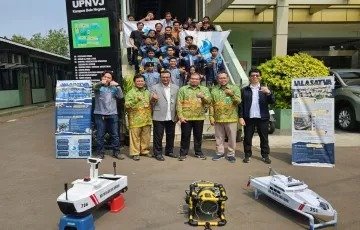
EduAsiaNews, Jakarta – The Jalasatva Student Study Group (KSM) of the Faculty of Engineering at Universitas Pembangunan Nasional “Veteran” Jakarta (UPNVJ) officially introduced three ship prototypes prepared for the final round of the 2026 Indonesian Ship Contest (KKI). The three student-developed prototypes consist of FERC, an Autonomous Surface Vehicle (ASV), and a Remotely Operated Vehicle (ROV). The prototypes were unveiled during the KKI 2026 Grand Launching on Wednesday (September 9, 2026), marking the team’s readiness for the final round scheduled to take place from September 14–17, 2026, at Politeknik Negeri Bengkalis.
The grand launching marked the culmination of a series of preparations undertaken by the students, ranging from team formation and design concept development to task allocation, production, and prototype testing. The event was attended by leaders of the Bureau of Academic Affairs, Student Affairs, and Cooperation (AKK), the Dean of the Faculty of Engineering, the Vice Dean for Student Affairs of the Faculty of Engineering, Rectorate staff, and the advisor of KSM Jalasatva.
Jalasatva’s participation in KKI 2026 provides an opportunity for students of Naval Architecture at UPNVJ to apply the knowledge they acquire in the classroom to real-world engineering projects. The competition also serves as a platform for students to test their ability to design, manufacture, and evaluate ship technologies while considering performance, efficiency, and maritime innovation.
The team’s preparations have been underway since the KKI 2026 series began in May. Following registration and the submission of design concepts or prototypes, participants underwent proposal selection in early June. Teams that qualified then entered the design and prototype development phase, which continued until early August, followed by an evaluation of progress reports and videos before advancing to the final round.
To ensure technical readiness, the students also conducted sea trials at Brigif Reservoir and the Physiotherapy Pool of the UPNVJ Faculty of Health Sciences (FIKES). The testing covered maneuverability and observations of vessel performance during operation on the water. This stage was used to evaluate prototype performance while identifying technical aspects requiring further refinement before the competition. Documentation included in the proposal shows the production process in the workshop as well as the testing of all three prototypes on the water.
The three prototype performance teams consist of students from different academic cohorts. The FERC team is led by Kunto Wibisono Mabilaka, the ASV team is headed by Muhammad Ikhsan Rais, and the ROV team is led by Weka Vivaldi. Each team comprises students responsible for the development and readiness of their respective vessels.
KSM Jalasatva was established as a platform for UPNVJ Naval Architecture students to develop technical and research skills through hands-on projects. The program is not solely focused on competition achievements but also on establishing a competitive research team, developing ship design and analysis methods, and producing scholarly publications. The KKI 2026 proposal targets at least three publications in indexed journals within a single research period.
In addition to KKI, Jalasatva plans to further develop the team’s competencies through participation in other national competitions, including the Indonesian Transportation Competition (LTI), COMET, and SAMPAN, as well as international competitions such as the International Roboboat Competition. These efforts form part of the Faculty of Engineering’s strategy to broaden students’ practical experience while strengthening UPNVJ’s academic presence in maritime technology.
As the team prepares to depart for Bengkalis, the launch of the three prototypes underscores that the competition process is not solely oriented toward the final outcome. The stages of design, manufacturing, testing, evaluation, and teamwork provide a hands-on learning experience that connects academic knowledge with real-world engineering challenges. Through KKI 2026, UPNVJ encourages its students to produce measurable and competitive innovations with the potential to contribute to the development of Indonesia’s shipbuilding and maritime technology sector.(www.upnvj.ac.id)