




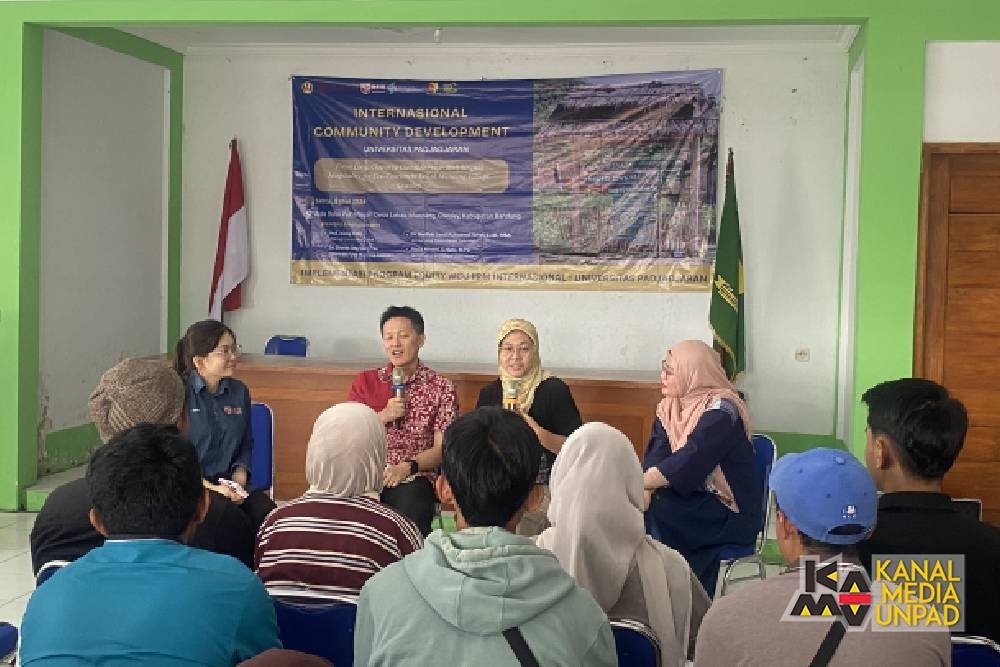
EduAsiaNews, Bandung – Universitas Padjadjaran (Unpad) organized an International Community Service Program (PPM) entitled “From Local Charm to Global Service: Multilingual Hospitality for Eco-Tourism in Lebak Muncang Village, Ciwidey.” Funded by the Equity World Class University (WCU) International Community Service Program, the event was held at the Village Hall of Desa Wisata Lebak Muncang, Bandung Regency, on Saturday, 9 May 2026.
The event was officially opened by the Head of Lebak Muncang Village, Diki Darmawan, and attended by 33 participants consisting of local tour guides. The program represents Unpad’s tangible contribution to empowering tourism villages through an international collaborative approach involving academics from Peking University and Universiti Putra Malaysia, alongside various local stakeholders.
Lebak Muncang Tourism Village possesses rich natural and cultural tourism potential, ranging from strawberry plantations and vegetable farms to traditional arts and a variety of local processed products such as strawberry chips, strawberry crackers, strawberry jelly, strawberry dodol, and the village’s distinctive civet coffee. However, these significant potentials have not yet been fully accessible to international tourists due to several challenges that require immediate attention.
The program consisted of two main sessions. The first session featured foreign language training in Mandarin and English, facilitated by Arbi Abdul Kahfi and M. Annas Zaenulloh, with the support of four international students from China, one international student from Malaysia, and two students from Unpad. This session produced one foreign language learning module along with digital learning content that can be independently utilized by the local community.
The second session involved mentoring and consultation activities with the invited speakers. Simultaneously with the training sessions, the international speakers conducted field observations at several tourism potential sites within the village, including strawberry plantations, vegetable farming areas, cultural tourism attractions, traditional musical instruments, and local processed products. The findings from these observations later became valuable discussion materials during the mentoring session with all participants.
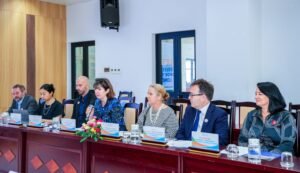
The speakers participating in the program included Prof. Xiang Yong from Peking University, China; Dr. Sharon Ong Yong Yee from Universiti Putra Malaysia, Malaysia; Dr. Nurillah Jamil Achmawati Novel from the Vocational School of Unpad; and Yang Nadia Miranti from Universitas Brawijaya.
Several issues were identified during the program. First, communication barriers with international tourists remain a major challenge. Second, cultural differences and varying habits also pose difficulties, particularly in the homestay business, where foreign guests generally expect bathroom facilities equipped with showers and sitting toilets. Third, local entrepreneurs face challenges in attracting tourists’ interest in local products, especially traditional musical instruments. Fourth, the production of local food and beverages is still largely made-to-order, resulting in limited stock availability and an inability to fulfill sudden large-scale demands. Fifth, the tourism village does not yet have standardized Standard Operating Procedures (SOPs) to consistently regulate cleanliness and service quality.
Dr. Sharon Ong Yong Yee recommended the use of smartphone-based translation applications, both paid and free versions, as a practical solution to overcome communication barriers. She also suggested that further implementation could become part of the sustainability agenda for future PPM programs.
Prof. Xiang Yong, accompanied by Yang Nadia Miranti, emphasized the importance of understanding the historical cooperation between Indonesia, particularly Bandung, and other Asian countries as a foundation for building a shared vision for sustainable village development. According to him, Bandung possesses extraordinary appeal in terms of both nature and culture, and therefore requires standardized service representation. He and Nadia also recommended that Lebak Muncang Tourism Village learn from best practices implemented in other tourism villages in Indonesia, such as the Borobudur area and Kampung Warna-Warni.
Furthermore, Prof. Xiang stressed that Unpad, as part of the community empowerment ecosystem, must continue collaborating with various parties at both national and international levels so that community service activities evolve beyond incidental programs and become sustainable efforts capable of addressing real societal challenges.
“This activity is not merely language training. It is a bridge between extraordinary local potential and the service standards expected by international tourists. We hope this program marks the beginning of a longer and more impactful collaboration for the people of Lebak Muncang Village and Indonesia,” said Prof. Xiang Yong of Peking University, China.
As a form of program accountability, the International Community Service Program produced several concrete outcomes, including:
A foreign language learning module (Mandarin and English) tailored to the context of tourism villages and hospitality services;
Digital learning content to support independent foreign language learning for the community;
Documentation of observations regarding the tourism potential of Lebak Muncang Village as a basis for sustainable development recommendations;
An international collaboration network among Unpad, Peking University, Universiti Putra Malaysia, and Universitas Brawijaya within the framework of research-based community service.
This initiative demonstrates Unpad’s strong commitment to implementing the Tri Dharma of Higher Education, particularly in the field of Community Service, through international standards. With full support from the Equity WCU International Community Service Program, Unpad hopes this initiative will become the starting point for sustainable and impactful empowerment programs for Lebak Muncang Tourism Village and other tourism villages across Indonesia.