




EduAsiaNews, Jember – Driven by concerns over the rapid expansion of illegal land clearing and the limited reach of conventional forest monitoring, a group of students from Universitas Jember (UNEJ) has developed an innovation called DeforTrack.
The innovation offers an integrated solution to address the urgent need for deforestation mitigation in Indonesia through the integration of advanced technology and the active involvement of local communities.
The recurring rate of deforestation and forest encroachment has become an urgent challenge, threatening biodiversity and triggering ecological disasters. Manual monitoring that relies on ground patrols is often constrained by vast areas, difficult access, and delays in early detection. In response to these challenges, UNEJ students were motivated to design a detection and prevention system that is precise, adaptive, and sustainable.
DeforTrack was developed by a student team led by Faruk Umar, together with Fadiyah Kamila and Yesika Indah from the Faculty of Agriculture, as well as Kiarra Putri and Anugrah Farel Putra from the Faculty of Computer Science. The entire development process was carried out under the supervision of Ir. Indah Ibanah, S.P., M.Si., a lecturer in the Agribusiness Study Program, Faculty of Agriculture.
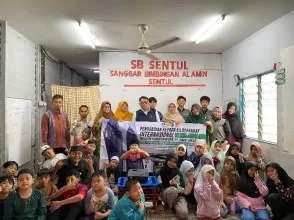
The DeforTrack PKM-VGK team presents its Manual Book to Perum Perhutani’s Jember Forest Management Unit (KPH).
In its implementation, DeforTrack employs a multisectoral approach that combines advanced spatial technology, cross-institutional data validation, and community empowerment:
1. High-Precision Remote Sensing (Hardware & Sensing):
DeforTrack combines an unmanned aerial vehicle (drone) equipped with a Light Detection and Ranging (LiDAR) laser scanning sensor. The sensor is capable of penetrating dense forest canopies to map terrain contours and detect land clearing and changes in tree density accurately and in real time.
2. Integrated Data Integration and Validation (Software & Network):
Data collected through drone scanning are integrated with existing monitoring systems, such as the SIMONTANA satellite monitoring system. The field data then undergo a joint verification process involving the Forestry Agency, Forest Management Unit (KPH), and Forest Rangers (Polhut) to facilitate rapid action at vulnerable locations.
3. Social Approach and Incentive Scheme (Community Empowerment):
Beyond the technical aspects, DeforTrack incorporates an economic and social incentive scheme for communities living around forest areas. This approach aims to provide alternative economic benefits, encouraging local communities to actively protect forests rather than encroach upon protected areas.
Ir. Indah Ibanah, S.P., M.Si., the supervising lecturer, expressed her appreciation for the breakthrough developed by her students.
“The DeforTrack innovation demonstrates the maturity of UNEJ students’ thinking in addressing environmental issues comprehensively. They not only offer advanced LiDAR scanning technology for early detection but also address the root social causes by involving local communities through an incentive scheme. We hope this concept will continue to be developed into an applicable solution that generates tangible impact,” said Indah Ibanah.
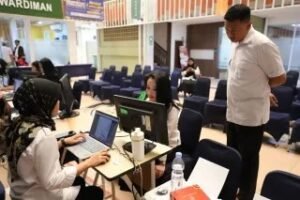
The team presents its concept and conducts an interview to obtain responses and feedback from Perum Perhutani’s Jember Forest Management Unit (KPH).
The innovation developed by the UNEJ students has secured official funding through the Student Creativity Program for Constructive Idea Videos (PKM-VGK), funded by the Ministry of Higher Education, Science, and Technology (Kemdiktisaintek) of the Republic of Indonesia.
The strength of the DeforTrack concept has also received appreciation and strong support from field practitioners, including the Jember Forest Management Unit (KPH) of Perum Perhutani. Head of the Production and Ecotourism Section of Jember KPH, Ir. Yona Bramantya Aji, S.Hut., IPM., assessed that the student innovation was highly realistic and could be practically implemented to help preserve forest areas.
DeforTrack Team Leader Faruk Umar emphasized that support from Perhutani, along with funding from Kemdiktisaintek, provided an important foundation for his team to expand the innovation to a broader level.
“Deforestation threats require rapid and collaborative action. Through DeforTrack, we want to demonstrate that students can make a tangible contribution to the conservation of Indonesia’s natural environment. We hope DeforTrack can serve as a pilot project that can eventually be adopted nationwide through collaboration with the Ministry of Environment and Forestry (KLHK) and various other stakeholders,” said Faruk Umar.
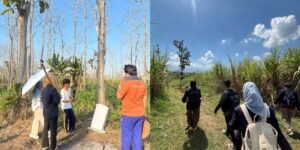
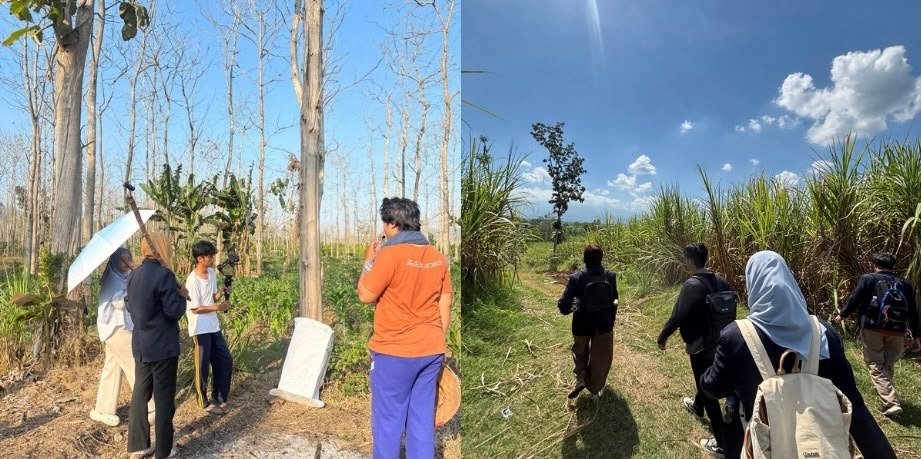
The DeforTrack PKM-VGK team prepares for the production of its project video in Ungkalan Hamlet, Sabrang Village, Ambulu District, Jember Regency.
Through DeforTrack (“Monitor Forests, Protect the Future!”), the student team from Universitas Jember reaffirms the commitment of young academics to addressing climate challenges and promoting forest conservation in Indonesia—from Jember to the nation.
(dil)