




EduAsiaNews, Senggi Papua – Team 12 of the Patriot Expedition of Universitas Diponegoro (UNDIP), led by Muhammad Iqbal Fauzan, S.P., M.Si., a lecturer in the Undergraduate Agroecotechnology Study Program, Faculty of Animal and Agricultural Sciences (FPP) UNDIP, together with five members from different academic disciplines—Fitran Dzulfikar Haryono, S.P.; Nurkhafizah, S.P.W.K.; Marta Junika Tambunan, S.Sos.; Ardhian Sasmita, S.A.B.; and Putri Duwi Ulia Sari, S.TP.—is developing the use of biochar to support sustainable agriculture and the green economy in the Senggi Transmigration Area, Keerom Regency, Papua.
The team’s interdisciplinary collaboration combines agricultural technical expertise, regional development, community and social aspects, processing technology, and economic empowerment to utilize abundant biomass, such as rice husks and corn cobs, which have not yet been optimally utilized. Team 12 is therefore exploring their potential as raw materials for biochar production.
Biochar is a carbon-rich solid material produced through the incomplete combustion, or carbonization, of organic waste or agricultural biomass. The team is currently developing a simple pyrolysis unit using a drum as the main container. Team members have also conducted trials to produce biochar using the Kon-Tiki method, a technique that produces biochar using an inverted cone-shaped container or pit. Initial trials indicate that the method is relatively simple and has the potential to be more easily adopted by local communities because it does not require complex equipment.
Team 12 Leader Muhammad Iqbal Fauzan, S.P., M.Si., explained that the technology was deliberately adapted to the local conditions and resources available in the transmigration area.
“Rice husks and corn cobs available in this area are actually resources that can be reused. We want the biochar technology not to stop with the activities of our team, but to be understood and adopted by the community. Therefore, we are exploring relatively simple methods, such as drum-based pyrolysis and the Kon-Tiki method,” said Iqbal.
The utilization of biochar is also being developed as part of a circular agriculture and green economy approach. Agricultural residues that were previously underutilized can be processed into useful materials and subsequently returned to the agricultural production system.
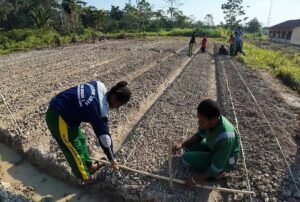
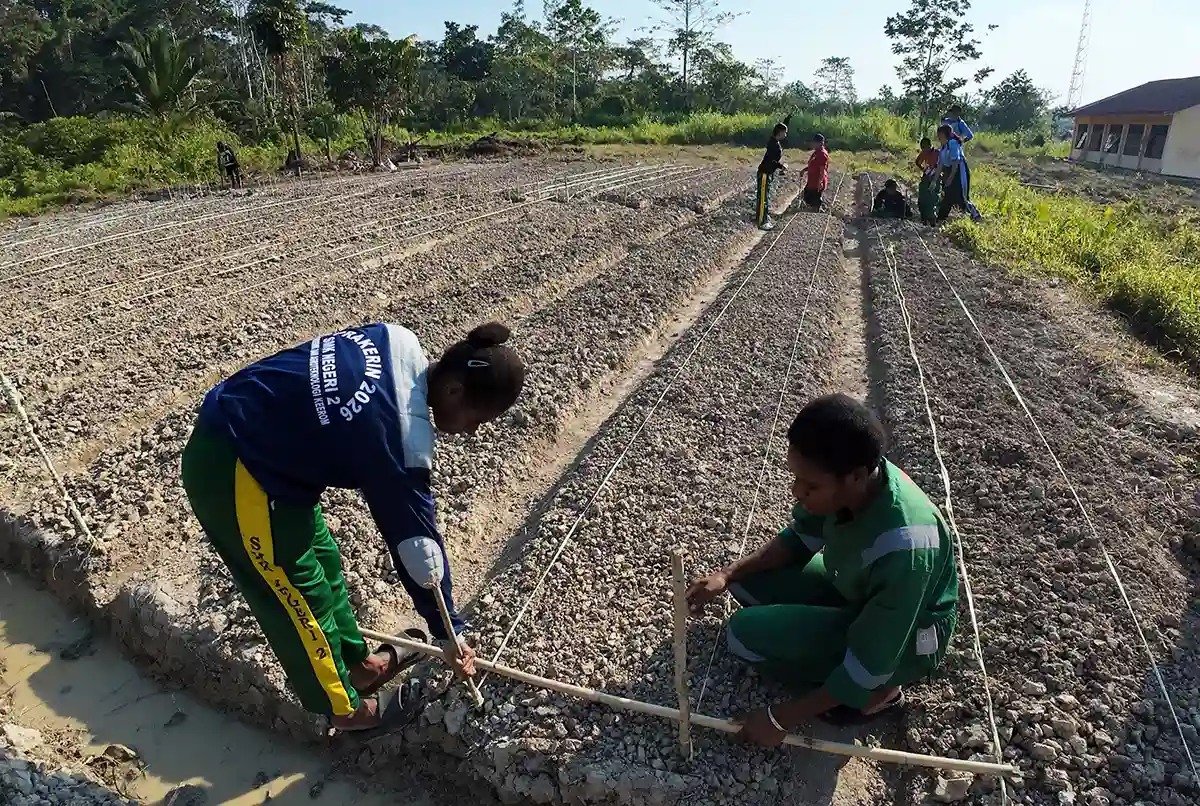
As a direct field application, Team 12 is preparing a demonstration plot for corn cultivation using biochar as an ameliorant, or a soil amendment designed to improve soil’s physical and chemical properties. The application of biochar has the potential to increase soil porosity and water-holding capacity while also helping raise the pH level of Senggi’s relatively acidic soils, thereby improving the availability and uptake of nutrients by plants.
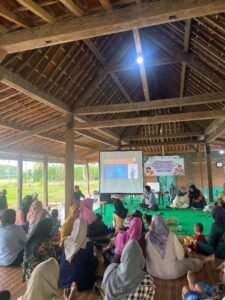
To ensure the sustainability of the technology, Team 12 is also organizing training sessions and a biochar production workshop for local residents. Participants are invited to practice the entire process directly, from selecting raw materials and carrying out carbonization using a drum pyrolysis unit and the Kon-Tiki method to applying biochar independently to agricultural land.
“Biochar is not merely a soil amendment. When agricultural residues can be processed into materials that benefit farmland, this embodies the principles of a green economy. Local resources can be used more efficiently, waste can be reduced, and, in the future, opportunities for creating added value for the community can emerge,” Iqbal added.
Through an integrated series of programs, ranging from the application of biochar technology and assistance with the corn demonstration plot to community workshops, Team 12 of the UNDIP Patriot Expedition hopes to sustain this innovation by transferring knowledge, appropriate technology, and self-reliant agricultural practices that can continue to be developed independently by residents of the Senggi Transmigration Area.
The concrete actions undertaken by Team 12 of the UNDIP Patriot Expedition support the achievement of the Sustainable Development Goals (SDGs), particularly SDG 2 (Zero Hunger) through the development of more sustainable cultivation and soil management practices; SDG 4 (Quality Education) through community workshops; SDG 12 (Responsible Consumption and Production) through the conversion of rice husks and corn cobs into biochar; and SDG 13 (Climate Action) through biomass management that converts agricultural residues into more stable carbon-based materials and promotes more sustainable agricultural practices.
(Public Communications/UNDIP)