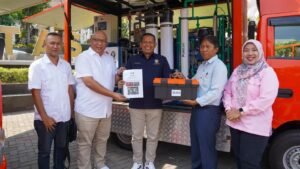





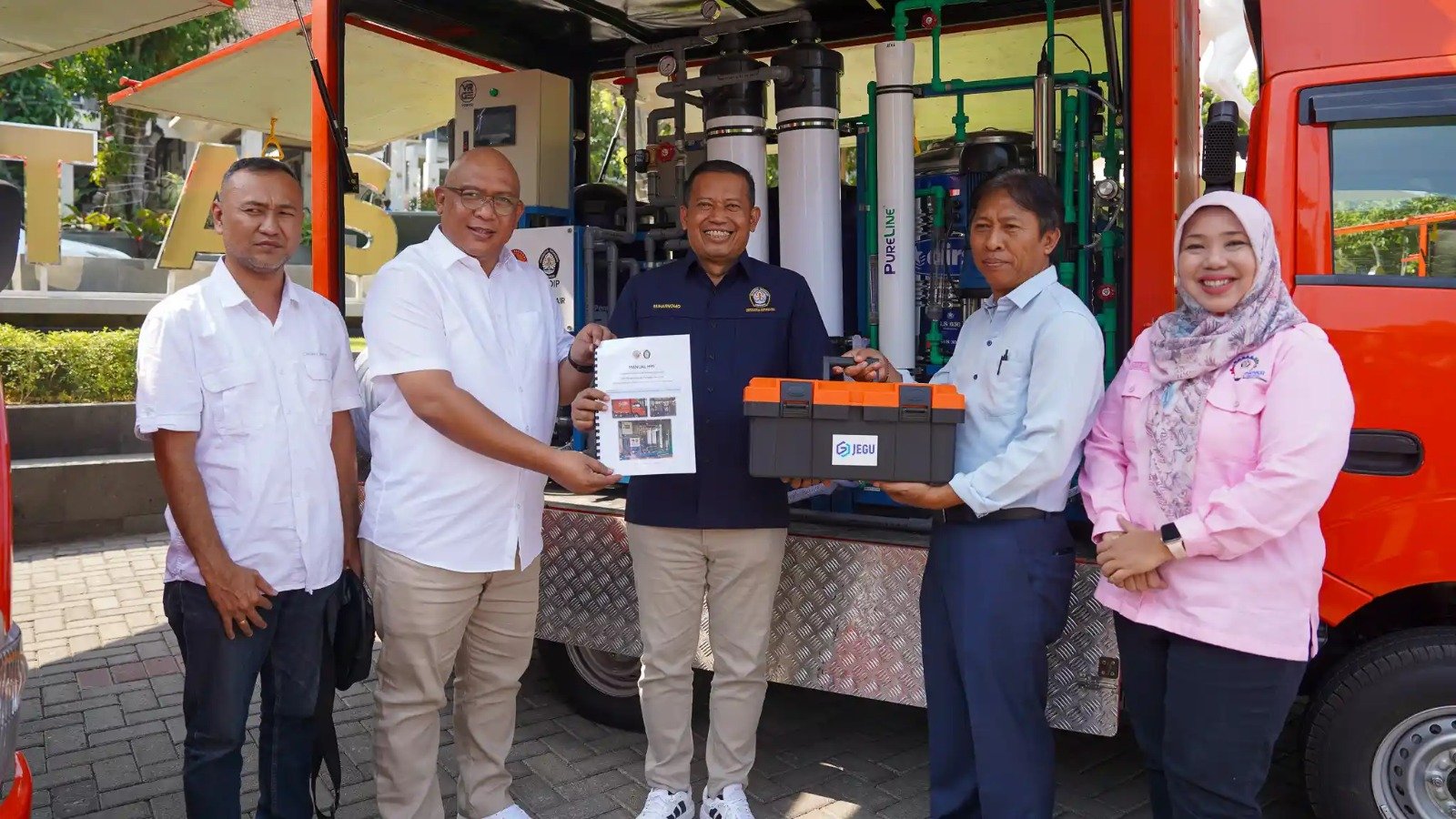
EduAsiaNews, Semarang – Universitas Diponegoro (UNDIP) has reaffirmed its commitment to supporting disaster response efforts through research and innovation that deliver direct benefits to society. This commitment was demonstrated through the handover of five Disaster Response Water Treatment Units to the National Disaster Management Agency (BNPB) at the Widya Puraya grounds, UNDIP, on Tuesday, September 1, 2026.
The five Disaster Response Water Treatment Units were developed by Prof. Dr. I Nyoman Widiasa, S.T., M.T., together with the UNDIP research team. The handover followed BNPB’s interest in the water treatment technology developed by UNDIP after conducting a working visit to the university in 2025.
UNDIP Rector Prof. Dr. Suharnomo, S.E., M.Si., emphasized UNDIP’s commitment to ensuring that its research and innovations provide tangible benefits to society, particularly in disaster situations.
“In principle, UNDIP is strongly committed to dedicating the results of its research and innovations to provide benefits for society. Today, we are putting this commitment into practice, among other things, through the handover of UNDIP-developed Disaster Response Water Treatment Units for use in disaster management efforts,” said Prof. Suharnomo.
The Disaster Response Water Treatment Units, or mobile water treatment systems, are capable of processing water into clean water as well as potable water. Each unit has a treatment capacity of approximately 20,000 liters of clean water and 2,000 liters of drinking water per day.
Innovation to Support Disaster Response
Prof. Dr. I Nyoman Widiasa, S.T., M.T., the innovator behind the Disaster Response Water Treatment Units, described the handover as the beginning of UNDIP’s contribution to strengthening disaster response efforts in Indonesia.
“This marks the beginning of UNDIP’s contribution to supporting disaster response in Indonesia. We hope that this trust will continue to grow, enabling UNDIP to make an even greater contribution to disaster management efforts across Indonesia,” he said.
BNPB partner representative Martino Budiawan expressed his appreciation for the complexity of the technology developed by Prof. Nyoman and his team, noting that it not only processes water into clean water but also produces water that is safe for consumption.
“The equipment developed by Prof. Nyoman together with UNDIP is indeed quite sophisticated compared with other systems. While other equipment may only process water into clean water, UNDIP’s technology can process it further into water that is ready for consumption,” Martino explained.
Martino explained that, as an initial step, the five units are planned to support disaster response needs in Central Java. Their subsequent placement and distribution will be adjusted according to directions and conditions in the field.
The handover of the five units forms part of UNDIP’s ongoing commitment to developing and implementing research and innovations as solutions to support disaster response efforts and deliver tangible benefits to society. (Public Communications/UNDIP/Hng)