


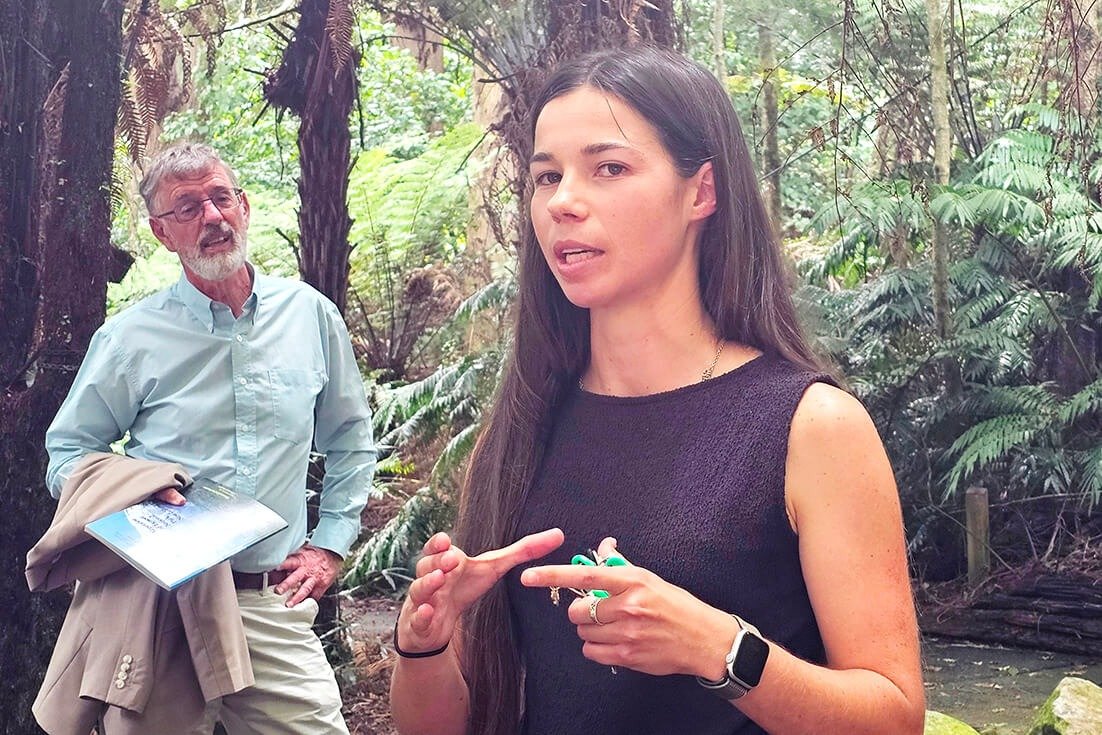
EduAsiaNews, Hamilton — In a shade-cloth-covered greenhouse at a corner of the University of Waikato campus, Hannah Rogers stands among rows of nearly dry pots. Her fingers touch the fragile-looking fronds of a small fern, and she smiles. “This one is still surviving,” she says softly. It is in this modest space that, for months, she has tested the resilience of epiphytes, plants that grow on other plants, amid simulations of increasingly hotter and drier cities.
Hannah Rogers, 26, is not merely a doctoral student immersed in laboratory data. Raised near Cambridge, she grew up with parents who would point out birds, moss, or branches changing color. That curiosity followed her to university, where she completed both her Bachelor of Science and Master of Science with First Class Honours at Waikato. Now nearing the completion of her PhD, her research coincides with major news: a NZ$5 million endowment, approximately Rp 50 billion, for her university.
The funding comes from the wind-up of the George Mason Charitable Trust, a philanthropic foundation that since 1995 has distributed millions of dollars to support environmental research and postgraduate scholarships across New Zealand. For Rogers, the multi-million-dollar figure is more than a statistic. “Without funding like this, a PhD might remain just a dream,” she says. She met George Mason early in her doctoral journey, an elderly benefactor known for his keen interest in genetics and plant adaptation mechanisms. Mason passed away in 2024, but his legacy now forms the backbone of interdisciplinary research across Waikato’s schools of science and engineering.
Rogers’ study is both technical and urgent. Over 11 months, she collected epiphyte seedlings, cultivated them under controlled conditions, and then subjected them to a 12-week experiment without water and under varying light intensities. The results were striking: some species demonstrated extraordinary resilience, while others collapsed within weeks. Her findings help explain why cities like New Plymouth, with older forests and more sheltered habitats, support richer epiphyte communities than Hamilton, which is more exposed and drier.
Behind the experiment lies a larger question: what will cities look like in the future as temperatures rise and humidity declines? Epiphytes, living in tree canopies and along trunks, are often overlooked by urban planners. Yet their presence influences microclimate balance, biodiversity, and the comfort of green spaces. “What survives in the canopy will determine how livable our cities remain,” Rogers says. The statement sounds less like observation and more like a warning.
The NZ$5 million gift to Waikato is part of a broader distribution of approximately NZ$25 million to universities across New Zealand. But for the small community of Tamahere – where residents watched Rogers grow from a curious schoolgirl into a nationally recognized young scientist – the story feels personal. In that quiet greenhouse, among pots and shade cloth, research on small plants becomes a story of perseverance, philanthropy, and the future of cities, a reminder that from fragile roots, science can grow tall. (**)