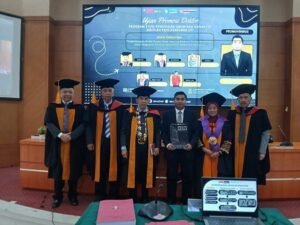





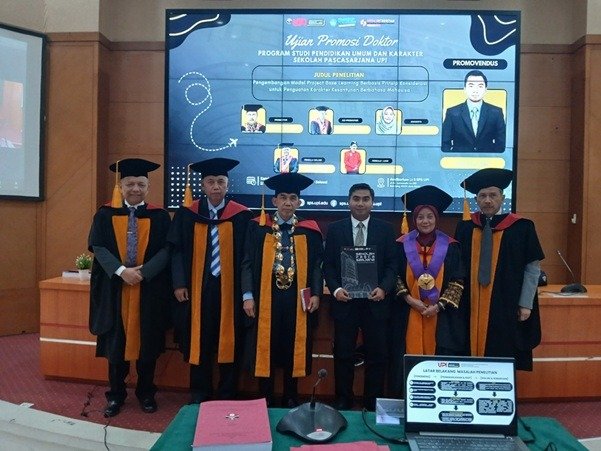
EduAsiaNews, Bandung – An innovative learning approach aimed at strengthening students’ language courtesy has been developed through doctoral research at Universitas Pendidikan Indonesia (UPI). Ahmad Fuadin officially earned his doctoral degree from the Graduate School of UPI, in the Program of General Education and Character, through the development of a Project-Based Learning (PjBL) model grounded in the Principle of Consideration.
His dissertation, entitled “Development of a Project-Based Learning Model Based on the Principle of Consideration to Strengthen Students’ Character in Language Courtesy”, produced a comprehensive learning model, complete with learning syntax, instructional tools, and evaluation instruments for assessing students’ character in polite communication.
Ahmad Fuadin explained that this model was motivated by the growing trend of critical academic communication among students, which often lacks awareness of ethical language use. In many university language learning practices, linguistic competence tends to dominate over the development of polite communication character.
“Language learning should not only train students to express ideas but also foster ethical awareness in communication,” he stated during his research presentation.
The model Ahmad developed integrates the Project-Based Learning approach with the Principle of Consideration, emphasizing empathy, respect for others, and moral awareness in communication practices. In its implementation, students are not only required to complete academic projects but are also guided to reflect on how they discuss, present arguments, and respond to differing opinions politely.
As a research product, the model was designed through a systematic Research and Development (R&D) process, including needs analysis, conceptual model design, development of learning tools, implementation trials, and evaluation of model effectiveness. The findings demonstrated that the application of this model enhances the quality of students’ academic interactions, fostering dialogue, reflection, and ethical language use.
The supervisory team, consisting of Prof. Dr. Syihabuddin as primary supervisor, Prof. Dr. Mupid Hidayat as co-supervisor, and Prof. Dr. Yeti Mulyati as committee member, noted that this research contributes significantly to university-level language education by integrating cognitive dimensions with the development of students’ communication character.
Going forward, this learning model is expected to serve as a reference for language learning development in higher education, emphasizing not only academic competence but also the cultivation of polite communication character in both academic and social life.