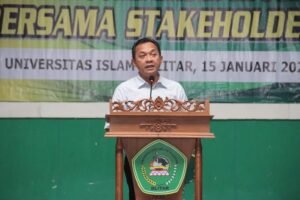



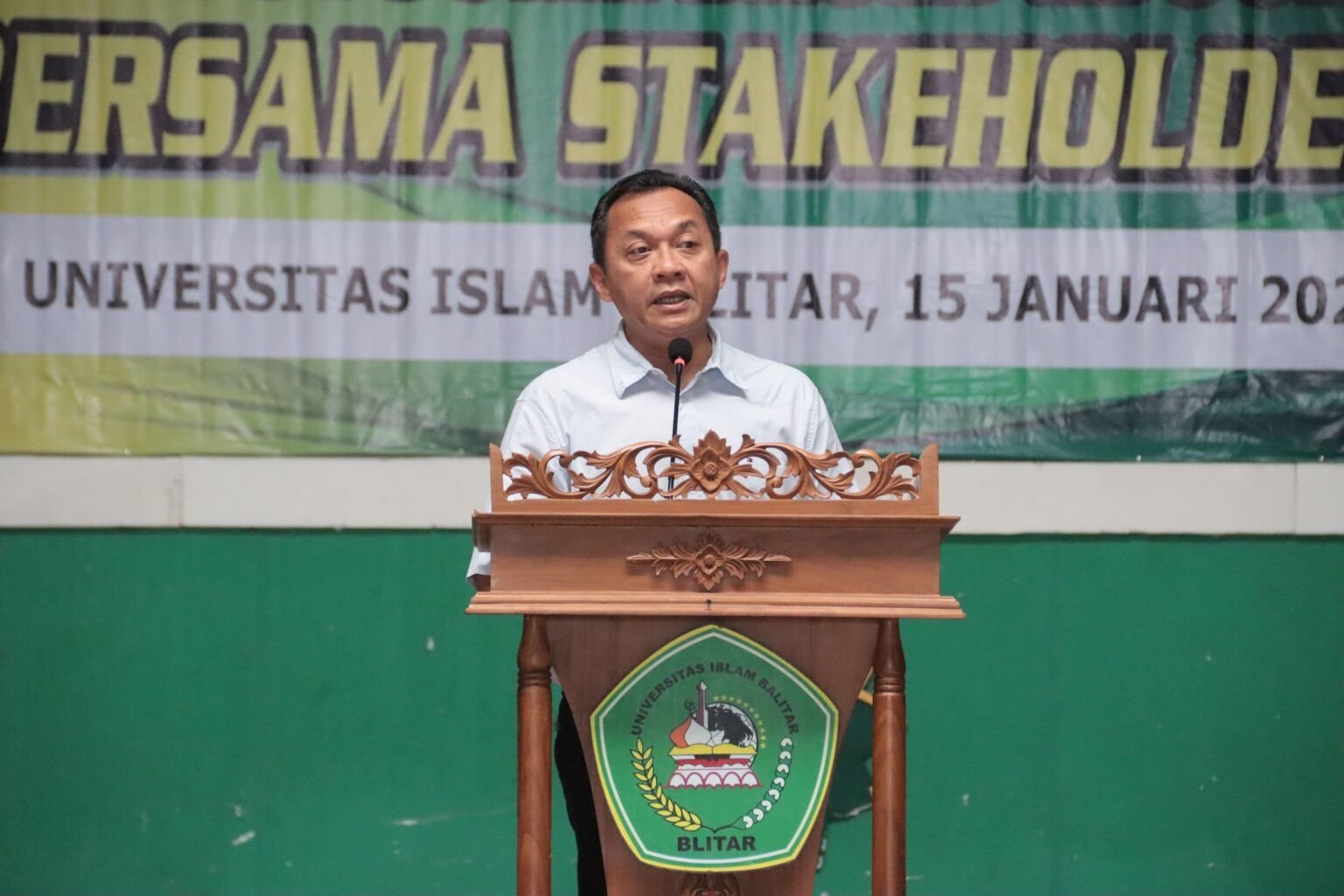
EduAsiaNews, Blitar – Universitas Islam Balitar (UNISBA Blitar) has taken a concrete step to align its curriculum with Outcome-Based Education (OBE) through a Stakeholder Focus Group Discussion (FGD) held on Thursday (15 January 2026) at the Open Hall. The event was attended by 143 invitees from the business and industrial sector (Du/Di), government institutions, the General Elections Commission (KPU), and alumni. Also present were the Rector of UNISBA Blitar, Dr. Soebiantoro, M.Si., along with Vice Rectors, Deans, and Heads of Study Programs.
In his remarks, the Rector emphasized that as an Islamic university, UNISBA Blitar has a responsibility beyond producing academically excellent graduates. The university is entrusted to cultivate scholars who are knowledgeable, morally upright, and beneficial to society and the nation, in accordance with the Islamic principle khairunnas anfa’uhum linnas (the best of people are those who bring the greatest benefit to others).
Dr. Soebiantoro—affectionately known as Pak Bin—explained that developing an OBE-based curriculum is not merely about regulatory compliance or following higher education trends. Rather, it is a serious effort to ensure that UNISBA Blitar graduates achieve tangible, measurable learning outcomes relevant to societal and workforce needs.
He further stated that UNISBA Blitar positions itself as The Real Entrepreneurial University. This is not merely a slogan, but a clear institutional policy. It is implemented through strategic measures, including the integration and strengthening of entrepreneurship courses into a structured five-semester program.
“In this context, UNISBA Blitar seeks to affirm itself as The Entrepreneurial University—not just a slogan, but an institutional policy direction. We aim to build an educational ecosystem that produces graduates who create jobs, not merely seek them,” he said.
Meanwhile, H. Hidayaturrahman, S.E., M.M., representing the business and industrial sector from PT Jatinom Indah Grup, noted that industries often face challenges because graduates’ competencies are not fully aligned with market needs, requiring companies to provide additional training. Through the adoption of an OBE-based curriculum, it is expected that graduates will possess relevant skills and be ready to work from day one.
He expressed optimism that, with active involvement from industry partners in curriculum development, UNISBA Blitar will produce graduates who are not only job-ready but also capable of creating competitive business opportunities.