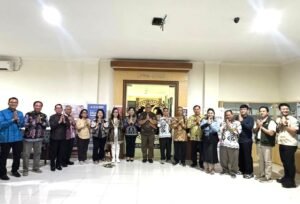




EduAsiaNews, Bali – The commitment to strengthening sustainable tourism governance continues to be reinforced through collaboration between academia and local government. The Center of Tourism Excellence (Pupar) at the Research and Community Service Institute (LPPM) of Universitas Udayana received an official visit from the Regional House of Representatives (DPRD) of Malinau Regency along with the Malinau Regency Culture and Tourism Office on Friday (27 February 2026) at the LPPM UNUD building in Jimbaran, Badung.
The meeting focused on collaboration for drafting the Academic Paper and Regional Regulation (Ranperda) on Tourism and Ecotourism Management in Malinau Regency. This regulation is expected to serve as a solid legal foundation for managing Malinau’s tourism potential in a structured, inclusive, and sustainable manner.
The Chair of Pupar LPPM Universitas Udayana, A.A.P. Agung Suryawan Wiranatha, expressed appreciation for the DPRD Malinau’s trust in the academic team. He affirmed Pupar’s readiness to assist in developing regulations based on scientific studies and best practices in tourism development.
He emphasized, “Regional tourism regulations should not only meet normative requirements but must also have strong implementation capacity in the field. Regulations must address local needs, protect community interests, and align with sustainable development principles and national policy directions.”
Pupar is recognized as the only Higher Education Excellence Center in Science, Technology, and Arts (PUI-PT) in tourism in Indonesia, with extensive experience in preparing academic papers, regional regulations, masterplans, and destination governance documents across various regions. This experience provides a strong foundation for assisting Malinau Regency in formulating regulations that are not only legally robust but also responsive to local social, economic, and environmental dynamics.
The PUI-PT status highlights Pupar’s national mandate to advance applied research, policy innovation, and support for science- and technology-based tourism development. Its focus includes sustainable destination development, tourism governance, regional planning based on carrying capacity, creative economy, and digital transformation in tourism.
During the presentation of Pupar’s institutional profile and activities, Nyoman Ariana explained the strategic role of Pupar as a multidisciplinary team comprising experts in regional planning, tourism law, economics, destination management, environment, and socio-cultural studies. This integrated approach ensures that policy documents are academically comprehensive and practically applicable.
“Every academic paper and regional regulation begins with in-depth studies based on data and empirical analysis, so that the recommendations produced are truly actionable and meet local needs,” he said. He also presented Pupar’s portfolio across Indonesia, which includes drafting Academic Papers and Regional Regulations (Ranperda), Tourism Development Masterplans, Detailed Engineering Designs (DED), Integrated Tourism Development Plans (DPPT), Destination Business Plans, and Tourism Governance and Institutional Frameworks.
Through this collaboration, Pupar reaffirmed its commitment to developing regulations that are adaptive to forest management challenges, strengthening tourism villages, protecting indigenous communities, and promoting conservation-based ecotourism.
The Chair of DPRD Malinau, Ping Ding, noted that Malinau Regency has abundant natural and cultural resources that have yet to be fully optimized, including tropical forests, waterfalls, hot springs, whitewater rafting sites, and cultural heritage sites. Several villages, such as Belayan, Pulau Sapi, Setulang, Toping, Serindit, and Long Loreh, have been designated as tourism villages. Malinau is also home to 11 ethnic groups with strong traditions, which provide significant social capital for cultural and ecotourism development.
“We aim for this potential to be sustainably managed, providing economic benefits to the community while preserving environmental and cultural heritage,” she said. She also highlighted the presence of National Strategic Projects (PSN) in Malinau, which could boost mobility and tourism, necessitating ready and clear regulations to guide growth.
The Head of Malinau Culture and Tourism Office, Kristian Radang, stated that around 111 tourist attractions have been inventoried across Malinau, some located in forest areas under central government authority, such as Semolon Waterfall near a National Strategic Project zone. Clear and collaborative regulations are needed to avoid policy overlaps, particularly concerning management authority and collection of fees.
The DPRD representatives also noted indigenous areas within national parks, covering approximately 1.3 million hectares, requiring governance that respects indigenous rights and emphasizes partnership and empowerment. Ecotourism development must consider conservation, social justice, and long-term sustainability.
From a legal perspective, I Gusti Ngurah Parikesit Widiatedja stressed that drafted regulations must consider both formal and substantive aspects, align with higher-level legislation, and integrate Sustainable Development Goals (SDGs).
The DPRD’s core points for the Ranperda include:
Strengthening regional tourism ecosystems
Classification and development of tourism villages
Digital transformation in promotion and governance
Disaster mitigation for tourist destinations
Inclusivity and community empowerment
Funding and investment schemes
Regulations on business obligations and administrative sanctions
This approach aims to build a tourism system focused not only on visitor growth but also on quality experiences and local community welfare.
The meeting concluded with an agreement to promptly follow up through drafting and finalizing a Memorandum of Understanding (MoU) and Cooperation Agreement (PKS). The preparation of the Academic Paper and Ranperda will proceed in stages, including mapping existing conditions, analyzing regulatory needs, public consultation, and harmonizing policies.
This collaboration is a strategic step to strengthen regional capacity for research-based policymaking. The synergy between the legislative, executive, and academic sectors is expected to produce regulations adaptive to development dynamics while balancing economic growth, environmental conservation, and social protection.
With comprehensive regulations, Malinau Regency is expected to position itself as a leading ecotourism destination based on tropical forests and local culture. Beyond destination development, this initiative represents a long-term policy investment to realize competitive, equitable, and sustainable tourism.