




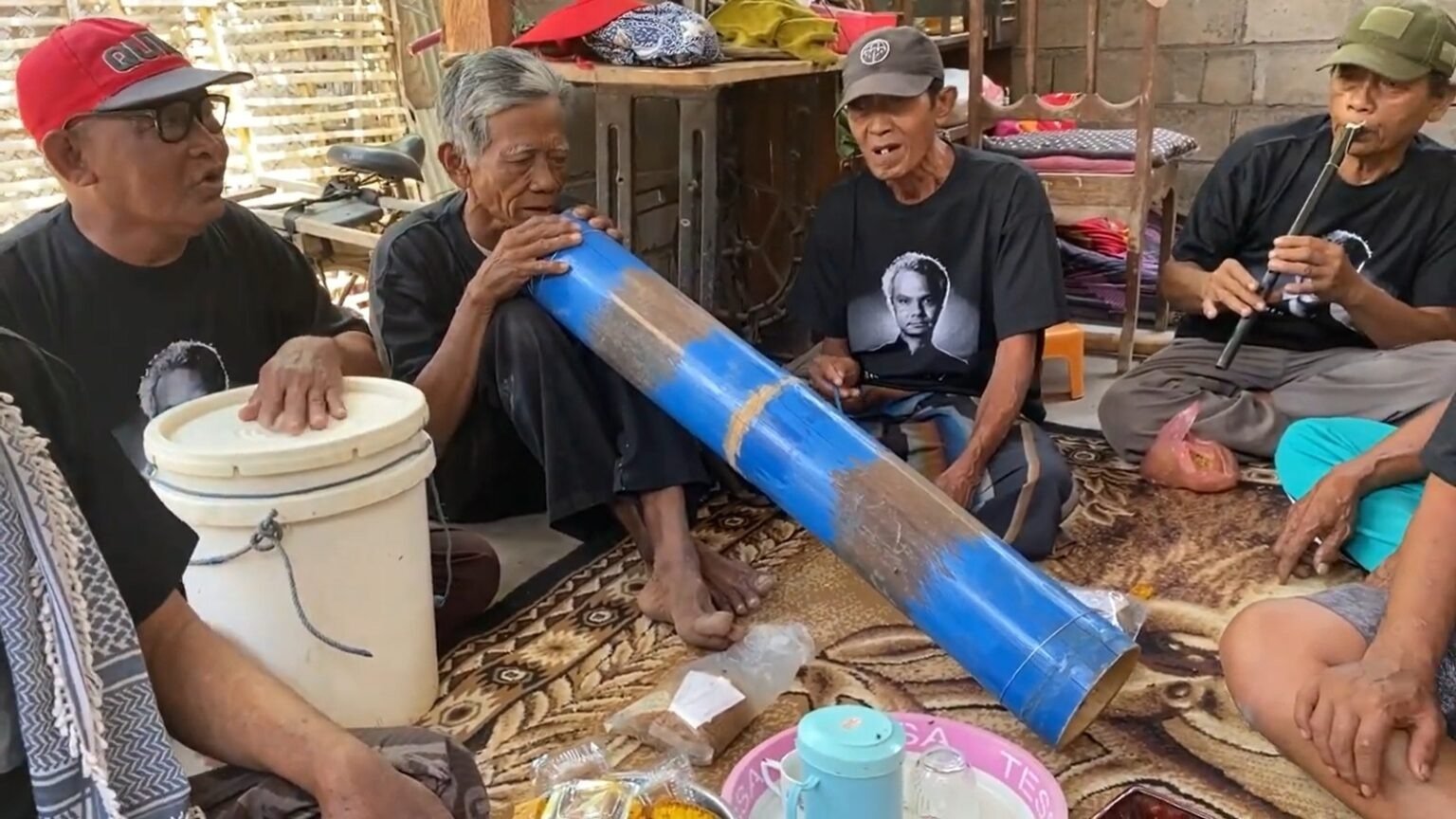
EduAsiaNews, Jember — Imagine a gamelan performance producing the sounds of bonang, kendang, gong and various other instruments, yet without a single visible metal musical instrument. All the sounds are produced using the performers’ mouths by elderly men sitting in a circle in the courtyard of a religious leader’s house in the coastal area of Panarukan, Situbondo Regency.
This is tabbhuwân colo’, an oral gamelan tradition whose name literally means “mouth percussion” in Madurese. A heritage of Madurese migrant fishing communities, the tradition is now on the verge of extinction.
The unique tradition was documented by Panakajaya Hidayatullah, a lecturer in the Television and Film Study Program at the Faculty of Humanities, University of Jember. Through ethnomusicological research, he examined the history, musical form, social functions and current condition of the tradition. The study became the first scholarly documentation specifically devoted to tabbhuwân colo’.
“Simply put, tabbhuwân colo’ comes from the Madurese language. Tabbhuwân means percussion, while colo’ means mouth. So, this is music performed using the mouth. The sounds produced are not merely musical notes, but the sounds of gamelan instruments such as the kenong and kendang, all reproduced using the mouth,” Panakajaya explained.
The tradition is closely linked to the history of Madurese migration from Sumenep to the Panarukan coast around the 1930s and 1940s. What initially began as seasonal migration eventually developed into permanent settlements, with the migrants establishing families and becoming part of the Panarukan fishing community.
Many of the migrants were performers in topeng kertè and tabbhuwân groups, traditional performances known as Madurese ketoprak. Through their artistic experience, they became familiar with the structure of gending and the functions of various Madurese gamelan instruments, bringing musical knowledge from their places of origin.
While at sea or repairing fishing nets during full-moon periods, when they did not use musical instruments, they imitated gamelan sounds with their mouths. From the intersection of their artistic experience and lives as fishermen, tabbhuwân colo’ developed as a form of working music among the Panarukan coastal community.
Each performer has a specific sonic role, imitating instruments such as the bonang, peking, gender, kendang, kempul or gong. Because only eight performers remain, each musician can now perform three to five instrumental roles simultaneously.
“The essence is that they reproduce gamelan gending using their mouths. One person can perform the roles of three to five musical instruments using the mouth,” Panakajaya said.
In practice, the performers carry out their respective roles without discussing them beforehand. One musician begins the gending, followed by others with different sonic roles. They know which sounds need to be added by listening to one another’s playing.
When one performer switches roles, the others adjust their sounds without interrupting the performance. This musical knowledge is not preserved in notation or sheet music but is developed through years of listening, imitation and playing gending together.
“What impresses me most is how connected they become when they play music. One of the musicians has impaired hearing and has considerable difficulty when spoken to. Yet when the other players begin performing the gending, he can immediately follow the sound pattern and know which part he should play. When they played together again after such a long time, there was a sense of nostalgia and emotion, as if they had returned home to be with their siblings,” Panakajaya said.
Tabbhuwân colo’ did not originate as a stage performance but developed from the everyday lives of fishermen. The tradition was primarily performed during tèra’an, the full-moon period when fishermen did not go to sea and instead used their time to repair fishing nets. While repairing their nets, fishermen played gamelan gending using their mouths as entertainment and accompaniment to their work. The tradition was also performed during fishing trips and while fishermen worked together to haul in fishing nets.
During these activities, tabbhuwân colo’ helped fishermen maintain their spirits, coordinate their movements and strengthen their sense of togetherness. The sounds followed the rhythm of their work, allowing the fishermen to synchronize their movements while repairing or hauling in nets.
According to the musicians, the tradition existed before the 1950s and flourished during the 1950s to 1970s. At the time, most Panarukan fishermen could perform at least one of the sonic roles in tabbhuwân colo’.
However, changes in fishing technology have also eliminated many of the spaces in which the tradition was once performed. The use of motorized gardan boats replaced traditional fishing systems. Work that was previously carried out collectively became faster and more individualized, reducing opportunities to perform tabbhuwân colo’.
Changes in the community’s entertainment preferences have also affected the tradition’s continuity. Younger generations are now more familiar with modern music than with gending or gamelan. As a result, they lack the basic knowledge needed to learn tabbhuwân colo’.
Panakajaya identified three main obstacles to regeneration. First, younger generations are no longer familiar with gamelan gending. Second, performing tabbhuwân colo’ is highly challenging because musicians must understand the structure and functions of gamelan instruments before reproducing their sounds with their mouths. Third, there are now very few social or performance spaces where the tradition can be practiced.
“The first issue is its endangered status. Among the traditional arts in the area, tabbhuwân colo’ is in the most concerning condition because only eight practitioners remain. Their number has declined, and all of them are elderly,” he said.
The survival of the group depends heavily on Kiai Sattar, a religious leader and community organizer. He once told Panakajaya, “Karè ria lah sè bisa nabbhu, marèna la tadek polè,” meaning, “These are the only ones who can still play; after them, there will be no one left.” Even to gather the eight musicians for a single rehearsal, Kiai Sattar has to pick them up individually from different hamlets, using his own money to buy coffee and tobacco to encourage them to attend.
Panakajaya’s efforts to document the tradition began in 2020, when the East Java Arts Council encouraged an inventory of performing arts in Situbondo. He subsequently conducted field research to identify traditions that had not yet been adequately documented or studied, including tabbhuwân colo’.
His interest was also supported by his academic background in ethnomusicology. Since pursuing his master’s degree, he has conducted various field recordings and studies of Madurese community arts.
Through a series of field visits in 2024 and 2025, Panakajaya conducted participant observation, in-depth interviews and audiovisual documentation. He sat within the circle of performers to observe the relationship between sound, breathing, body movements and social interaction during performances.
In 2025, when the Situbondo Culture Office needed a strong proposal for Indonesian Intangible Cultural Heritage designation, Panakajaya submitted tabbhuwân colo’ along with the academic paper he had prepared. The proposal was also strengthened by a documentary film produced by students of UNEJ’s Television and Film Study Program. Titled Tabbhuwan Colo’: Senandung Nelayan Pesisir Panarukan, the film by Ersa Faren Borut documented tabbhuwân colo’ as part of the local knowledge of the Panarukan community.
In 2025, the film passed the selection process for the Local Knowledge Acquisition Program in Book and Audiovisual Forms organized by the National Research and Innovation Agency (BRIN). In 2026, following the national Intangible Cultural Heritage session in July 2026, tabbhuwân colo’ was officially designated as an Indonesian Intangible Cultural Heritage from Situbondo Regency.
“They told me that for a long time they had never been visited or received recognition from the cultural authorities because they were considered a marginal form of art. With the Intangible Cultural Heritage designation, there is at least now an opportunity for government intervention and protection at the national level,” he said.
For Panakajaya, tabbhuwân colo’ is more than a musical phenomenon. It also records the history of migration, working experiences and the lives of the Panarukan fishing community. The tradition has no authoritative musical leader. The way the performers listen, wait for their turns and adjust their sounds reflects values of togetherness and tolerance. No single performer dominates because musical balance can only be achieved when everyone understands their respective role.
Panakajaya hopes younger generations can learn from these values.
“Things that are considered old or outdated actually contain many valuable lessons. Through traditional arts, we learn to listen and tolerate one another. When playing music, there are times when we have to remain silent and wait our turn so that harmony can emerge,” he said.
Following the Intangible Cultural Heritage designation, Panakajaya was asked to develop a preservation roadmap for tabbhuwân colo’. The most feasible initial step, he said, is comprehensive documentation and recording, including recordings of the repertoire, performance structures, distribution of sonic roles and the sources of knowledge held by the musicians.
The documentation can then be developed into learning materials that are easier for art groups to use. Training through art groups is needed so that the knowledge of senior musicians can be learned and passed on to the next generation. The form of presentation can also be developed to make the tradition more accessible to younger generations without altering its fundamental structure.
According to Panakajaya, designation as an Intangible Cultural Heritage is not the end of preservation efforts. The recognition needs to be followed by documentation, training, the provision of performance spaces and regeneration so that tabbhuwân colo’ is not merely recorded as a cultural heritage, but continues to be performed and passed on to future generations. (qf)