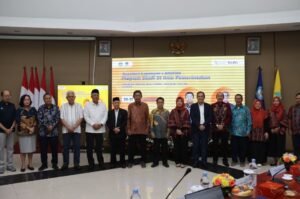



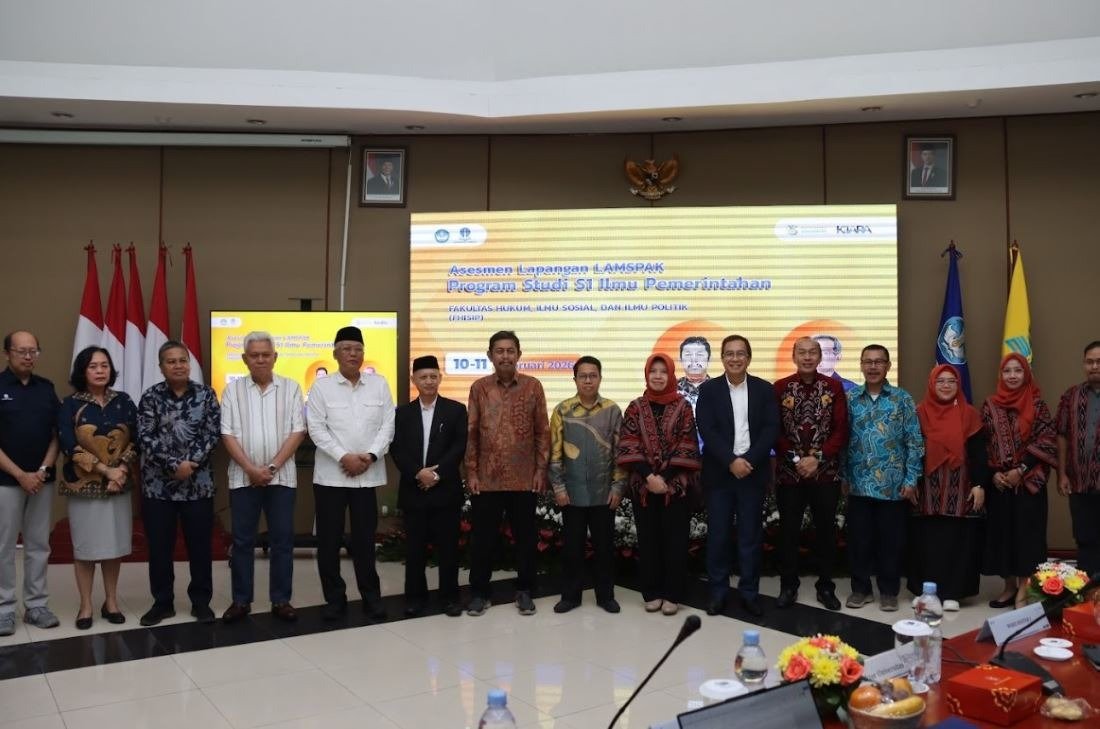
EduAsiaNews, South Tangerang — Universitas Terbuka (UT) conducted a field assessment by the Lembaga Akreditasi Mandiri Sosial Politik Administrasi dan Komunikasi (LAMSPAK) for its Bachelor’s Program in Government Studies under the Faculty of Law, Social Sciences, and Political Sciences (FHISIP) on Tuesday (10/2/2026).
The activity was attended by members of the university leadership, faculty executives, and strategic units, including the Rector, Vice Rectors, Heads of Centers, the Quality Assurance Office, the Academic Quality Control Group, lecturers, and education personnel. The assessment forms part of UT’s broader efforts to strengthen the quality of open and distance higher education serving students across Indonesia.
The evaluation was carried out by Dr. Suranto, M.Pol (Universitas Muhammadiyah Yogyakarta) and Dr. Drs. Fauzi, M.Si (Universitas Brawijaya), appointed as LAMSPAK assessors to verify and clarify data, documents, and academic practices in accordance with accreditation standards.
In his remarks, the Rector of Universitas Terbuka, Prof. Dr. Ali Muktiyanto, S.E., M.Si., emphasized that a culture of quality has been embedded since the University’s establishment. “Our quality culture has existed since UT was founded. Given that distance education practices in Indonesia are unique, we have adopted many international best practices,” he stated.
As an institution implementing an open and distance learning system, UT applies the principles of open to people, open to place, and open to ideas. This means that anyone may access higher education without academic entrance examinations, provided they meet administrative requirements.
This model presents distinct challenges, particularly regarding the lecturer–student ratio, which traditionally serves as an indicator in conventional, face-to-face–based accreditation instruments.
“Learning at UT still spans 16 weeks, similar to other universities. Eight weeks are allocated for guided independent study,” he affirmed. Instructional materials are designed based on the principles of self-contained, self-instruction, and self-explanatory, enabling students to study independently and effectively.
To date, nearly all of UT’s business processes have been digitized within an integrated ecosystem. The University offers various learning modalities—from limited offline support to fully online delivery—ensuring services remain accessible under diverse conditions.
FHISIP is among the largest faculties at UT, serving approximately 250,000 students, with the Government Studies Program being one of the most in demand. The program plays a strategic role in enhancing the competencies of regional government officials across Indonesia.
During the response session, Dr. Fauzi highlighted the need to harmonize accreditation instruments with the characteristics of open education. “Issues related to accreditation instruments cannot be resolved solely at the assessor level. A clear policy framework is required to avoid misalignment,” he explained. He further noted that UT makes a significant contribution to the nation, with a student population approaching one million.
Through this assessment, Universitas Terbuka reaffirmed its commitment to continuous quality improvement and to strengthening the standards of distance education services. These efforts align with the Sustainable Development Goals, particularly SDG 4 (Quality Education) and SDG 10 (Reduced Inequalities).
UT’s open, inclusive, and technology-based approach continues to reinforce its role in expanding access to quality higher education.