




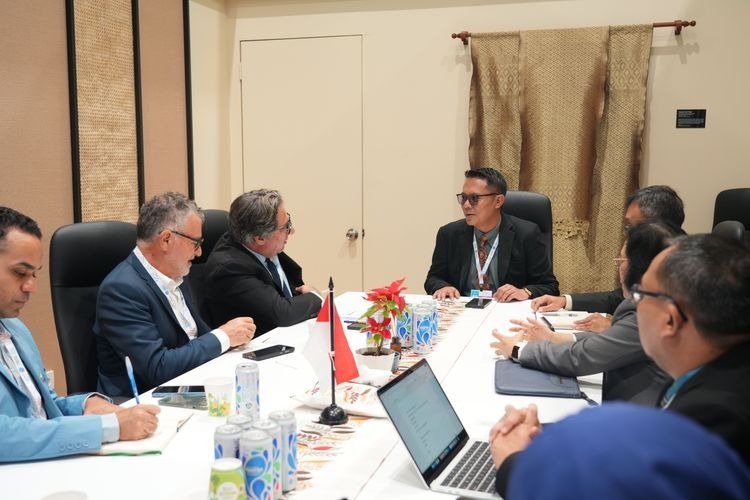
EduAsiaNews, Antalya — Indonesia’s Ministry of Forestry is exploring ways to strengthen cooperation with Brazilian representatives in sustainable tropical forest management, particularly through conservation financing, carbon certification, and community empowerment around forest areas. The potential cooperation was discussed during a meeting on the sidelines of the 31st United Nations Climate Change Conference (COP31 UNFCCC) in Antalya, Türkiye, on Friday (November 13).
The Indonesian Ministry of Forestry delegation was represented by Senior Advisor to the Minister of Forestry Prof. Haruni Krisnawati and Head of the Bureau of Public Relations and International Cooperation Ristianto Pribadi. Brazil was represented by Virgilio Viana, Director General of Fundação Amazônia Sustentável (FAS), and Marco Tulio Scarpelli Cabral, who handles climate, energy, and environmental affairs at Brazil’s Ministry of Foreign Affairs.
The meeting discussed Brazil’s experience in developing forest conservation approaches that integrate environmental protection with improvements in community welfare. One example highlighted was FAS’s programme to promote sustainable development for communities in the Amazon region.
Through this approach, forest protection is linked to meeting communities’ basic needs, including access to drinking water, solar energy, internet connectivity, and food security. This experience provided an opportunity to exchange knowledge on how conservation efforts can go hand in hand with improving the quality of life of people living in and around forest areas.
The Indonesian delegation also discussed Brazil’s experience in developing forest protection financing mechanisms, including the Amazon Fund. The exchange provided an opportunity to learn about results-based financing approaches and international funding support that can strengthen forest management while delivering benefits to local communities.
In addition to conservation financing, the Brazilian representatives offered to explore cooperation and exchange experiences concerning Ecora, a carbon credit certification system developed in Brazil. Ecora is designed to strengthen the credibility of carbon credits through science-based methodologies, traceability, verification, and transparent governance. The initiative was among the topics discussed in exploring opportunities to strengthen forest carbon certification systems and market integrity.
For Indonesia, this exchange of experience is relevant to the Indonesia’s FOLU Net Sink 2030 agenda, the strengthening of Social Forestry, ecosystem restoration, and the development of a credible forestry carbon market. Discussions on Ecora offer opportunities to study a carbon certification approach developed with consideration for national conditions, while strengthening cooperation among tropical forest countries.
During the meeting, the parties also explored opportunities for technical cooperation involving government institutions, universities, civil society organizations, and development partners. Cross-sector collaboration was considered essential to connecting scientific knowledge, field experience, and financial support in tropical forest management.
As a follow-up, the meeting discussed the possibility of preparing a joint study document, or white paper, on potential Indonesia–Brazil partnerships, as well as organizing a technical workshop to further examine conservation financing, carbon certification, and sustainable forest management. The workshop is being considered for February or March 2027, with its schedule and agenda to be coordinated further.
The meeting forms part of the Ministry of Forestry’s efforts to expand international partnerships, particularly with other tropical forest countries, to develop solutions that connect ecosystem protection, innovative financing, stronger carbon governance, and economic development for local communities.
Through the exchange of experience and exploration of cooperation opportunities, Indonesia and Brazil are expected to strengthen results-oriented collaboration in preserving forests, developing conservation financing, improving carbon market integrity, and enhancing the welfare of communities that depend on forest resources. (*)