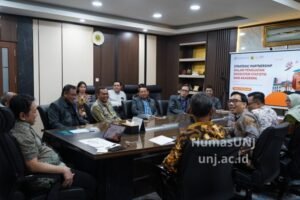



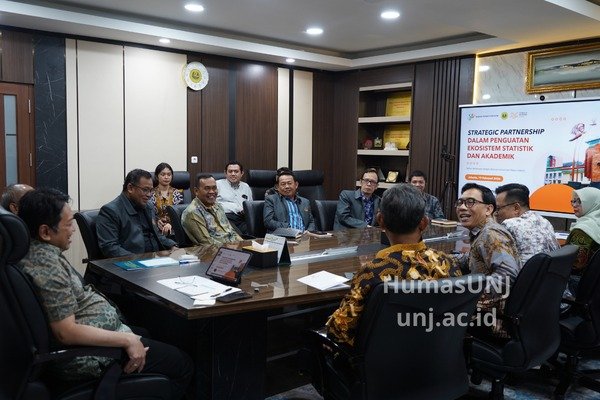
EduAsiaNews, Jakarta – Universitas Negeri Jakarta (UNJ) welcomed an official working visit from Badan Pusat Statistik Republik Indonesia (BPS RI) at the Rector’s Meeting Room, 2nd Floor of the Rectorate Building, on Thursday, 19 February 2026. The delegation was led by the Deputy Head of BPS RI, Sonny Harry Budiutomo, accompanied by the Principal Secretary Zulkipli, the Deputy for Social Statistics Nashrul Wajdi, as well as bureau chiefs, the Head of Risk Management, and representatives of BPS RI staff. The delegation was warmly received by the Rector of UNJ, Prof. Komarudin, together with the Vice Rectors, the Dean of the Faculty of Mathematics and Natural Sciences (FMIPA), the Vice Dean for Academic Affairs III of the Faculty of Economics (FEB), and the Head of the UNJ Office of Public Relations and Public Information.
During the meeting, Sonny emphasized that BPS RI carries a strategic mission to establish sustainable collaboration between the national statistical office and higher education institutions.
“We aim to integrate UNJ’s academic strengths with the official statistics produced by BPS in order to generate credible and wide-ranging policy recommendations. This collaboration will not only enhance UNJ’s institutional reputation, but also strengthen BPS’s position as an internationally recognized national statistical office,” he stated.
He further noted that BPS RI is open to establishing joint centers of excellence in the fields of social statistics, population studies, and the Sustainable Development Goals (SDGs), including the strengthening of data-driven policy dialogue.
“Robust public policy must be grounded in accurate data and rigorous analysis. We recognize that UNJ possesses strong academic capacity to serve as a strategic partner in research and the development of social statistics,” he added.
The proposed synergy also encompasses the development of student and faculty talent through data leadership programs, statistical data camps, and the expansion of thematic internship opportunities. UNJ students will have the opportunity to be directly involved as professional enumerators in BPS’s strategic surveys. In addition, the collaboration will extend to data-based community engagement initiatives, including assistance to villages and urban wards, as well as public education in preparation for the 2026 Economic Census.
In response, Prof. Komarudin expressed his appreciation and UNJ’s full commitment to following up on the cooperation with concrete actions.
“UNJ regards data as a fundamental pillar in decision-making processes, both at the institutional and national levels. Therefore, we warmly welcome this collaboration as a strategic step toward strengthening the tridharma of higher education through data-driven and impactful research,” he affirmed.
The meeting concluded with a visit to the Statistics Corner facility on the UNJ campus, symbolizing the enhancement of data literacy and accessibility among the academic community.
Through this engagement, UNJ and BPS RI not only strengthened institutional ties but also reaffirmed their shared commitment to advancing more precise, inclusive, and sustainable public policies through the responsible and accurate use of data. This collaboration is expected to serve as a foundation for a long-term partnership that reinforces the role of academia in supporting evidence-based national development.