


EduAsiaNews, Surabaya – ITS Campus, Opinion Mount Kelud in East Java, one of the most active volcanoes in Indonesia, erupted violently on 13 February 2014 at 22:50 WIB. The Mount Kelud Monitoring Post had previously raised the alert status to Advisory (Level II) on Sunday, 2 February 2014. The following day, the status was elevated to Standby (Level III). On Thursday, 13 February 2014 at 20:00 WIB, the alert level was further increased to Warning (Level IV), signifying that all residents within Disaster-Prone Areas (KRB) III and II were required to evacuate immediately.
Typically, eruptions occur several days after a Level IV alert is declared. However, in this instance, a major eruption took place only two hours after the announcement. Tens of thousands of residents were forced to evacuate with extremely limited preparation time. Thousands fled simultaneously, many covered in sand and volcanic ash.
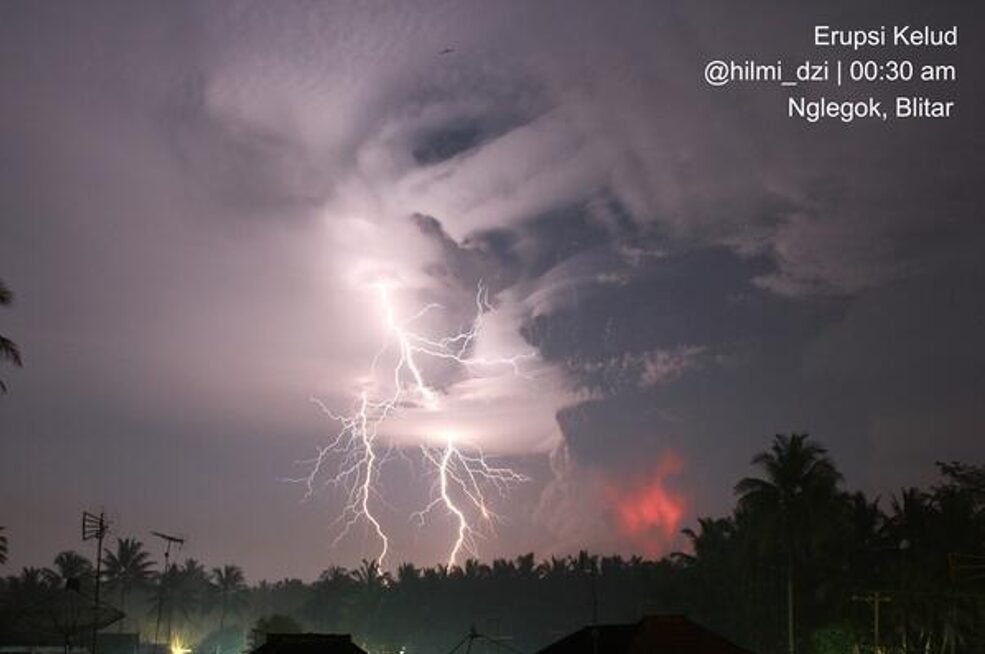
At approximately 22:00 WIB, a powerful eruption occurred. Visually, the initial eruption was observed via CCTV as flashes of fire and incandescent material ejected from the walls of the 2007 Lava Dome. Five minutes later, in the darkness of the night, thick black ash was seen billowing forcefully from the summit crater and rising high into the sky, accompanied by flashes of lightning. The sound of explosions was not clearly audible from the Kelud Observation Post. All members of the Mount Kelud Volcano Emergency Response Team immediately evacuated to the City of Kediri.
The eruption was explosive in nature, with the eruption column reaching tens of kilometers into the atmosphere and ejecting volcanic material, followed by showers of stones, gravel, and ash. When magma rapidly breached the surface and encountered open air, explosive reactions occurred due to significant temperature differences. The magma solidified and fragmented into materials of various sizes, ranging from blocks (>6.4 cm) to fine ash (<2 mm).
Rock fragments larger than 0.4 cm generally fell around the summit area. With an eruption column reaching 20 km in height, rocks larger than 6.4 cm fell approximately 3 km from the summit, while rocks measuring 0.4 cm could reach distances of up to 10 km. If the eruption column exceeded 20 km, rocks measuring 6.4 cm could reach a radius of 10 km. The direction and distribution of falling materials were also heavily influenced by wind speed and direction.
The relationship between eruption height and pyroclastic fall distance (source: Wohletz, 1992) illustrates this correlation.
Several testimonies from residents of Kebonrejo Hamlet, Kepung District—located approximately 5 km away and within KRB II—depicted the severity of the eruption. They had experienced three eruptions (1990, 2007, and 2014), yet the 2014 event was regarded as the most severe. Thunder roared, the sky turned pitch black, and gravel rained down heavily for a considerable duration.
The evacuation of residents during the Kelud eruption became a success story. Approximately 180,000 people in Kediri, Malang, and Blitar were successfully evacuated in less than two hours, between 21:15 and 22:50 WIB. There were no fatalities, and the evacuation process proceeded in an orderly and efficient manner. The emergency response and post-disaster recovery period lasted less than one year before conditions returned to normal.
The response to the Kelud disaster demonstrated the cultural strength of the local community. The predominantly Javanese society around Mount Kelud upholds the values of respect and harmony. Respect is interpreted as appreciation for each individual’s role and steadfast commitment to fulfilling responsibilities. Harmony is understood as the effort to maintain balance between humanity and nature. Kelud’s ash is even believed to be a legacy of fertility for future generations.
The international community has recognized the resilience of the people living around Mount Kelud, as tens of thousands survived the disaster. This event underscored the crucial role of communities in disaster risk management. Residents, together with local governments and various stakeholders, had long learned from Kelud’s eruption cycles. Initiatives in education, preparedness, evacuation management, and shelter coordination were conducted independently and in an organized manner. (*)