




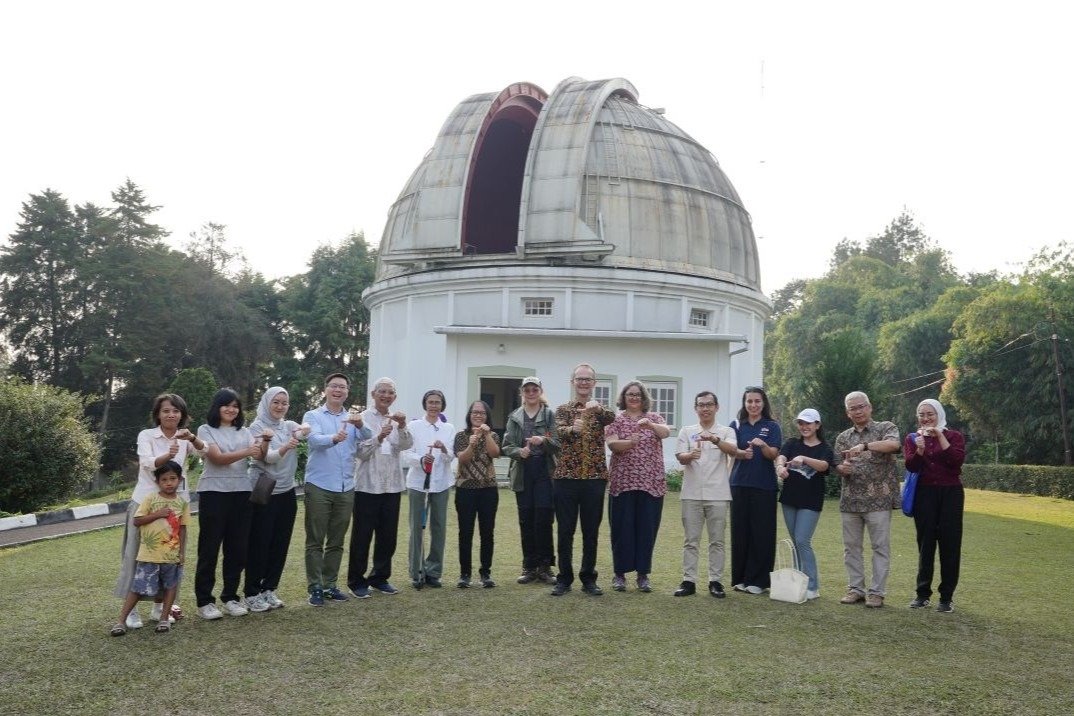
EduAsiaNews, Lembang — The British Ambassador to Indonesia and Timor-Leste, H.E. Dominic Jermey CVO OBE, visited the Bosscha Observatory of the Bandung Institute of Technology (ITB) in Lembang, West Bandung Regency, on Saturday (29/8/2026). During the visit, the delegation learned about the long history of the Bosscha Observatory, modern astronomical facilities developed through international collaboration, as well as efforts to preserve historical astronomical instruments and data.
Dominic Jermey was accompanied by a delegation from the British Embassy Jakarta and the British Council Indonesia, including Summer Xia, Country Director of the British Council Indonesia. The delegation was welcomed by Dean of the Faculty of Mathematics and Natural Sciences (FMIPA) ITB, Aep Patah, Ph.D.; Head of the Bosscha Observatory, Dr.rer.nat. Hesti Retno Tri Wulandari, S.Si., M.Si.; and ITB astronomers, including Prof. Dhani Herdiwijaya, Prof. Taufiq Hidajat, and Prof. Dra. Premana Wardayanti Premadi, Ph.D.
The visit to the Bosscha Observatory was part of Dominic Jermey’s series of engagements in the Bandung area. One of the related events was the exhibition “Setanah, Tak Diam: Merawat dan Membentuk Masa Depan di Tanah Bergerak” at Selasar Sunaryo Art Space, which involved researchers from ITB, the National Research and Innovation Agency (BRIN), the British Geological Survey (BGS), and a number of national and international partners.
The Bosscha Observatory was selected as one of the destinations not only because it is part of ITB and holds historical significance for the Bandung region, but also because its location is closely associated with environmental dynamics and fault activity in the Lembang area.
Exploring Modern Astronomical Technology at VGOS
The visit began at the Very Long Baseline Interferometry Global Observing System (VGOS) facility. The facility demonstrates how the Bosscha Observatory continues to keep pace with developments in astronomical technology while strengthening its international networks.
The VGOS facility at the Bosscha Observatory was developed through international collaboration between ITB and the Shanghai Astronomical Observatory, which is part of the Chinese Academy of Sciences. The technology represents an advanced approach to radio astronomy, particularly through the use of Very Long Baseline Interferometry (VLBI).
From the modern facility, the delegation proceeded to explore the historical side of the Bosscha Observatory through the History Exhibition Room. The room houses various instruments that were once used for astronomical observations. These instruments hold significant value as part of the history of astronomical research in Indonesia.
Dr. Hesti explained that during its early years, the Bosscha Observatory was one of only a small number of observatories located in the Southern Hemisphere. Since many observatories at the time were located in the Northern Hemisphere, observations produced by Bosscha were highly significant to the international astronomical community.
“When the Bosscha Observatory was established, it was one of only three observatories in the Southern Hemisphere, so its data were highly anticipated by the international community,” she said.
Preserving the Nearly Century-Old Zeiss Telescope
The delegation then visited the Koepel Building, which houses the Double Refractor Zeiss Telescope, one of the iconic landmarks of the Bosscha Observatory.
During the visit, the delegation viewed the Zeiss telescope as well as a collection of astronomical photographic plates that form part of the extensive record of observational activities at Bosscha.
Dr. Hesti explained that the nearly century-old telescope is not only a symbol of the history of astronomy in Indonesia, but also demonstrates the ability to preserve scientific instruments and keep them operational under good conditions.
“The telescope is nearly 100 years old, and we are still taking care of it. Indonesia has demonstrated that it can preserve the instrument properly so that it remains functional and can still be used in good condition,” she said.
Several components have been modernized in line with technological developments, while the telescope’s primary function and historical character have been preserved.
“The Bosscha Observatory is something of a showcase where other countries can see that, in science and technology, Indonesia continues to strive to contribute and keep pace with the times,” she said.
A Track Record of Collaboration with the United Kingdom
The visit also provided an opportunity to discuss the Bosscha Observatory’s international relations, particularly with scientific communities and institutions in the United Kingdom.
The Bosscha Observatory has a history of engagement with British scientists, including through support from the Newton Fund, which has enabled astronomers at Bosscha to collaborate with astronomers in the United Kingdom.
In addition, the Bosscha Observatory’s efforts to preserve archives and collections of photographic plates containing astronomical data have attracted the attention of the British Library.
Dean of FMIPA ITB, Aep Patah, Ph.D., said that visits by international figures demonstrate the Bosscha Observatory’s position as an institution recognized not only nationally but also by the international community.
“This visit is highly strategic for future collaboration and the development of Bosscha within FMIPA ITB. It demonstrates that Bosscha is not only known nationally but is also internationally recognized,” he said.
According to him, international attention toward Bosscha is also reflected in visits by prominent figures from around the world. One such figure is Nobel Prize-winning physicist Brian Schmidt, who has previously visited the Bosscha Observatory.