




EduAsiaNews, Antalya — Indonesia has emphasized that forest protection is a foundation of national development and resilience, requiring fair international financing and a stronger role for local communities.
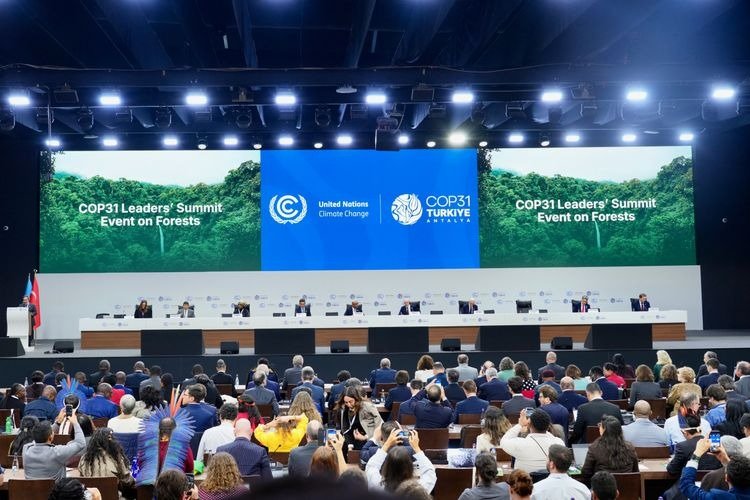
The message was delivered by Presidential Special Envoy for Climate and Energy Hashim Djojohadikusumo at the COP31 Leaders’ Summit Event on Forests, held at the Akdeniz Plenary Hall during the 31st United Nations Climate Change Conference (COP31 UNFCCC) on Wednesday (Nov. 11).
The forum, which brought together national leaders and international partners, focused on the contribution of forests to addressing climate change. It aimed to build political momentum toward the 2030 goal of halting and reversing deforestation, while advancing the capitalization and operationalization of the Tropical Forest Forever Facility (TFFF), launched in Belém at COP30.
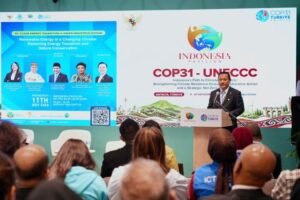
“Forests are not an obstacle to development. They are the foundation of our future. For Indonesia, protecting forests means protecting our people, water and food security, and national resilience,” Hashim said.
Hashim expressed appreciation to Brazil and Norway for their leadership in advancing forestry cooperation, including through the TFFF. He said tropical forest countries provide a global public good, and that this responsibility must be matched by fair, predictable and long-term international financing.
As a member of the TFFF Council, Indonesia will advocate for fair and transparent arrangements, respect for national priorities, and tangible benefits for local communities. Financing mechanisms should also recognize reliable national monitoring systems.
Hashim reaffirmed Indonesia’s investment commitment to the TFFF and encouraged more partners to join the initiative. He added that private investment and high-integrity forest carbon markets could help, but should complement rather than replace public financing and the responsibilities of developed countries.
Domestically, Hashim explained, Indonesia’s FOLU Net Sink 2030 agenda combines forest protection, sustainable forest management, and the restoration of degraded forests, peatlands and mangroves. Indonesia is protecting primary forests while improving productivity on existing and degraded land.
Indonesia is also continuing to expand its Social Forestry program. More than 8.3 million hectares have been made accessible to communities for management, benefiting around 1.4 million households.
“This is how forest protection supports jobs, livelihoods and the dignity of communities,” Hashim said.
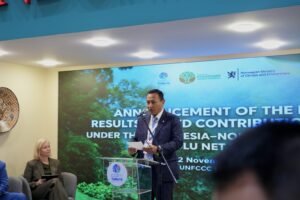
At the forum, Hashim also announced that Indonesia would declare its participation in the Forest and Climate Leaders’ Partnership (FCLP) at the Indonesia Pavilion on Thursday (Nov. 12).
Through the partnership, Indonesia will share its experience in forest management, Social Forestry and restoration, while expanding cooperation on financing, credible carbon markets and sustainable livelihoods in pursuit of the 2030 forest targets.
Indonesia also welcomed the United Nations Decade for Afforestation and Reforestation, in line with the 2027–2036 Sustainable Forest Management agenda.
According to Hashim, restoration efforts must be guided by science, protect natural ecosystems and address community needs, with support from long-term financing and management.
As a signatory to the Intergovernmental Land Tenure Commitment (ILTC), Indonesia will also continue strengthening Social Forestry, recognizing customary forests and resolving tenure issues in accordance with national law.
“Communities must be partners in protecting the forests on which their livelihoods depend,” he stressed.
“Together, the TFFF, FCLP and ILTC can connect financing, forest protection, restoration and community rights. Our success must be measured not by new announcements, but by forests preserved, empowered communities and financing that is actually delivered,” Hashim concluded.
Media contact: Ristianto Pribadi, Head of the Bureau of Public Relations and International Cooperation, Ministry of Forestry.