




EduAsiaNews, Korea – Professor An Jee-hyun, Dean of the College of Humanities, opened the event with a tribute built around a few words she has come to associate with him. The first was teaching load. Had the university ever set a fixed number of credit hours for a professor to fulfill over a career, she suggested, Professor Bong would have met the requirement a decade before retiring, which was indicative of the devotion and passion he brought to his teaching. The second was poetry recitation, and she recalled how he spent summer after summer giving up his own time to teach students how to hear and savor the words on the page. The third was Auden: though Professor Bong is best known as Korea’s foremost T. S. Eliot scholar, she confessed that it is his Auden translations she finds herself returning to. She closed by borrowing a part from Auden’s “Musée des Beaux Arts,” “they were never wrong, / The Old Masters,” leaving little doubt as to whom she counted among them
Professor Yi Dongshin, Department Chair of English Language and Literature, then read the biography. Professor Bong took his BA and MA at Yonsei University and his PhD at Rutgers before joining SNU in 2003, where he taught in the Department of English Language and Literature and in the Interdisciplinary Program in Performing Arts Studies. He also served over the years as Director of the Language Proficiency Testing Center at the Language Education Institute and as Director of the Center for English Languages and Cultures. He received the SNU Excellence in Teaching Award in 2018, which Professor Yi remarked had gone to exactly the right person: as a new faculty member, he had watched Professor Bong carry out numerous classes and reading groups, and had found himself thinking, “so this is how hard it is possible to work.” He ended by gesturing at the full lecture hall, noting that, while colleagues are to be expected at a retirement ceremony, the number of students who had come was the clearest evidence of a life’s work.
The floor then passed to colleagues, who came armed with stories. Professor Kim Hyon-Jin traced their first encounter to 2002, when Professor Bong arrived late to a conference dinner. By his own account, he had heard so much about Professor Bong that when he saw the figure crossing the room he thought, “so that’s him,” and he claims that he saw something like a halo behind him that night. Weeks later, he recalled, they met again when the department was discussing candidates for a position in modern English poetry, and Professor Kim, then a green assistant professor with no standing to speak, remembers telling everyone that he hoped they could bring in someone like Professor Bong. He also mentioned that he happened to lose his wallet that night, which contained a few credit cards and 150,000 won in cash, and that the following March Professor Bong joined the faculty. At this he humorously remarked, “for 150,000 won, I got twenty-three years and six months of him as a colleague. I have never made a better investment, and I doubt I will.” Quoting Pi Chun-deuk on chance encounters, that we may long for someone and meet them only once, or live a whole life never forgetting someone we never meet again, he said that in his case the meetings had been many, and not one of them was one he would wish undone. Of all the fine teachers he has known in the college, Professor Bong was and is the one he has most deeply respected, trusted, and relied on.
Professor Lee Haram picked the story up from the student’s side of the desk. He recalled taking Professor Bong’s “Modern Poetry in English” in his first semester of graduate school, where he got his first real taste of the depth of English poetry and where, he noted to laughter from the floor, the classes ran particularly long. Former students he had spoken to remembered the same dedication: Professor Bong held weekly one-on-one meetings to sharpen their writing with whole hours spent reading their prose line by line and giving detailed feedback. As a graduate student, he had assumed this was simply what teaching was. Now that he stands on the other side of the desk, he understands that such devotion is not a given, that he will never manage it himself, and that the most he can do is learn the spirit of it and try to keep up. His retirement is a loss for the department and the University, but for Professor Bong, he hoped, it would be the beginning of a new road, and he asked him to keep sharing what he knows.
The moderator, Professor Oh Ye Sul, then played video messages from former students now in the United States, each recalling how much Professor Bong had helped them through their MA years at SNU. With that, the floor was his.
Professor Bong’s Final Lecture
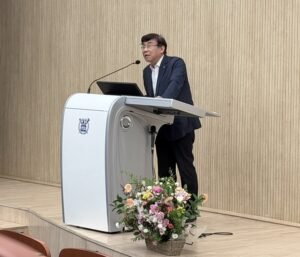
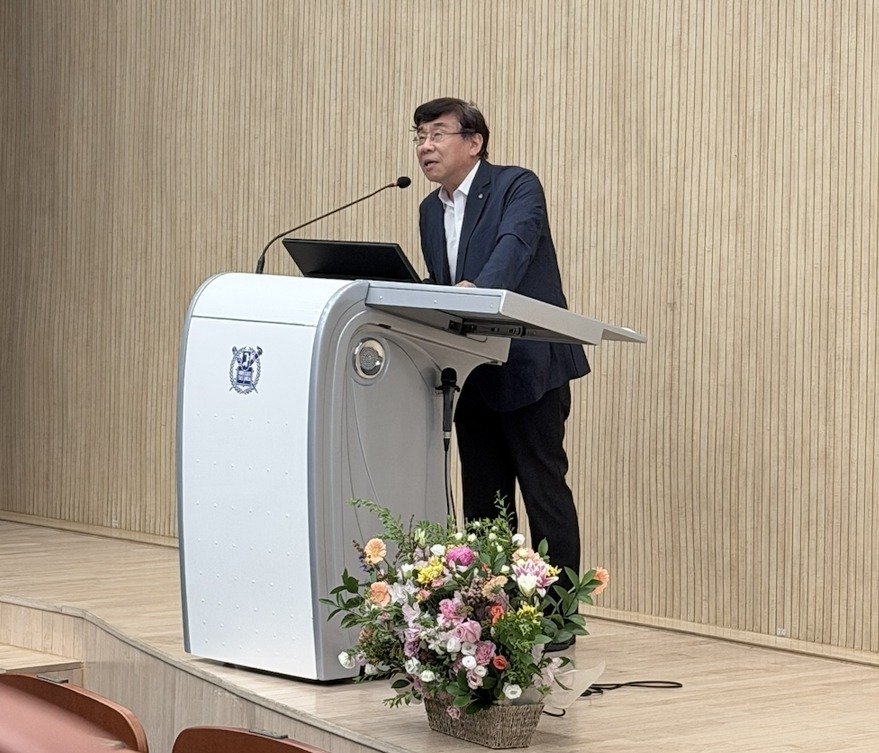
Professor Bong opened by announcing that since the occasion was a fresh start, he would not do what he has always done, which is read poems closely, as if in a classroom. Instead, he invited the audience to sit comfortably and listen to his words, as if tuning into the radio. He reflected on the circular pattern of his teaching career, having spoken his way into a professorship and now, at the end of it, speaking his way out.
For his lecture, Professor Bong wanted to sketch what it means for time to pass and how that bears on the way we see the world. His premise was that text, world, and memory are, from a certain angle, synonyms. We understand the world in the form of a text, and the perspective we bring to reading one always remains with us. Memory too is something akin to a text, a palimpsest of sorts that has been written and erased with the former traces still faintly legible. For a landscape to become a place that contains meaning, it too must be captured within a text, or approached in the form of one, since it will only begin to acquire meaning within the structure of language. The world, in other words, is not an object waiting to be described, since the way we look at it has already been taught to us by what we have read. It follows that returning to a place is an act of rereading it, and that rereading a text is a way of returning to that same place.
He discussed six texts over the course of the lecture: Wordsworth’s “Tintern Abbey,” Yeats’ “Sailing to Byzantium,” Robert Browning’s “Memorabilia,” Mervyn LeRoy’s 1940 film Waterloo Bridge, and two poems by Eliot, “Ash-Wednesday” and a passage from “Little Gidding.” In Wordsworth’s poem, the speaker walks back to a valley after five years away and finds the landscape unchanged and himself altered, and much of what follows is spent persuading himself that what he lost with age was repaid with something else. The other poets are less willing to accept that trade. Yeats’ speaker seeks to escape the aging of the flesh altogether, sailing to an imagined Byzantium to be remade as a golden bird, on the grounds that art can preserve what the body cannot. Eliot goes further still, since in “Ash-Wednesday” he holds out little hope of transcending time or age, taking time as simply time and place as simply place, and accepting that some losses can never be repaid at all. Between these two positions sits Browning’s poem, which takes up the selective and highly personal nature of memory. To this, Professor Bong tied his own experience of watching the 1940 film, and how his response to it changed as he aged; he had felt it deeply as a child without understanding it and understood it as an adult without feeling it as deeply.
He ended by tying all this together with his own translation of “Little Gidding,” and the closing lines in which Eliot imagines our exploring carrying us, at the last, back to the place we set out from, to be known properly for the first time. That paradox, that the end of all our discoveries is a return to the beginning, is for Professor Bong the truest description we have of growing old. When we go back to the poems and films of our youth as adults, we are not seeing what we saw then. Our memories have shifted along with us, and we carry forward only fragments of the past. Aging, then, is not simply a movement away from what formed us, but an unceasing movement back toward it in order to look at it again. What formed us may be a particular place, a particular text, a particular world, but whatever it was, we cannot help but return. Put another way, every return is a kind of rereading. As we change, so do the places, the texts, and the memories. We find when we go back not only that the past is not as we remembered it, but the more disconcerting fact that our memory of it has itself become part of who we now are.
With that final lesson imparted, the ceremony closed with the presentation of a plaque of appreciation from the department, read out by Professor Yi, followed by a group photo. Professor Oh Ye Sul then closed the program and invited everyone to dinner, where they could share more stories about Professor Bong and celebrate his retirement together.

Professor Yi Dongshin, chair of the Department of English Language and Literature, presents Professor Bong with a plaque of appreciation
Professor Bong, in His Students’ Words
Three students who attended spoke afterward about what he has meant to them.
Rhie Seoyoung (Stella), an MA student in English Literature currently specializing in American poetry, first met him in “Modern Poetry in English.” “He taught us how to conduct close reading by showing how a line-by-line analysis should be done,” she said, and through that thorough work she learned to attend to diction, form, and rhyme in order to understand the speaker’s consciousness and the poet’s intention behind it. He insisted just as firmly on contextualization, pushing students to “articulate what a poet had selectively inherited from his predecessors.” The course is where she realized poetry was what she wanted to specialize in, and she remains grateful to him “for guiding us into the fascinating, intricately designed world of poetry within a teaching that is charismatic and warm.”
She heard the retirement lecture as an argument against the linear view of growing older. “Seeing time and our life in a non-linear way was an idea that I had long been drawn to, though I still struggled to grasp what it truly entailed,” she said. “Thanks to his lecture, I learned that a non-linear way of looking at life allows us to encounter our ever-evolving self instead of viewing aging as a mere loss.” Asked what comes to mind first when she thinks of him, she offered a single word. “I believe Professor Bong is the embodiment of sprezzatura, which translates into the art of effortlessness. His students look up to him for many reasons, but what stays with me is the way he pairs precise language with humor, an elegance that I have not found anywhere else.”
Lee Sunghyeok, who has completed an MA in Conducting at the SNU Graduate School of Music and leaves soon to study in Leipzig, met Professor Bong while double majoring in English Literature alongside Conducting, in a course taught jointly with a professor from his home department. One lesson from that class remains imprinted on him: “Whenever I encounter an aria in an opera, I remember him telling us that all arias are lyrics, in which the singer speaks alone, so that time comes to a halt and the focus moves to the inner world.”
He remembers the after-party too, where Professor Bong remarked that most double majors find it hard to integrate into a group, and that he had been surprised to run into Lee at a colleague’s trial lecture. Later in the evening he dozed off for a few minutes and woke to a hand on his shoulder. A conductor, Professor Bong said, should never sleep during a party, because he is the one who makes the other members drink harder. “He never lost his sense of humor even though he always spoke like a gentleman.” What stayed with him from the retirement lecture was the claim that all revisits are rereadings. “I will be revisiting so many places and texts for the rest of my life, and whenever I do, his words will revisit me again.”
Cho Hyunjoo, an MA student in the same department specializing in medieval English literature, had heard about Professor Bong countless times without ever taking a class, her interests lying outside modernism, and finally did so in spring 2025, in his course on comparative literary theory. “It was an ambitious course, sweeping through classicism, romanticism, and modernism in Western literature along with a weekly assignment reading In Search of Lost Time,” she said. “Although modernism was still not my thing, I loved every second of it because I could feel the professor’s passion and love for this topic.”
She had loved every second of the retirement lecture too, and had come to it eagerly, since the passage of time and what aging means were topics she had reflected on from time to time. Her favorite section was his analysis of “Sailing to Byzantium.” “I could sympathize most with his sentiment: becoming a golden bird with eternal life looking down on human affairs? I’d be absolutely willing to be like that, if it were possible!” As for what comes to mind first, she thinks of Oedipus Rex, which he had once introduced as the best piece of literature in history, followed closely by Eliot and “The Waste Land,” another of his favorites. What she actually pictures, though, is “his unique frowning with an expression of ‘Here comes the problem child,’ which I enjoyed secretly,” an expression she suspects she earned by submitting an incomplete final paper.

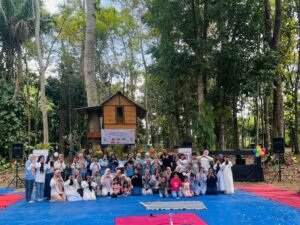
Professor Bong with colleagues, students, and alumni following the lecture
What emerges across all of these accounts is a teacher who changed how his students read and, in doing so, how they see. The sharpness of his readings, the wry humor that ran alongside them, and his insistence that students look past the surface of a text into what lies beneath it are what they will carry with them. The gratitude of those who learned from him was plain that afternoon, and it will outlast the occasion that gathered them.