




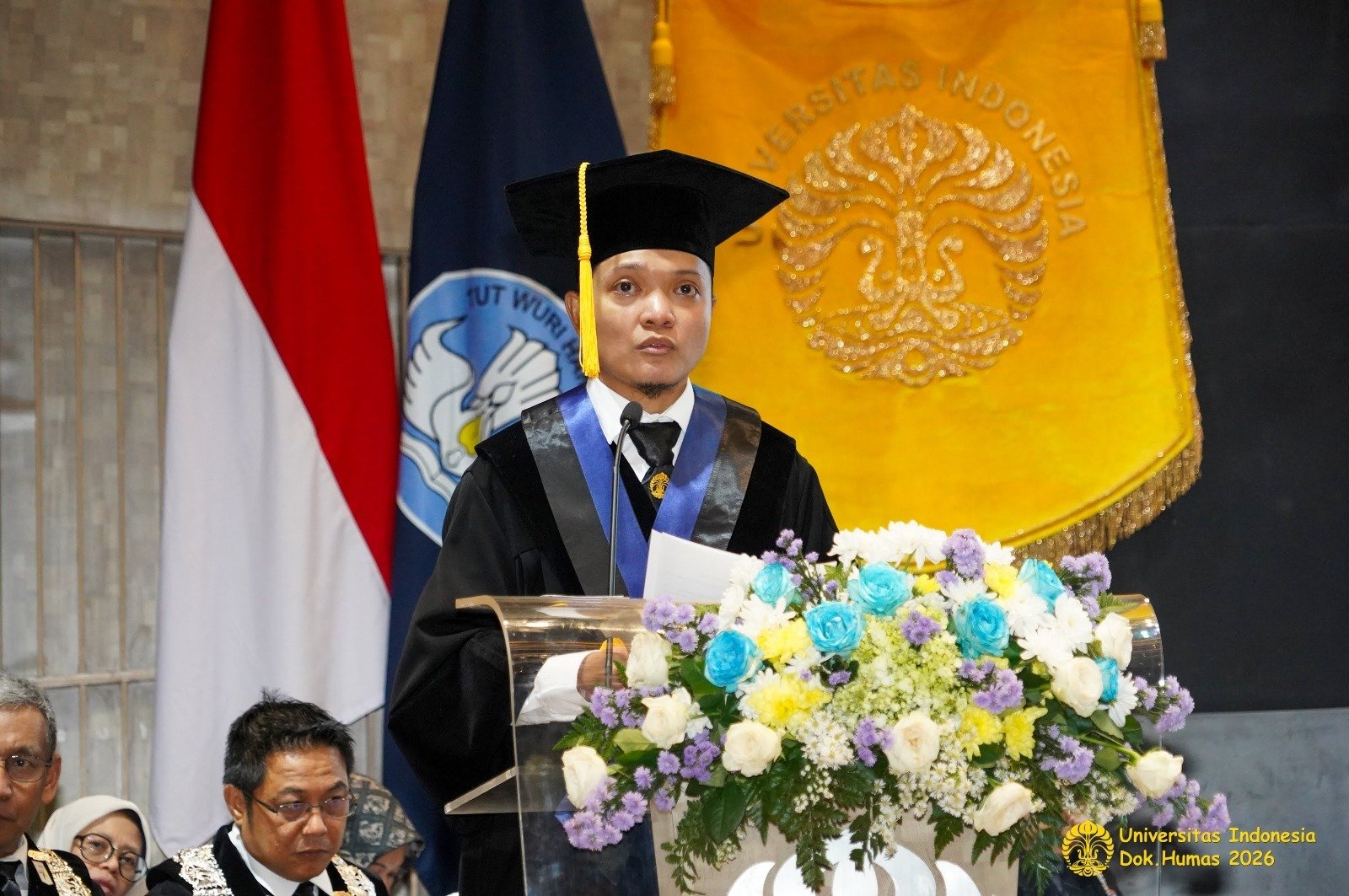
EduAsiaNews, Depok West Java – Dengue fever arrives with the rainy season, recedes and returns the next year. That familiar pattern is the problem, said Dipo Aldila in his inaugural professorial address at the University of Indonesia (UI) on Wednesday. Dipo, a professor of mathematical epidemiology at the Faculty of Mathematics and Natural Sciences (FMIPA), was the 36th professor inaugurated by UI in 2026, bringing the faculty’s total to 39.
Delivering the address at the Makara Art Center, titled “Scientific Mutual Cooperation: Synergy of Epidemiological Models and Machine Learning for Infectious Disease Control in Indonesia,” he said mathematical models and machine learning are not rivals but complements in tackling diseases such as dengue, malaria, tuberculosis and COVID-19.
“Mathematical models and machine learning are not two competing things but complementary: one gives us understanding, the other gives us sensitivity to data. But their full power can only be realized through scientific mutual cooperation,” Dipo said.
The Health Ministry recorded 131,393 dengue cases and 544 deaths from January to October 2025. Every disease control decision, Dipo said, is essentially a choice of when, where and how to use limited resources, so he uses mathematical models as a “simulated world” to test strategies before they are applied.
Models calibrated with data from Jakarta and Palu showed that the best strategy differs by city. In Palu, active case finding matters more, while Jakarta is more sensitive to the rate of transmission. Fogging when mosquito populations pass a certain threshold also works better than continuous fogging. “Timely intervention is worth more than continuous intervention,” he said.
Mathematical models explain how diseases spread but tend to be rigid when faced with real data. Machine learning is flexible in finding patterns but often works like a black box. The two are combined in physics-informed neural networks (PINN), artificial neural networks that learn from data while obeying the laws of disease transmission. In joint research with partners in Sri Lanka, the approach produced more accurate weekly forecasts for Jakarta and Colombo. “A good forecast is an umbrella for our health system,” he said.
For malaria, tuberculosis and COVID-19 in Jakarta, limited medicines or hospital beds can let a disease persist even when its reproduction number is below one, a phenomenon called backward bifurcation. In HIV and mpox coinfection, disease dynamics can even become chaotic. “Limits do not merely make control more expensive; they can change the rules of the game entirely,” he said.
He urged policymakers not to stop interventions just because the reproduction number has fallen below one, and to strengthen health service capacity. Dipo likened disease control to a river: community health center workers record cases upstream, modelers process them in the middle and decision-makers act downstream. Going forward, he aims to expand PINN to support the 2030 elimination of malaria and tuberculosis, which is still hampered by limited field data.
UI rector Heri Hermansyah, who presided over the ceremony, praised the achievement. “That Prof. Dipo has been inaugurated as a professor at FMIPA at age 38 will hopefully set a good precedent and spur other UI academics,” he said.
Dipo has been a lecturer in UI’s mathematics department since 2015 and now heads the IMPACT Lab research cluster and serves as second vice president for research at the Indonesian Mathematical Society. He has been named among the World’s Top 2% Scientists by Stanford University and Elsevier for six consecutive years (2021-2026) and received a national high-impact publication award from the research ministry (RISTEK-BRIN) in 2020.
Answering the concern he raised at the start, he voiced hope for the direction of national research. “May we move toward an Indonesia that no longer greets the rainy season with anxiety, an Indonesia that no longer treats tropical diseases as a normal annual burden,” he said.
Through the inauguration, UI said it reaffirmed its commitment to producing professors who are academically excellent and who apply science to real social problems, including infectious disease control, and hopes Dipo’s idea will inspire more researchers and policymakers to collaborate.