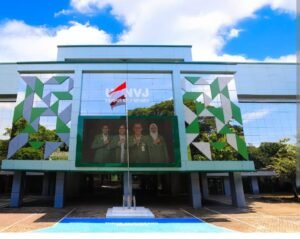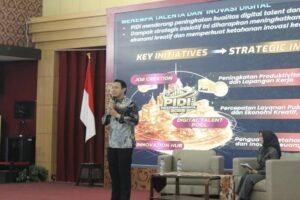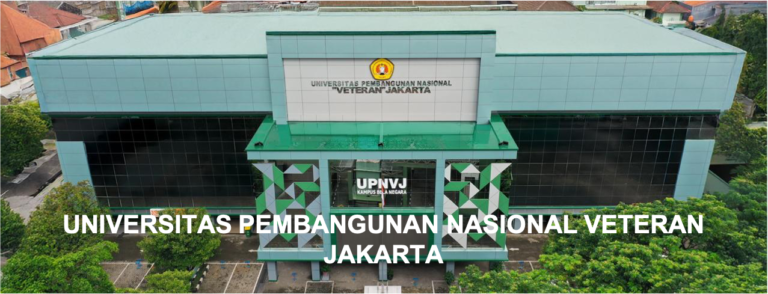





EduAsiaNews, Jakarta – The Faculty of Social and Political Sciences (FISIP) of Universitas Pembangunan Nasional “Veteran” Jakarta (UPNVJ), through its Department of International Relations, held a national seminar under the theme “Neocolonialism and Neo-Nazism: Challenges of a Multipolar World for the Global South and ASEAN” on Thursday, November 5, 2026, at the Mulyono Sudirman Auditorium, Faculty of Medicine, UPNVJ.
Organized in collaboration with the Global Thinkers Institute (GTI), with the support of the Global Future Institute (GFI), the national seminar featured several distinguished speakers, including Hendrajid, Director of GFI; First Air Marshal (Ret.) R. Agung Sasongkojati, a geopolitical and military analyst; Musa Maliki, Ph.D., Lecturer in International Relations at UPNVJ; and Prof. Dr. Ali Mochtar Ngabalin, M.Sc., Head of the Golkar Party’s Central Executive Board (DPP) for Foreign Policy and International Relations.
In his opening remarks, the Acting Vice Rector for Academic Affairs, Dr. Henry Binsar Hamonangan Sitorus, S.T., M.T., emphasized the importance of higher education institutions contributing to responses to international geopolitical developments through the advancement of academic research, the exchange of ideas, and critical discussions.
“Higher education institutions have a responsibility to provide an academic dialogue platform that brings together diverse perspectives, particularly in understanding changes in the global order. Through this forum, we hope to generate critical, objective, and constructive ideas that can contribute to strengthening Indonesia’s position in international affairs,” Henry stated.
He also emphasized ASEAN’s strategic role in maintaining stability, strengthening regional resilience, and fostering solidarity among countries to counter various forms of political and economic domination as manifestations of neocolonialism.
On the same occasion, Mani Eriza, Head of the Center for Multilateral Policy Strategy at the Ministry of Foreign Affairs of the Republic of Indonesia’s Foreign Policy Strategy Agency, delivered the keynote address, elaborating on the relevance of Indonesia’s independent and active foreign policy (bebas aktif) in shaping a multipolar global governance system.
She stressed that an independent and active foreign policy does not mean Indonesia remains passive or distances itself from international developments. On the contrary, it allows Indonesia greater flexibility in establishing partnerships with various countries without being bound to any particular power bloc.
“An independent and active foreign policy means proactive strategic independence, not passive neutrality,” Mani Eriza emphasized when explaining Indonesia’s foreign policy direction.
She further explained that this policy is rooted in historical and constitutional foundations, including the spirit of the 1955 Asian-African Conference, which strengthened solidarity among developing countries in opposing colonialism.
During the main session, Muhammad Ma’ruf, Director of GTI, highlighted the emergence of renewed narratives of neocolonialism and neo-Nazism within the dynamics of international politics.
He argued that historical manipulation and political propaganda can serve as instruments for expanding influence and shaping public perceptions of other countries.
“Neocolonialism and Neo-Nazism are inherently ideologies based on racial and class supremacy. Both tend to be expansionist and coercive,” Ma’ruf explained.
He also emphasized that both ideologies are fundamentally incompatible with the principles of humanity, justice, equality, and sovereignty that underpin Pancasila.
From a geopolitical and military perspective, First Air Marshal TNI (Ret.) R. Agung Sasongkojati stated that Indonesia needs to strengthen its commitment to an independent and active foreign policy through a strategic approach focused on national sovereignty.
Agung also linked the dynamics of the Russia-Ukraine conflict to the competition for influence among the United States, Western countries, and Russia. He considered NATO’s eastward expansion into Eastern Europe to be one of the significant factors in understanding the conflict.
Meanwhile, Hendrajid, Director of GFI, stated that changes in the global geopolitical landscape should be leveraged by Indonesia to renew and strengthen solidarity among developing countries.
He highlighted the resurgence of practices such as mercantilism in the economic policies of major powers, including through the dominance of technology companies and large-scale control over global data. According to him, these developments present new challenges for developing countries in maintaining their economic and political independence.
“Indonesia should seize the opportunities arising from these developments to revive the spirit of the 1955 Asian-African Conference,” he emphasized.
From an academic perspective, Musa Maliki, Ph.D., highlighted neocolonialism as a form of domination that is no longer limited to direct territorial occupation but also operates through political, economic, social, and cultural systems.
He drew upon the ideas of Kwame Nkrumah in his book Neo-Colonialism: The Last Stage of Imperialism (1965), which describes neocolonialism as the most dangerous form of imperialism.
“For those who practice it, it means exercising power without responsibility, while for those who suffer from it, it means exploitation without any means of escape,” Musa explained.
Through this seminar, participants are expected to develop perspectives that prioritize foreign policy independence, control over natural resources, and stronger solidarity among ASEAN member states and the Global South as essential agendas in addressing changes in the global geopolitical landscape.
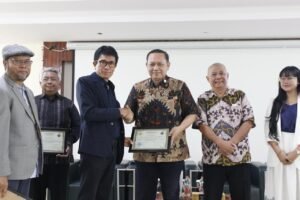
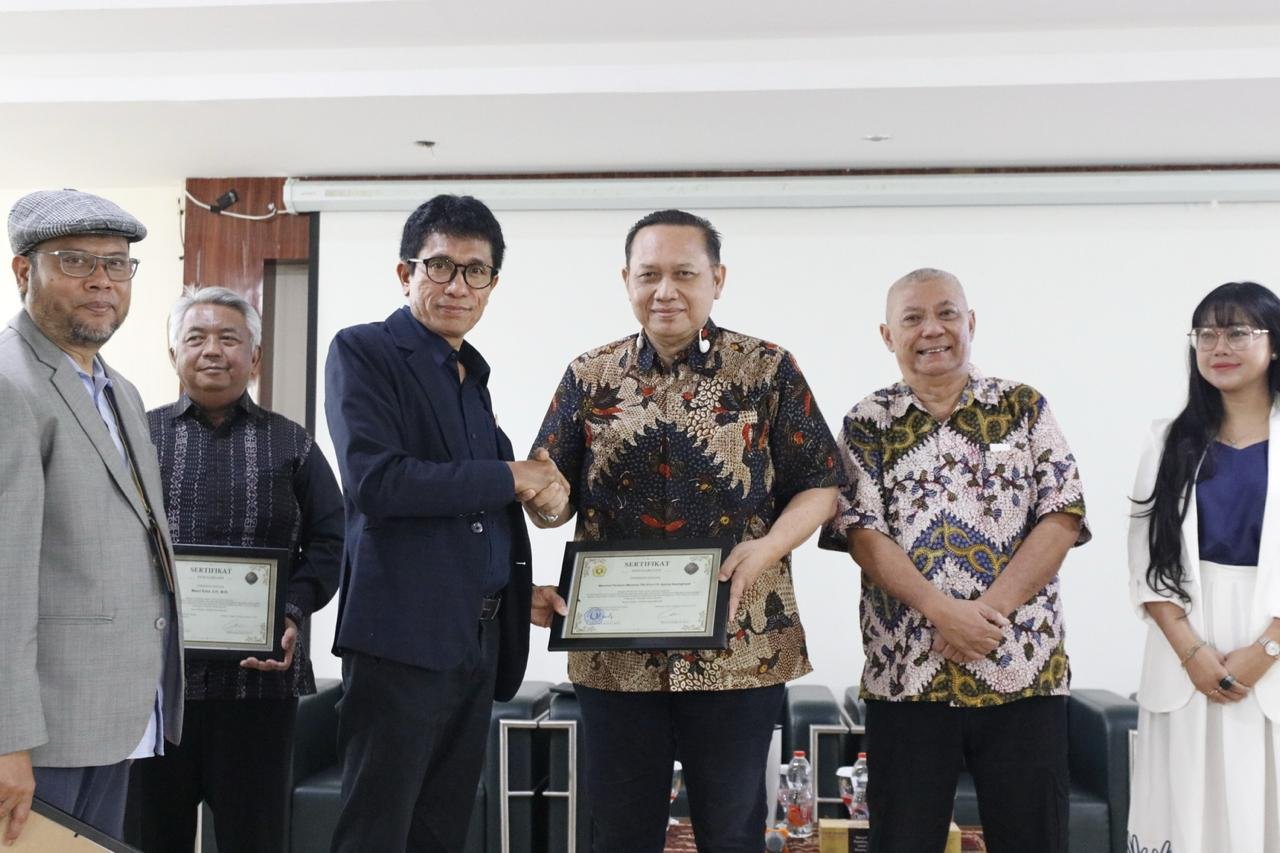
The national seminar concluded with the signing of a Cooperation Agreement (Perjanjian Kerja Sama or PKS) between FISIP UPNVJ and GTI.