




EduAsiaNews, Depok – Universitas Indonesia (UI) has revisited the history of its environmentally conscious campus development through a talk show titled “Callback Arsip Hutan UI: Memori Kolektif, Konservasi, dan Masa Depan Hutan UI” (UI Forest Archive Callback: Collective Memory, Conservation and the Future of UI Forest). The event also reaffirmed the university’s commitment to the sustainable management of UI Forest as an ecological asset, conservation area and natural laboratory for education and research.
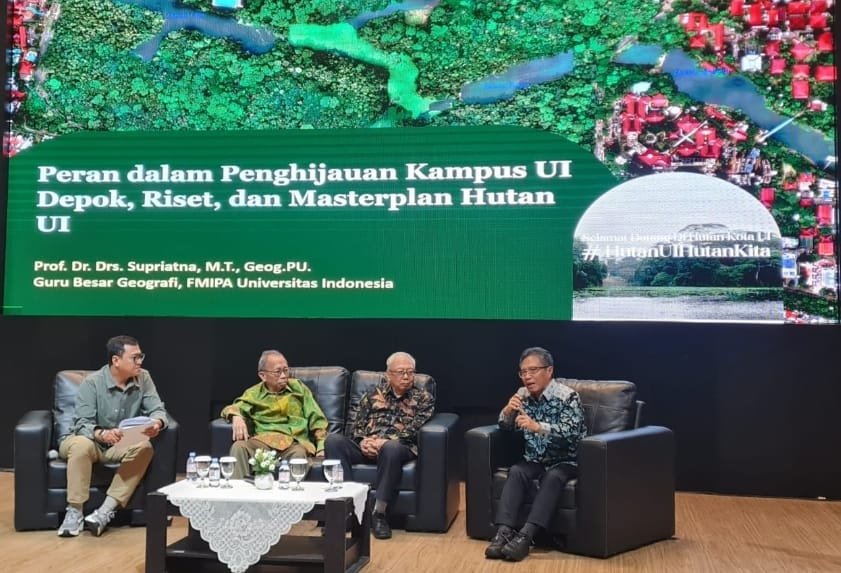
Held at the Makara Art Center Auditorium on the UI campus in Depok on Saturday (Nov. 21), the event featured three UI professors who played significant roles in the history of the design, construction and greening of the university’s Depok campus.
Gunawan Tjahjono, a professor at the UI Faculty of Engineering and the architect behind the design of the Depok campus, explained that the campus development had emphasized the identity of the Nusantara architectural tradition from the outset, while taking local environmental characteristics into account. The campus was designed by Indonesian architects, drawing on spatial planning and architectural studies from 27 provinces across the country, which identified centralized and elongated building patterns. These concepts formed the basis for the arrangement of building clusters, the division of academic zones and the integration of academic areas with the natural environment. Existing vegetation and rubber plantations were also preserved to maintain ecological balance.
“From the outset, the design of the UI campus took into account not only the physical needs of buildings and academic activities, but also national identity and environmental sustainability. Vegetation and wildlife habitats are part of an ecosystem that must be respected and preserved. This principle must continue to guide future campus development so that it remains aligned with the original design philosophy: creating an educational environment in harmony with nature that reflects the richness of Indonesian architecture,” Gunawan said.
Meanwhile, Abimanyu Takdir Alamsyah, a professor at the UI Faculty of Engineering who was directly involved in the development of the Depok campus, explained that since construction began in the 1980s, the campus had been conceived as a model for environmentally conscious higher education development, integrating the built environment with green spaces. The concept was based on the understanding that environmental quality is a prerequisite for the sustainability of human life. Over time, however, campus facility development has not fully followed the original concept, as individual units have drawn up their own development plans.
“From the beginning, the UI campus was designed not merely as a place for delivering higher education, but as an integrated whole in which physical development and the environment support one another. It is therefore important to revisit the original vision for the campus so that the development of educational facilities remains in harmony with forest conservation and provides ecological benefits for Jakarta, Depok and surrounding areas,” Abimanyu said.
Supriatna, a professor of geography at the UI Faculty of Mathematics and Natural Sciences (FMIPA), director of the UI School of Sustainable Development Studies (SPPB) and a member of the supervisory board of the Center for Sustainability Communication and Policy (CSCP) Indonesia, delivered a presentation titled “The Role of Campus Greening, Research and the UI Forest Master Plan.” He explained that the development of UI Forest was part of a long-term policy implemented through greening initiatives, research, and sustainable area planning and management.
UI Forest serves several strategic ecological functions, including absorbing carbon and air pollutants, regulating the microclimate, conserving biodiversity and absorbing rainwater. Its water catchment function is integrated with six lakes to reduce flood risks and maintain groundwater reserves. Topographical features, soil types and vegetation are also important considerations in research and the preparation of a master plan for UI Forest management.
“Future management of UI Forest must be based on scientific research and a comprehensive master plan to ensure that its ecological, conservation, educational and research functions can be sustained. UI Forest is more than just green open space; it is an ecological asset and a natural laboratory of strategic importance in addressing climate change, maintaining the environmental balance of urban areas and advancing scientific knowledge. It is a legacy that we must safeguard together for future generations,” Supriatna said.
Moderated by Niko Gratadirga, head of the Green Archive Innovation community service team, the dialogue provided an opportunity to preserve the collective memory of the UI campus’s development while strengthening the direction of future UI Forest management.
The alignment of the campus’s original vision, the identity of Nusantara architecture, environmental conservation, and management based on research and a master plan is expected to reinforce UI’s role as an environmentally conscious university that benefits society, supports climate action and preserves a high-quality living environment for future generations. (*)