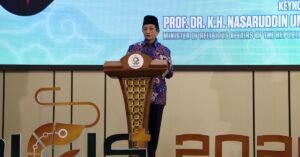





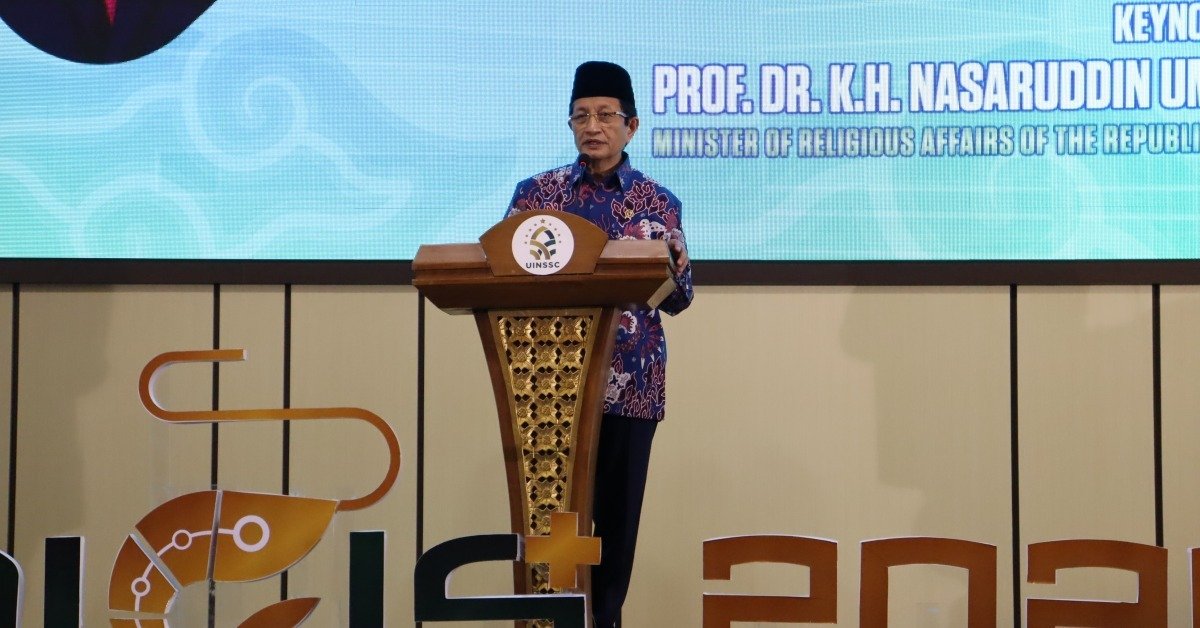
EduAsiaNews, Cirebon West Java – Religious Affairs Minister Nasaruddin Umar officially opened the 25th Annual International Conference on Islam, Science, and Society (AICIS+) 2026 at the Siber Syekh Nurjati State Islamic University (UIN) campus in Cirebon on Tuesday. He called on state Islamic higher education institutions (PTKIN) to transform their education so they can respond to changing patterns of religiosity in the digital era.
According to Nasaruddin, advances in information technology have changed how people acquire knowledge and understand religion. Young people are increasingly independent in making religious choices, relying not only on understanding passed down by family or community but also seeking references on the internet, social media and artificial intelligence (AI).
The phenomenon presents both challenges and opportunities for Islamic education, he said. PTKIN and Islamic boarding schools (pesantren) need to adapt their curricula and teaching methods to the times and the needs of the job market, without abandoning the basic principles of sharia.
“PTKIN management must be able to keep up with changing needs of society and the world of work. But there are limits that must be maintained. Learning methods and approaches can be developed with the times, while the basic principles of sharia remain a foundation that must not be abandoned,” he said.
AICIS+ 2026 carries the theme “Revitalizing Islamic Civilization for Sustainable Life: Local Heritage, Technological Innovation, and Human Flourishing.” The international forum brings together academics and thinkers from various countries to discuss the contribution of Islamic scholarship in facing developments in science, technology and global social dynamics.
Participants’ enthusiasm was reflected in the number of submissions. The organizers recorded 3,420 abstracts from 607 institutions in 21 countries across five continents, up from the 2,434 abstracts received for AICIS 2025. The increase shows growing attention among academics worldwide to dialogue among Islam, science and society.
The minister also warned that innovation in Islamic economics and banking must remain grounded in fiqh muamalah, the Islamic jurisprudence of commercial transactions. Industry progress must not erase the identity and substance of Islamic scholarship, he said, so lecturers and academics play an important role in upholding principles while producing competitive innovations.
Nasaruddin also encouraged the development of contextual Islamic jurisprudence that makes use of advances in science and technology. He cited weather modification technology such as cloud seeding as a new phenomenon that Muslim scholars could study.
He further urged PTKIN to revive the spirit of cross-disciplinary and interfaith collaboration seen in the scholarly tradition of the Bayt al-Hikmah, or House of Wisdom. Islamic universities were also encouraged to strengthen ecotheology as a follow-up to the Istiqlal Declaration, apply the Curriculum of Love and develop religious diplomacy to support world peace.
The message underscores that the future of Islamic education is not just about keeping up with technological change, he said. PTKIN must be able to steer change through knowledge, Islamic values and real contributions to humanity.
Separately, Syarif Hidayatullah State Islamic University (UIN) Jakarta rector Asep Saepudin Jahar welcomed the minister’s direction. The transformation of PTKIN in the digital era should be understood not merely as adapting to technology but also as strengthening the relevance of Islamic education in addressing societal problems and global humanitarian challenges, he said.
“The minister’s message is an important reminder for Islamic universities to keep developing an open, integrative scholarly tradition that is responsive to changing times. Mastery of technology, including AI, needs to be balanced with stronger ethics, academic integrity and Islamic values,” he said.
Asep also stressed the importance of cross-disciplinary collaboration in developing knowledge at PTKIN. Dialogue among religious studies, science, technology and the social sciences needs to be strengthened so that PTKIN are not only centers of Islamic studies but also able to produce concrete solutions to societal problems, he said.
“I hope this year’s AICIS+ will build stronger international academic networks and give rise to innovative ideas that can strengthen the contribution of Islamic universities to building an inclusive, sustainable civilization oriented toward the welfare of humankind,” he said.