




EduAsiaNews, Surabaya – Universities must go beyond improving governance and learning quality to ensure their presence benefits society. To meet the challenge, transformation is needed through stronger institutions, adaptation to technological developments, cross-sector collaboration and more equitable access to higher education.
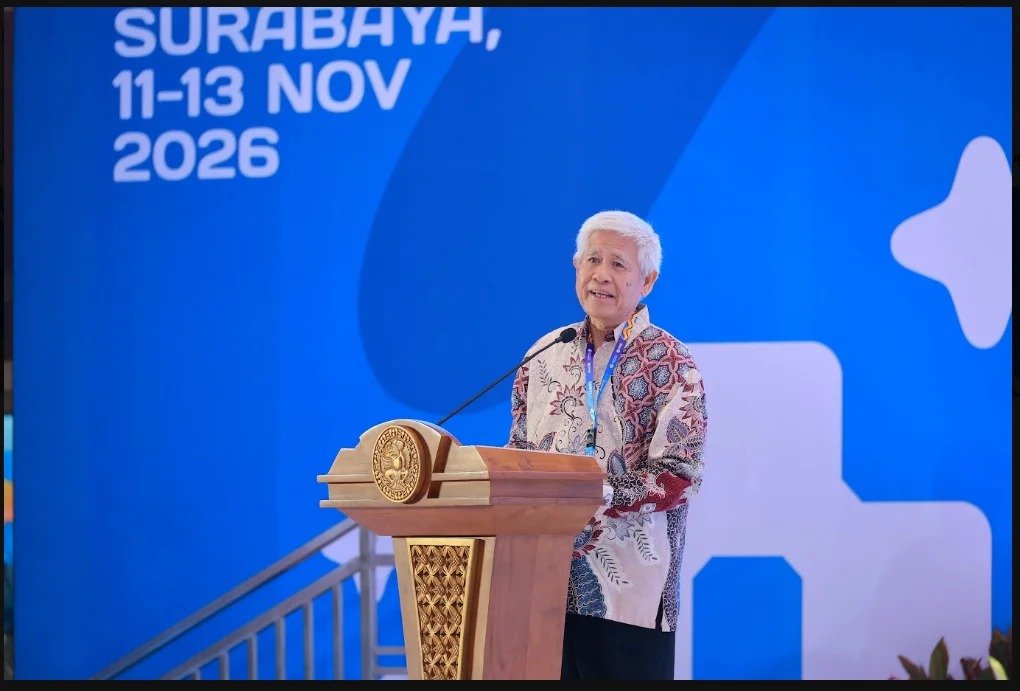
These steps have been formulated in the Impactful Higher Education Action Matrix, a synthesis of the outcomes of the 2026 Higher Education Summit Conference (KPPTI). Higher Education Council (DPT) chair T Basaruddin presented the matrix at the first-floor hall of the Airlangga Convention Center (ACC) on the MERR-C campus of Airlangga University (UNAIR) on Friday.
The matrix comprises four clusters, Basaruddin said, adding that universities have great potential to provide benefits to society.
“Comprehensive collaboration is needed, given the enormous potential of Indonesian universities, which will grow even larger if their potentials are brought together,” he said.
Strengthening governance and transforming learning
The first cluster focuses on governance, leadership and sustainability. Basaruddin highlighted the strengthening of institutional autonomy and accountability, the development of transformational leadership and the diversification of funding sources to keep campuses sustainable.
“Universities need to implement a measurable performance evaluation system covering outputs, outcomes and impact in a transparent manner. They must also apply governance systems that ensure good university governance and university autonomy. The hope is to create healthy universities that become a moral force,” he said.
The second cluster deals with the transformation of learning, digitalization and graduates. According to Basaruddin, universities need to promote the responsible integration of artificial intelligence (AI) in teaching and assessment.
“Universities must also strengthen the measurement of digital maturity, integration and data security, and ensure the implementation, oversight and management of AI use in line with national policy at the institutional level. The impact will be integrated, secure, transparent and accountable data and AI governance,” he said.
Collaboration and equitable impact
The third cluster emphasizes strengthening partnerships and the three pillars of higher education (Tridarma) through collaboration with the government, industry and communities. The partnerships are expected to speed up the commercialization of innovations so that the results of scientific and technological development can be used more widely.
“Universities must open themselves up and collaborate with various parties to commercialize innovations,” Basaruddin said.
The fourth cluster stresses access, inclusion and higher education networks. Universities are directed to strengthen services for vulnerable groups, expand partnerships for underdeveloped, frontier and outermost regions (3T), and build collaboration among campuses and with the international diaspora.
“Universities develop affirmative systems and partnerships with various community groups considered underrepresented or with limited access. Through this action, equitable access and reduced inequality can be achieved,” he said.
Through the four clusters, universities are expected to strengthen governance, transform learning, expand collaboration and improve equitable access to education. The steps must be implemented collectively so that the potential of universities can benefit society and national development more broadly.