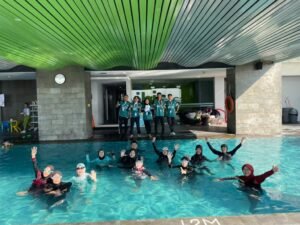





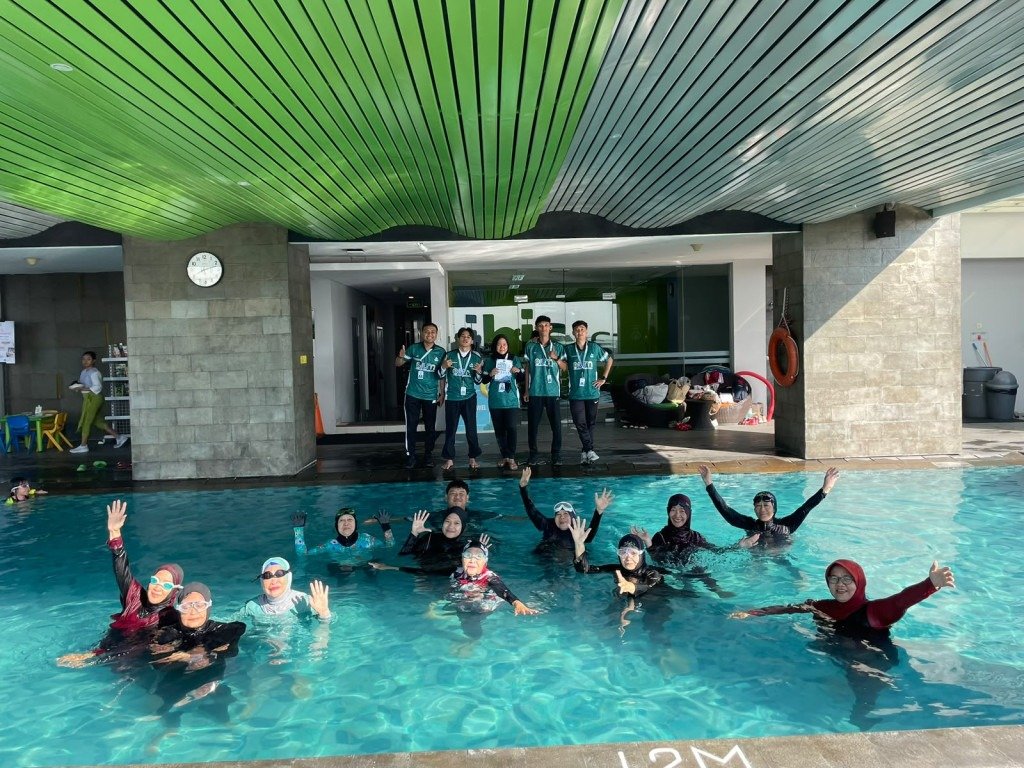
EduAsiaNews, Malang – Lecturers and students from the Teacher Professional Education (PPG) program at Universitas Negeri Malang (UM), working as part of a Leadership Project group, organized a community service initiative titled “Innovating Physical Activity for Older Adults through Water Exercise Walking as a Basic Aquatic Therapy Approach.” The program was held on August 3, 2026, at the swimming pool of Hotel Ibis Malang, involving 20 older adults aged 55–70 who are members of the Universitas Brawijaya Healthy Heart Club in Malang.
The initiative represents UM’s contribution to the Sustainable Development Goals (SDGs), particularly SDG 3: Good Health and Well-being, by introducing an alternative form of physical activity with the potential to support physical fitness and quality of life among older adults. In this program, the Universitas Brawijaya Healthy Heart Club served as both a collaborative partner and the beneficiary group.
The program was initiated and led by Dr. Ari Wibowo Kurniawan, M.Pd., a lecturer in the Master’s Program in Sports Education and the Bachelor’s Program in Physical Education, Health, and Recreation at Universitas Negeri Malang. It was designed to introduce water-based physical activities as an alternative fitness option for older adults.
Introducing Alternative Physical Activities for Older Adults
The program was developed in response to the need for a wider range of physical activities that older adults can undertake while taking their physical condition and safety into account. Previously, members of the Universitas Brawijaya Healthy Heart Club had primarily engaged in land-based exercise. Through this initiative, participants were introduced to Water Exercise Walking, an activity involving walking and performing various body movements in water.
Water-based exercise utilizes the characteristics of the aquatic environment, including buoyancy and water resistance, to provide a different movement experience from land-based physical activities. These characteristics allow participants to explore various movements in water while taking their individual physical abilities and safety into consideration.
Through this introduction, participants gained new experience in water-based physical activity. The program is also expected to broaden the range of fitness activities that the partner organization can develop according to its members’ needs and physical conditions.
Three-Stage Program Implementation
The program was conducted in three main stages: socialization and educational sessions, movement demonstrations, and hands-on practice in the swimming pool.
The first stage involved socialization and educational sessions covering the importance of physical activity for older adults, the concept of Water Exercise Walking, the characteristics of water-based exercise, and safety principles before engaging in swimming pool activities. Participants were also introduced to a guidebook titled “Water Exercise Walking as Basic Aquatic Therapy,” developed by the implementation team as an educational resource to help them understand the concepts and exercise procedures systematically.
Participants demonstrated enthusiasm throughout the sessions. They actively asked questions about the benefits of the exercises, implementation techniques, and safety considerations when engaging in physical activity in water. This interaction provided an opportunity for the team to explain the materials and address participants’ specific needs.
The second stage involved demonstrations of the Water Exercise Walking movements by the implementation team. The demonstrations covered warm-up exercises, core movements involving various walking techniques in water, and cool-down exercises. Each movement was demonstrated step by step to help participants understand the techniques before proceeding to the practical session.
The third stage consisted of hands-on practice in the swimming pool under the supervision of the implementation team. Participants followed the exercise sequence according to their individual abilities. Assistance was provided to help them understand and perform the movements correctly while maintaining safety throughout the activities.
At the beginning of the session, some participants appeared hesitant about moving in the water. However, following the demonstrations and guidance, they gradually began participating in the exercise sequence. This process became part of their learning experience in exploring water-based physical activities.
Guidebook to Support Program Sustainability
In addition to providing practical experience, the implementation team presented the partner organization with a guidebook titled “Water Exercise Walking as Basic Aquatic Therapy.” The book covers fundamental exercise concepts, the characteristics of water-based physical activity, pre-exercise preparation, exercise stages from warm-up to cool-down, and illustrated movements to help readers understand the materials.
The distribution of the guidebook represents an important program outcome in supporting long-term sustainability. Through this educational resource, the partner organization has a reference that can be used to revisit the concepts and stages of Water Exercise Walking after the program concludes.
The guidebook is also expected to help the partner organization introduce various water-based physical activities to other members. Its use can be adapted to participants’ needs, physical conditions, facility availability, and applicable safety principles. As a result, the benefits of the initiative may extend beyond the training session and potentially support the sustainable development of fitness activities.
Supporting Physical Activity among Older Adults and Advancing SDG 3
Overall, the initiative introduced Water Exercise Walking as an alternative water-based physical activity to 20 members of the Universitas Brawijaya Healthy Heart Club. The program included educational sessions, demonstrations, hands-on practice, and the provision of a guidebook as an educational resource for the partner organization.
The initiative contributes to SDG 3: Good Health and Well-being, particularly by encouraging physical activity and raising awareness of the importance of maintaining fitness among older adults. Introducing different forms of physical activity is expected to expand the range of options available to older adults according to their individual abilities and needs.
Dr. Ari Wibowo Kurniawan, M.Pd., the program’s initiator and leader, said the initiative was expected to address older adults’ need for alternative physical exercise that takes safety and fitness into consideration. “This activity is also an answer to the need for forms of physical exercise that are safe while remaining effective in maintaining fitness among older adults,” Ari said.
Looking ahead, the program is expected to be further developed through the use of the guidebook, gradual introduction of the exercises, and continued collaboration between the implementation team and its partner organization. Further development should continue to consider participants’ health conditions, individual abilities, facility availability, and safety supervision during aquatic exercise.
Through this initiative, Universitas Negeri Malang reaffirms its commitment to encouraging lecturers and students to develop community service programs that address actual societal needs. The Water Exercise Walking initiative represents an effort to introduce alternative physical activities for older adults while promoting greater awareness of the importance of maintaining a healthy and active lifestyle throughout life.