



EduAsiaNews, Jakarta– The Ministry of Higher Education, Science, and Technology (Kemdiktisaintek), through its Directorate of Transformative Learning Strategies and Systems under the Directorate General of Science and Technology, has partnered with the Indonesia Endowment Fund for Education (LPDP) under the Ministry of Finance to launch the 2026–2027 Science and Technology Transformative Learning Research Program (SATRIA).
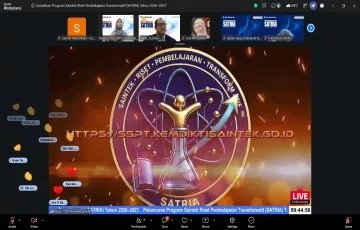
The program was officially launched online on Tuesday (Nov. 3, 2026), attracting thousands of participants from universities and Regional Offices of Higher Education Services (LLDIKTI) Regions I–XVII across Indonesia.
SATRIA is a strategic government initiative aimed at promoting the development and implementation of research-based transformative learning models at the course level. The program is designed to strengthen lecturers’ capacity to develop innovative learning approaches that are adaptive, grounded in empirical evidence, and focused on improving the quality of teaching and learning outcomes.
Kemdiktisaintek Director of Transformative Learning Strategies and Systems Ardi Findyartini said universities played a crucial role in producing highly skilled and innovative human resources capable of making meaningful contributions to national development. He noted that advances in science and technology, coupled with changing societal needs, required universities to continuously strengthen the relevance and quality of their learning processes.
Ardi emphasized that transforming higher education could not be achieved solely through curriculum revisions at the study program level or the adoption of educational technologies. Instead, transformation must be reflected directly in students’ learning experiences in every course.
Through transformative learning approaches, students are expected to develop critical thinking skills, reflect on their experiences and existing knowledge, build new perspectives, and apply their competencies to address real-world challenges in society.
This approach is also aligned with the government’s Kampus Berdampak (Impactful Campus) policy, which positions universities not merely as institutions that produce graduates but also as centers for knowledge development, innovation, and solutions to societal challenges.
Ardi further explained that SATRIA had three main objectives: strengthening lecturers’ readiness and capacity to transform teaching and learning; developing transformative learning models through systematic research at the course level; and promoting the dissemination of innovations through scientific publications, reference books, learning materials, and documented best practices.
Under the program, research funding of up to Rp200 million, including taxes, will be available for each proposal. The amount awarded will depend on the proposed research needs, budget justification, and overall proposal quality. Funding will be disbursed in two stages, with 70 percent allocated in the first phase and the remaining 30 percent in the second, in accordance with the established procedures.
Meanwhile, LPDP Director of Research Facilitation Ayom Widipaminto reaffirmed the agency’s commitment to supporting SATRIA through funding as part of broader efforts to strengthen Indonesia’s higher education research and innovation ecosystem.
Ayom said funding from the Endowment Fund for Research was expected to encourage the development of innovative learning approaches relevant to technological advances, including the use of artificial intelligence (AI) and learning management systems (LMS).
He added that SATRIA was scheduled to run for two years, with a total funding allocation of Rp7 billion. The funding is expected to enable lecturers to develop learning innovations that go beyond conceptual frameworks and can be implemented and put to practical use.
The program is open to lecturers at universities under Kemdiktisaintek, subject to the applicable requirements. Expected outputs include transformative learning models that have been implemented and tested, scientific articles published in reputable journals, ISBN-registered reference books, implementation documentation videos, learning materials, and intellectual property rights.
According to the implementation schedule, research activities will run from December 2026 to September 2027. The process will include proposal selection, the announcement of funding recipients, contract signing, and technical guidance sessions. Throughout the program, Kemdiktisaintek will also conduct regular monitoring, mentoring, and evaluation.
Through SATRIA 2026–2027, Kemdiktisaintek and LPDP aim to foster a stronger culture of research-based learning innovation across Indonesian universities. The resulting outputs are expected to go beyond administrative requirements, improving students’ learning experiences and making a sustainable contribution to the transformation of Indonesia’s higher education sector.