




EduAsiaNews, Jakarta – Batavia Team of Universitas Negeri Jakarta (UNJ) continues to develop innovations in the automotive sector through research, energy-efficient vehicle development, education, competitions, and community service. Since its establishment in 2012, this student organization has provided a platform, particularly for students of the Faculty of Engineering (FT) at UNJ, to hone their technical capabilities while developing teamwork and management skills.
General Manager of Batavia Team UNJ, Reinhart Janssen Octario, a student of the Undergraduate Mechanical Engineering Education Study Program at the Faculty of Engineering, UNJ, said that Batavia Team was initially established to provide a platform for students interested in the automotive field.
“When it was first established, there was a desire to create a platform for UNJ students, particularly those from the Faculty of Engineering, who have an interest in the automotive sector, enabling them to learn, conduct research, and directly develop innovations,” Reinhart said in an online interview with UNJ Public Relations on Friday (August 28, 2026).
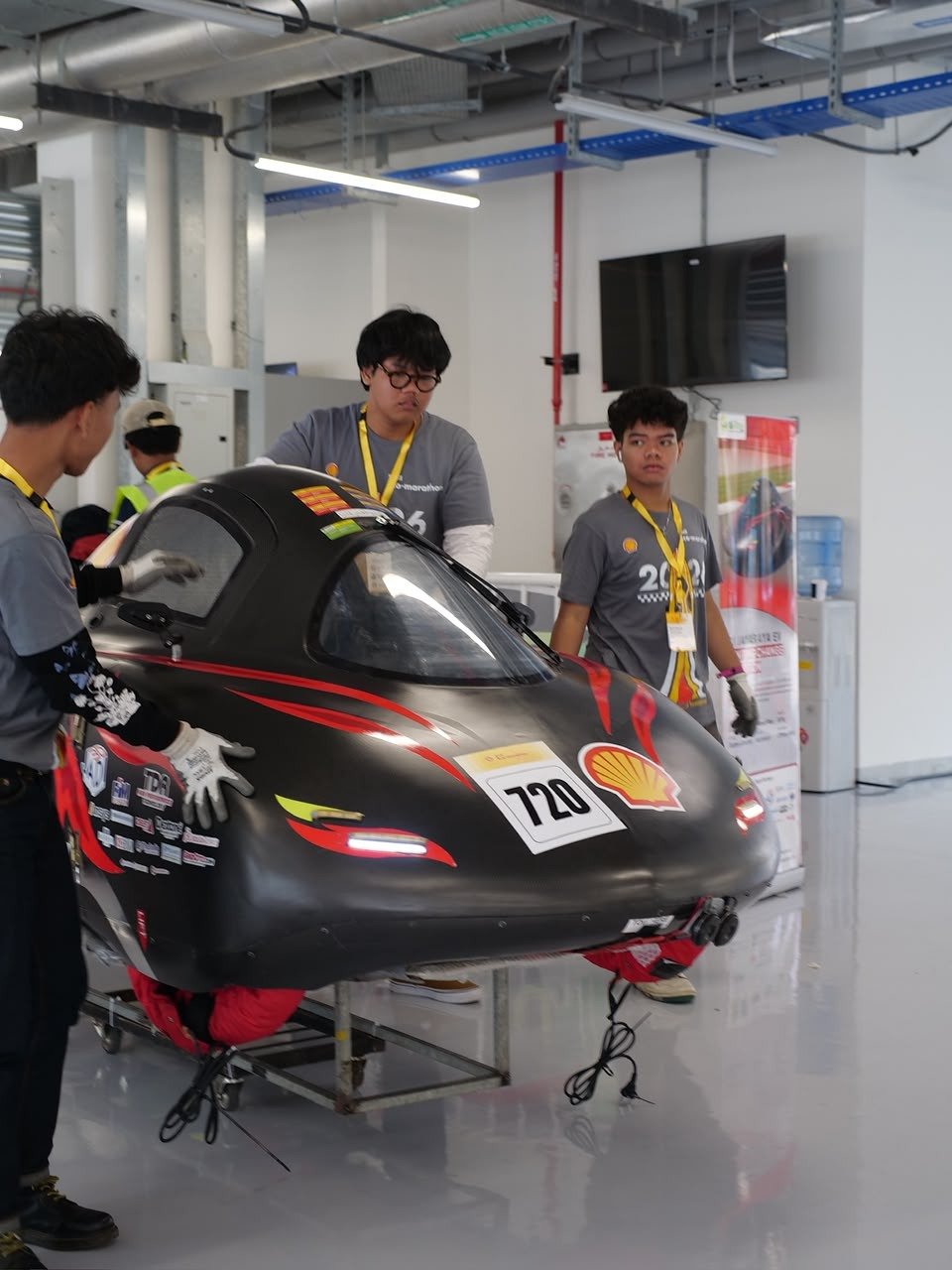
As it has evolved, Batavia Team has focused its activities on developing energy-efficient vehicles. The results of its research and innovations are not only applied to vehicle development but are also tested through various national and international competitions.
Currently, Batavia Team has 29 active members, with each management term lasting one year. The members are divided into two main areas, namely Technical and Non-Technical, which have different but complementary roles in implementing programs and developing the team.
Active in Competitions and Showcasing Innovation
Competitions have become an important part of Batavia Team’s journey. Each year, the team participates in various competitions to test the results of research and vehicle development carried out by its members.
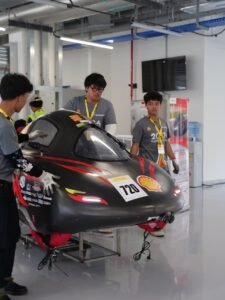
At the national level, Batavia Team participates in the Kontes Mobil Hemat Energi (KMHE), or Energy-Efficient Vehicle Contest. At the international level, the team participates in the Shell Eco-marathon, a competition that challenges participants to develop vehicles with high energy efficiency.
In addition to competitions, Batavia Team actively showcases its innovations through various automotive exhibitions, including the Gaikindo Indonesia International Auto Show (GIIAS), Indonesia International Motor Show (IIMS), and EV Indonesia at JIExpo Kemayoran.
Batavia Team’s activities are also aimed at strengthening the knowledge and skills of the younger generation. In 2018, for example, the team organized a Coaching Clinic at SMK PB Sudirman and a Stadium Generale under the theme of innovative and creative youth.
The educational program continued in 2022 through a Coaching Clinic at SMKN 26 Jakarta under the theme “Welcoming the Era of Electric Vehicle.” In 2025, Batavia Team conducted a Contextual Teaching and Learning program entitled “Composite Materials in Automotive for Energy Efficient Vehicles” at SMKN 34 Jakarta.
Through these activities, students not only gain an understanding of concepts and theories but also have the opportunity to learn about the practical application of technology through hands-on activities in the automotive field.
Contributing through Community Service
Batavia Team’s journey extends beyond competitions and technological development. Community service is also an integral part of the organization’s activities.
In 2020 and 2021, Batavia Team conducted community service activities at an orphanage. In 2021, the activity focused on understanding and preventing premarital sexual activity. In the same year, Batavia Team also organized a National Seminar entitled “The Implementation of Composite in Replacing Metal as the Innovative Material.”
In 2022, Batavia Team organized a “Free Motor Vehicle Emissions Testing” program at the UNJ campus in collaboration with the Jakarta Provincial Environmental Agency. A similar activity was conducted again in 2025 as part of efforts to raise public awareness of the importance of maintaining environmental quality.
Meanwhile, in 2023, Batavia Team served as a speaker at a talk show organized by the Indonesian Motor Association (Ikatan Motor Indonesia) during IIMS 2023 at JIExpo Kemayoran. In the same year, Batavia Team also organized a National Seminar entitled “Empowerment of Youth: Transform to Low-Carbon Mobility for Future Sustainability,” involving 13 vocational high schools across the Greater Jakarta area.
These activities demonstrate Batavia Team’s efforts to expand the scope of student contributions, not only through technological innovation but also through education and by increasing young people’s awareness of environmental issues and low-carbon mobility.
Focus on Electric Vehicles
The development of electric vehicles has become one of Batavia Team’s key areas of focus in recent years. In 2024, the team launched a series of activities by organizing a panel discussion with Spora EV and the Ministry of Energy and Mineral Resources (ESDM) under the theme “Heading the Future: Advancement in Electric Vehicle for a Sustainable Energy.”
The event was attended by 130 participants from various higher education institutions across the Greater Jakarta area. In the same year, Batavia Team also participated as both a speaker and exhibitor at EV Indonesia 2024 at JIExpo Kemayoran.
Entering 2026, Batavia Team’s electric vehicle development efforts have focused on two key aspects: a more efficient battery system and the use of a lighter chassis. Both aspects are considered important because they affect energy efficiency and vehicle performance.
“For the development of electric vehicles, Batavia Team is currently focusing on developing a more efficient battery system and a lighter chassis in the near future,” Reinhart said.
In addition to electric vehicles, Batavia Team is also developing students’ capabilities in the use of digital technologies. In 2026, the team organized Applied Contextual Technology in 3D under the theme “Integrating Digital Design, Prototyping, and Innovation through Additive Manufacturing Technology.”
The activity introduced a series of processes, ranging from three-dimensional design using digital design software and simulation to prototyping and demonstrations of object printing using additive manufacturing technology.
Batavia Team also organized Innovation Growth in Engineering, consisting of a seminar and workshop on machine learning in collaboration with Braincore under the theme “Exploring the Potential of Intelligent Technologies.” The activity formed part of the team’s efforts to expand students’ competencies in integrating digital technologies with engineering.
Learning from the Process and Competitions
For Reinhart, joining Batavia Team has provided learning experiences that go beyond technical skills in the automotive sector. Organizational activities and competitions have also helped develop his time-management, communication, teamwork, and problem-solving skills.
“Here, I am not only learning how to develop energy-efficient vehicles, but also how to manage my time effectively, work as part of a team, communicate, face various challenges, and solve problems together,” he said.
According to Reinhart, achievements in competitions cannot be attained instantly. The process requires consistency, hard work, sacrifice, and collaboration among all team members.
“Success does not come instantly. It requires hard work, consistency, sacrifice, and teamwork from all members of the team,” he said.
Despite their involvement in various activities, education remains the priority for Batavia Team members. Technical members generally attend lectures from morning until midday before continuing their research and vehicle development activities in the afternoon.
Meanwhile, Non-Technical members adjust their organizational activities to their academic schedules. Various organizational tasks and assignments are completed at the Batavia Team Secretariat from Monday to Friday, from 8:00 a.m. to 4:00 p.m. Western Indonesia Time (WIB), while remaining aligned with each member’s academic commitments.
UNJ Support and Future Targets
Reinhart expressed his appreciation for UNJ’s support for Batavia Team’s activities, both in competitions and non-competition programs. Such support includes facilitating research and vehicle development.
According to him, the university’s support also motivates students to continue developing innovations and representing UNJ in various competitions and events.
“This support is one of the forms of motivation for us to continue growing, creating, and bringing pride to Universitas Negeri Jakarta,” he said.
Going forward, Batavia Team aims to continue serving as a platform for UNJ students’ development in academic excellence, technology, leadership, and teamwork. The team is also committed to improving the quality of its research and achieving the best possible results in the various energy-efficient vehicle competitions in which it participates.
Batavia Team UNJ’s Track Record of Achievements
Batavia Team’s consistency in developing energy-efficient vehicles is reflected in the various achievements it has earned since 2014. Among them are:
- 1st Place, National Gasoline Prototype at the 2014 Kontes Mobil Hemat Energi (KMHE) in Surabaya, achieving 646 km/liter.
- 3rd Place in Asia at the 2015 Shell Eco-marathon in Manila, the Philippines.
- 3rd Place, National Level at KMHE 2015 in Malang.
- 1st Place, Electric Prototype at KMHE 2016 in Yogyakarta, achieving 321 km/kWh.
- 2nd Place, Gasoline Prototype at KMHE 2016 in Yogyakarta, achieving 572 km/liter.
- 3rd Place, Electric Prototype at KMHE 2017 in Surabaya, achieving 344 km/kWh.
- 5th Place, Electric Prototype at Shell Eco-marathon Asia 2018 in Changi, Singapore, achieving 256 km/kWh.
- 8th Place at Shell Eco-marathon Asia 2018 in Changi, Singapore, achieving 149 km/liter.
- 2nd Place at KMHE 2018 in Padang, achieving 469 km/liter.
- 1st Place, Electric Prototype at KMHE 2019 in Malang, achieving 258 km/kWh.
- 3rd Place, Gasoline Prototype at KMHE 2019 in Malang, achieving 535 km/liter.
- 1st Place, Prototype Category – Body and Chassis Design Criteria at KMHE 2020 in Depok.
- 1st Place, Prototype Category – Steering and Braking System Criteria at KMHE 2020 in Depok.
- 2nd Place, Electric Prototype at KMHE 2021 in Surabaya, achieving 428 km/kWh.
- 3rd Place, Electric Prototype at KMHE 2022 in Surabaya, achieving 395 km/kWh.
- 3rd Place, Gasoline Prototype at KMHE 2022 in Surabaya, achieving 607 km/liter.
- 2nd Place in Asia, Electric Prototype at the 2022 Shell Eco-marathon Asia Pacific and Middle East in Lombok, Indonesia, achieving 528 km/kWh.
- 5th Place in Asia, Urban Gasoline at the 2022 Shell Eco-marathon Asia Pacific and Middle East in Lombok, achieving 177 km/liter.
- 5th Place in Asia, Electric Prototype at the 2023 Shell Eco-marathon Asia Pacific and the Middle East in Lombok, achieving 549 km/kWh.
- 4th Place, National Electric Prototype at KMHE 2023 in Ancol, Jakarta, achieving 688.32 km/kWh.
- 4th Place, National Urban Gasoline at KMHE 2023 in Ancol, Jakarta, achieving 242.5 km/liter.
- 4th Place in Asia, Urban Gasoline at the 2024 Shell Eco-marathon Asia Pacific and the Middle East in Lombok, achieving 195 km/liter.
- 1st Place in Asia, Virtual Off-track – Simulate to Innovate Category at the 2024 Shell Eco-marathon Asia Pacific and the Middle East in Lombok.
- 2nd Place, Gasoline Prototype at KMHE 2024 in Ancol, Jakarta, achieving 554.76 km/liter.
- 7th Place, Electric Urban at KMHE 2024 in Ancol, Jakarta, achieving 150.97 km/kWh.
- 1st Place in Asia, Virtual Off-track – Data and Telemetry Category at the 2025 Shell Eco-marathon Asia Pacific and the Middle East in Doha, Qatar.
- 4th Place in Asia, Gasoline Prototype at the 2025 Shell Eco-marathon Asia Pacific and the Middle East in Doha, Qatar, achieving 600 km/liter.
- 3rd Place, Gasoline Prototype at KMHE 2025 at Universitas Jember, achieving 508.635 km/liter.
- 4th Place, Electric Urban at KMHE 2025 at Universitas Jember, achieving 197.571 km/kWh.
- 5th Place in Asia, Electric Urban at Shell Eco-marathon Qatar 2026 in Doha, Qatar, achieving 180 km/kWh.
These achievements reflect Batavia Team’s journey in advancing energy-efficient vehicle technology over the years. By combining research, competitions, education, and community service, Batavia Team UNJ continues to strengthen its role as a platform for student innovation while contributing to efforts to advance more efficient and sustainable automotive technology and mobility.