




EduAsiaNews, Dumai – Access to clean water remains a challenge for some communities in areas where peat water is used as a primary water source. This condition is also experienced by residents of Bukit Timah Urban Village, Dumai Selatan District, Dumai City, Riau Province.
In response to this need, a Community Service team from the Analytical Chemistry Scientific Group, Faculty of Mathematics and Natural Sciences (FMIPA), Institut Teknologi Bandung (ITB), introduced a clean water provision technology based on slow sand filtration.
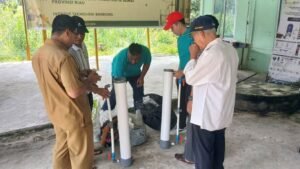
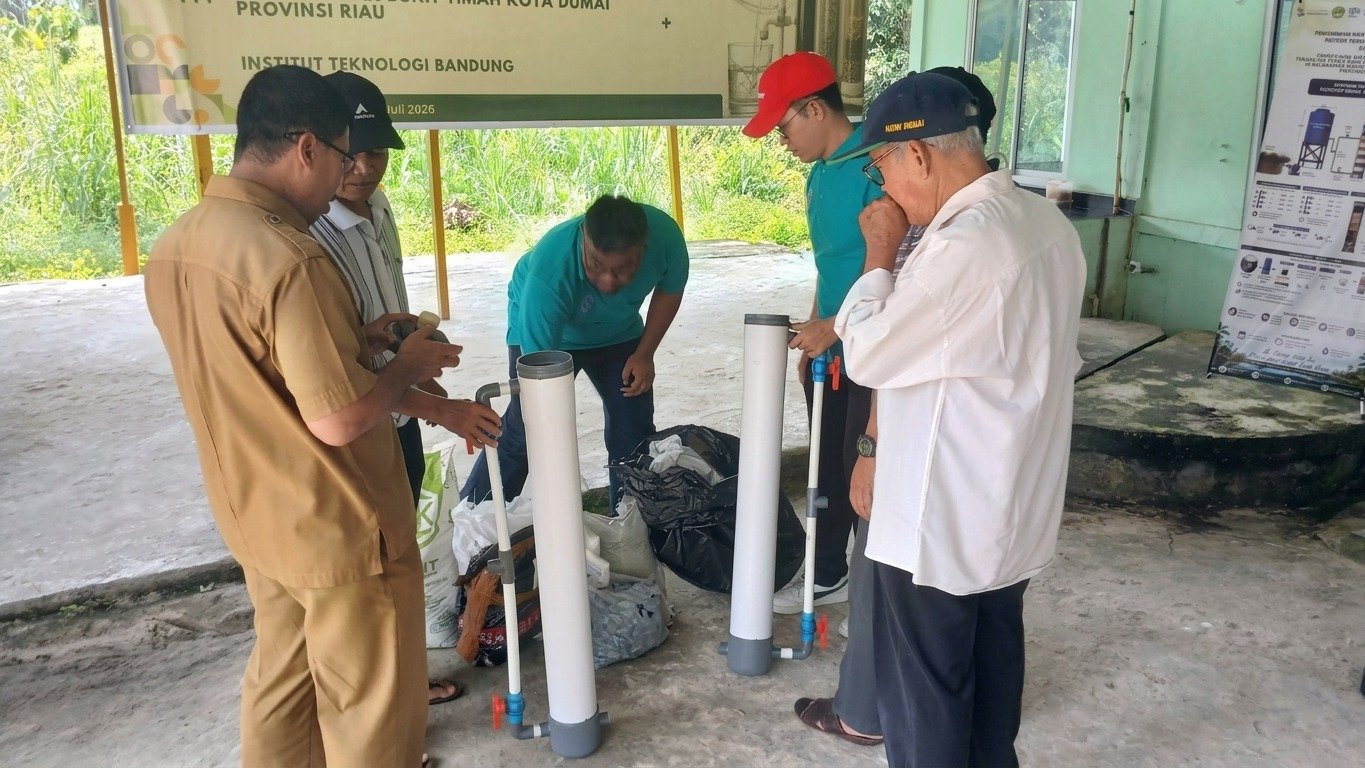
The activity, held on Monday (July 27, 2026), at Al-Furqan Mosque in Bukit Timah Urban Village, was part of the 2026 ITB Bottom-Up Community Service Program.
The peat water used by the local community has distinctive characteristics, including a high organic matter content that can affect its physical quality. Although various water treatment technologies have been developed, some require relatively high operating costs, additional chemicals, and specialized technical skills.
Therefore, the ITB team introduced a filtration technology that is simple, economical, and can be independently operated by the community. The system utilizes several filtration media, including gravel, sand, activated carbon, and zeolite, to help improve water quality.
In addition to installing the filtration system, the team, comprising faculty members, students, and graduate alumni of the Chemistry Study Program at FMIPA ITB, also provided training for local residents. Participants were equipped with knowledge about the composition of the materials, equipment operation, and maintenance to ensure that the technology could be utilized sustainably.
The activity also involved local residents and youth organizations. Dumai Selatan District Head Aldi Lubis, S.Sos., M.IP., expressed his appreciation for the implementation of the program and hoped that similar technologies could be applied more broadly to benefit communities in other areas.
Chair of the Analytical Chemistry Scientific Group at FMIPA ITB and Head of the organizing team, Prof. Ir. Muhammad Ali Zulfikar, M.Si., Ph.D., IPM., ASEAN Eng., said that slow sand filtration technology could serve as an alternative approach to peat water treatment.
“The composition of the materials used has undergone laboratory testing and was designed to be implemented in a simple manner by the community. In addition, residents were provided with guidelines on how to measure the appropriate material composition and maintain the filtration system,” he said.
Through this initiative, ITB not only provided a science- and technology-based solution but also promoted community self-reliance in managing local water resources. This approach is expected to support access to more suitable water for daily needs while offering a sustainable solution that can be replicated in other communities.
The Community Service activity was supported by the Directorate of Community Service and Expertise Services (DPMK) ITB, the Analytical Chemistry Laboratory of FMIPA ITB, and the Department of Chemistry, Faculty of Mathematics and Natural Sciences, Universitas Riau.