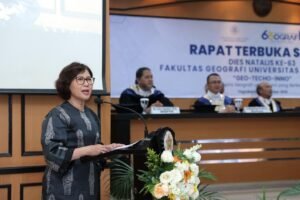





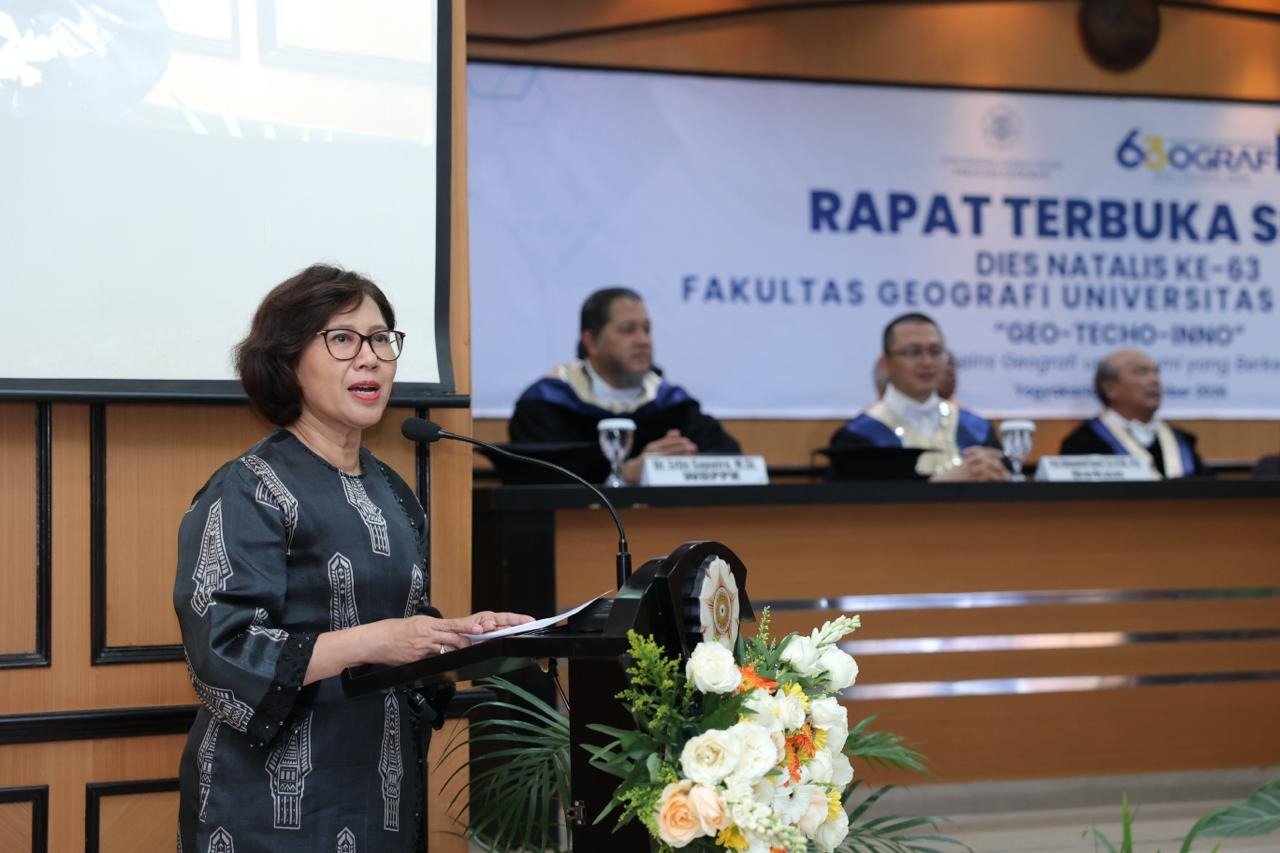
EduAsiaNews, Yogyakarta – Faculty of Geography at Universitas Gadjah Mada (UGM) has reached its 63rd anniversary. Over more than six decades, the Faculty has produced graduates who have contributed to the advancement of knowledge about the Earth and the complex interactions between humans and their environment. It has also promoted public education and literacy to foster ecological awareness and values of environmental sustainability.
UGM Rector Prof. Dr. Ova Emilia, Ph.D., stated that the Faculty of Geography plays an important role in safeguarding the sustainability of the Earth as an interconnected system. She also expressed her appreciation to the Faculty of Geography community for its contributions to advancing knowledge about the Earth and the reciprocal relationship between humans and their environment, as well as for supporting the development of Universitas Gadjah Mada.
Ova encouraged the Faculty of Geography to continue conducting solution-oriented research that emphasizes innovation and the utilization of cutting-edge technology. She also called for stronger connections between science and development policy, as well as greater interdisciplinary collaboration. Equally important, she emphasized the need to enhance public education and literacy to foster ecological awareness and promote values of environmental sustainability.
“I believe that continuous innovation and collaboration have become the foundation for the development of educational, research, and community service programs at the Faculty of Geography,” she said during the culmination of the Faculty’s 63rd Anniversary celebration on Tuesday (September 1) at the Merapi Auditorium.
On the occasion, Ova also highlighted the Faculty’s various research initiatives as a testament to its dedication to delivering tangible contributions and solutions to environmental challenges. These include research on water resource assessment, waste management to reduce environmental pollution, studies on climate change and greenhouse gas emissions, contributions to various policy designs, and efforts to promote sustainable regional development.
“Hopefully, this year’s Dies Natalis celebration will inspire renewed enthusiasm among all of us, particularly the Faculty’s academic community, to position geography as a key foundation for the development of technologies and innovations capable of addressing a wide range of environmental challenges,” she said.
Meanwhile, Dean of the Faculty of Geography, Prof. Muhammad Kamal, S.Si., M.GIS., Ph.D., outlined several achievements made by the Faculty during the 2021–2026 period in his annual report. In the areas of academics and student affairs, all study programs at the Faculty of Geography successfully obtained national and international accreditation. The Faculty also strengthened its double-degree partnerships with strategic overseas partners and saw an increase in the number of international students.
In his scientific oration entitled “The Geographical Intelligence: Weaving Intelligence toward Spatial Wisdom for the Sustainability of the Earth,” Dr. Sc. Sanjiwana Arjasakusuma, a lecturer in the Department of Geographic Information Science at the UGM Faculty of Geography, emphasized that geographical intelligence is not merely about developing spatial intelligence, but also about cultivating spatial wisdom—an awareness of wisdom that maintains a balanced harmony among humans, technology, and the Earth.
Through this paradigm, geographical intelligence is positioned as a moral, intellectual, and practical guide for national and global collaboration in guiding civilization toward sustainability.
“The most valuable form of intelligence is not the intelligence that enables us to dominate the Earth, but the intelligence that allows us to wisely care for it and ensure the sustainability of life for every living being on it,” he explained.