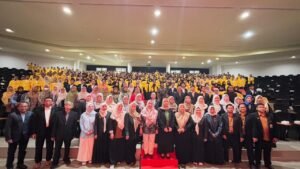





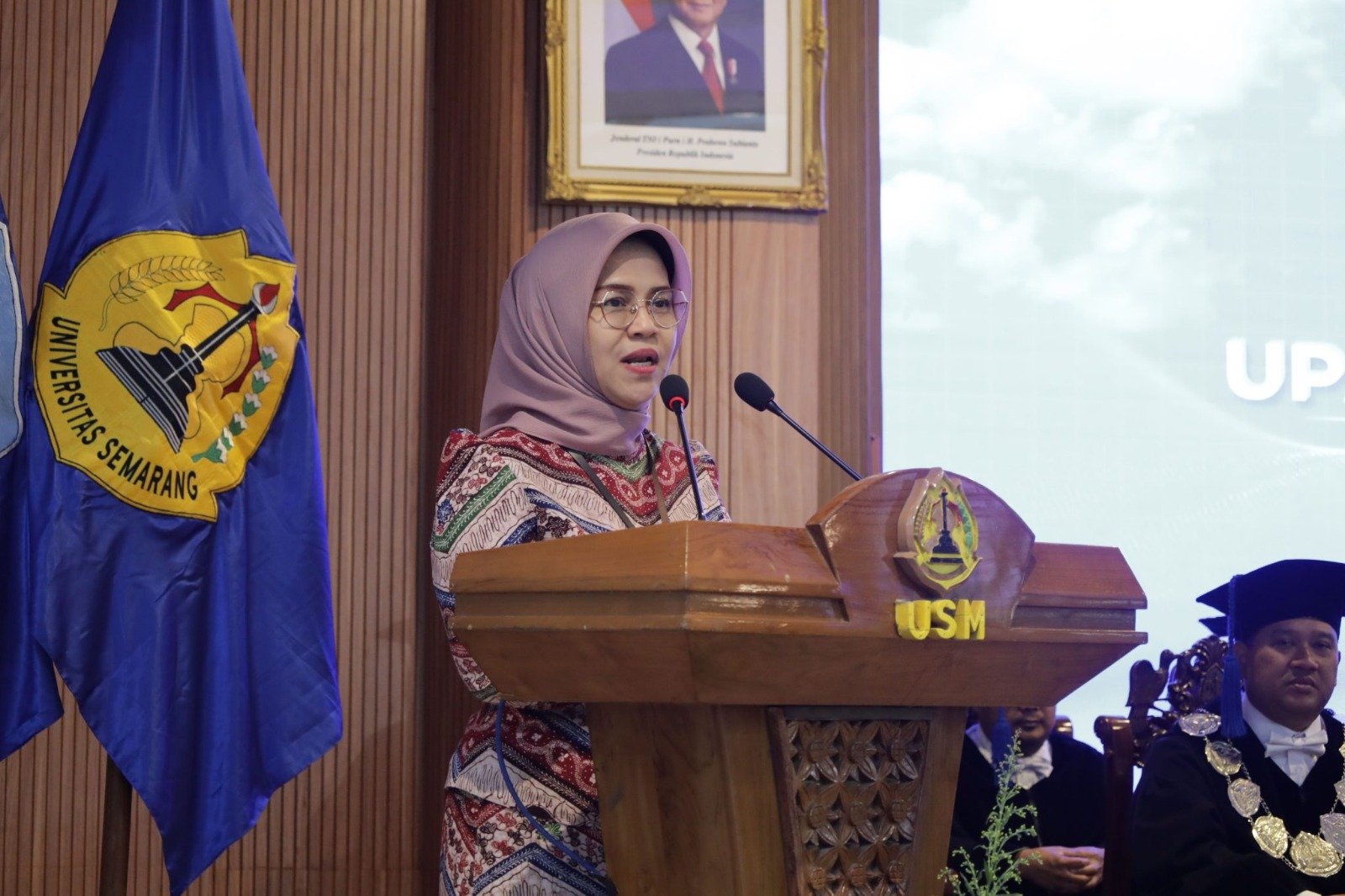
EduAsiaNews, Semarang — Head of the Higher Education Service Institution (LLDIKTI) Region VI Central Java, Prof. Dr. Ir. Aisyah Endah Palupi, M.Pd., attended the 77th Graduation Ceremony of the University of Semarang (USM). On the occasion, she congratulated the graduates while highlighting the importance of graduate preparedness in facing competition in the workforce.
Prof. Aisyah noted that higher education institutions, both public and private, produce a significant number of graduates. Nevertheless, opportunities to compete for employment remain open to graduates who possess adequate competencies.
According to current graduate data, the University of Semarang (USM) has produced alumni, most of whom have entered the workforce or established their own businesses. A total of 63.28% of alumni are employed, 26.60% are engaged in business or entrepreneurship, 8.84% are seeking employment, and 1.28% are pursuing further studies. When employed and entrepreneurial alumni are categorized as graduates actively engaged in economic activities, 1,892 alumni, or approximately 90%, are already working or running businesses.
Among alumni who are active in the workforce, 68% work for private companies, 9% work for government institutions or state-owned enterprises (SOEs), 15% run their own businesses, 3% work for regionally owned enterprises (ROEs), and 4% work for non-governmental organizations (NGOs) or nonprofit organizations. The remaining 1% work for other types of organizations. In terms of income, the average earnings of alumni are recorded at above the regional minimum wage. These figures indicate that USM graduates have been absorbed into various sectors and demonstrate diverse forms of economic activity.
The data further demonstrate that USM graduates have achieved a strong level of workforce absorption, with alumni working across a wide range of sectors, including private companies, government institutions, businesses, and nonprofit organizations.
According to Prof. Aisyah, this situation must continue to receive attention in light of existing mismatches in the labor market. Horizontal mismatch occurs when an individual works in a field unrelated to their field of study, while vertical mismatch occurs when the job or income obtained does not correspond to their level of education.
“An academic degree remains important, but a degree alone is not enough. The world needs people who are able to adapt, be more creative, and create value amid changes in the labor market,” she said.
In the digital era, graduates need to continuously learn and enhance their competencies, including mastering technology and artificial intelligence (AI). Communication and adaptability skills also need to be continuously developed as essential preparation for entering the workforce.
Prof. Aisyah also encouraged graduates not merely to become job seekers, but to create opportunities and employment. Experiences gained during university, such as participating in organizations, conducting research with lecturers, and contributing to solutions for community challenges, should be developed into portfolios as evidence of competencies and achievements.
Furthermore, the knowledge acquired in higher education is expected to be transformed into meaningful work and generate benefits for society.
“Indonesia does not lack people with academic degrees. What Indonesia needs more are educated people who are capable of turning knowledge into solutions,” she said.
Prof. Aisyah expressed hope that the graduation ceremony would serve as a starting point for graduates to continuously strengthen their competencies, create opportunities, and become resilient, adaptable, and ethical individuals who make a meaningful impact.
“Do not wait for the future to come to you. Instead, prepare your competencies, create opportunities, and take part in shaping your own future,” she said.