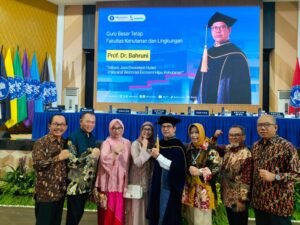





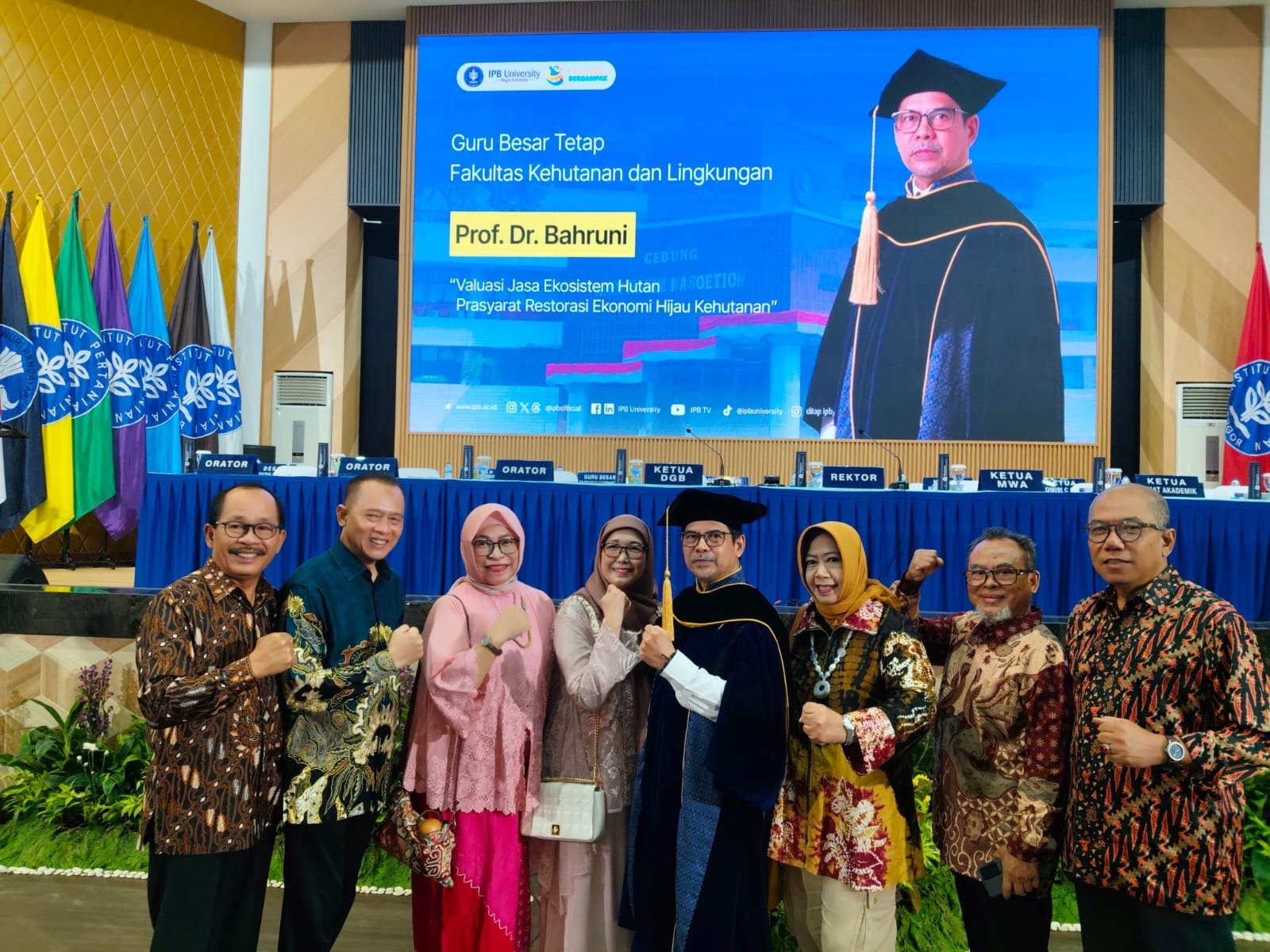
EduAsiaNews, Bogor — Professor Bahruni, a Permanent Professor at the Faculty of Forestry and Environment, IPB University, has called for the valuation of forest ecosystem services to become an integral part of economic policy, spatial planning, and sustainable forest management.
“Forest ecosystems constitute both natural capital and ecological infrastructure that underpin the economy and human well-being. Therefore, ecosystem service valuation is a prerequisite for implementing the restoration of a green forestry economy,” Bahruni said during his Professorial Scientific Oration at the Andi Hakim Nasution Auditorium in Bogor on Saturday (August 22, 2026).
In his oration, titled “Valuation of Forest Ecosystem Services: A Prerequisite for Restoring a Green Forestry Economy,” Bahruni explained that the contribution of forests extends beyond timber and non-timber forest products. It also encompasses flood regulation, clean water provision, carbon storage, habitat protection, cultural values, and the preservation of natural assets for future generations.
According to Bahruni, these various ecological benefits are not yet fully reflected in market transactions and economic calculations. As a result, the costs of environmental degradation are often shifted onto communities and public budgets.
“The absence of a price does not mean the absence of value. The public benefits provided by forest ecosystems are often overlooked because complete markets for them do not exist,” Bahruni said.
Therefore, Bahruni proposed the use of the Total Economic Value (TEV) framework to account for direct use values, indirect use values, option values, as well as existence and bequest values associated with forest ecosystems.
“Valuation is not intended to ‘sell’ nature or replace ethical considerations and intrinsic values, but rather to improve the completeness of information and clarify who benefits from and who bears the costs of a particular decision,” Bahruni said.
Bahruni cited the results of an ecosystem service valuation conducted in other-use areas (areal penggunaan lain/APL) in Sintang Regency, West Kalimantan. In 2020, the estimated stock value of the ecosystem services assessed reached IDR 26.126 trillion, while the potential annual flow of benefits was approximately IDR 7.292 trillion.
Projections through 2050 without intervention indicate that forest cover in the area could decline by nearly 59 percent. This condition could lead to reductions in timber production, water availability, carbon stocks, erosion protection, and non-timber forest products.
Bahruni said the analysis demonstrates that business profitability does not always align with the principles of a green economy. Under several research scenarios, converting forests into monoculture plantations could increase private profits while reducing regional value added and environmental services. By contrast, agroforestry generated the strongest green economic value under the assumptions of the study.
“Land use should prioritize open or degraded land, increase the productivity of existing cultivated land through agroforestry, and maintain forests with high total economic value. Forest conversion should be the last resort,” Bahruni said.
At the national level, Bahruni noted that approximately 14.98 million hectares, or 26.9 percent, of production forests are currently non-forested. When all forest functions are taken into account, the total area requiring restoration is estimated at 24 million hectares.
According to him, restoring such a vast area cannot rely solely on forest and land rehabilitation financed through the State Budget. Restoration must also be supported by private-sector and community investment, spatial and tenure certainty, strong institutions, market access, financing, and equitable benefit-sharing mechanisms.
Restoration strategies must also be tailored to the conditions of each area. Well-functioning forests should be maintained through sustainable forest management, reduced-impact logging, habitat protection, and income diversification through non-timber forest products, carbon, water, and nature-based tourism.
Meanwhile, natural regeneration should be strengthened in areas that remain forested but have been degraded. Open land and severely degraded areas can be restored through agroforestry by integrating forestry crops, fruit trees, spices, non-timber forest products, and commodities suited to ecological conditions and community needs.
“Green economic restoration is a bridge between ecological recovery and the transformation of the forestry economy. Investment can become a source of conservation funding when it is directed toward rebuilding natural capital and ensuring that economic benefits are distributed fairly among stakeholders,” Bahruni said.
The scientific oration summarized the findings of Bahruni’s research since 1993, particularly studies conducted during the 2018–2024 period in collaboration with students, academics, government institutions, the business sector, and development partners. Through this approach, ecosystem service valuation is expected to strengthen the basis for policymaking while revitalizing the role of the forestry sector in sustainable development.