




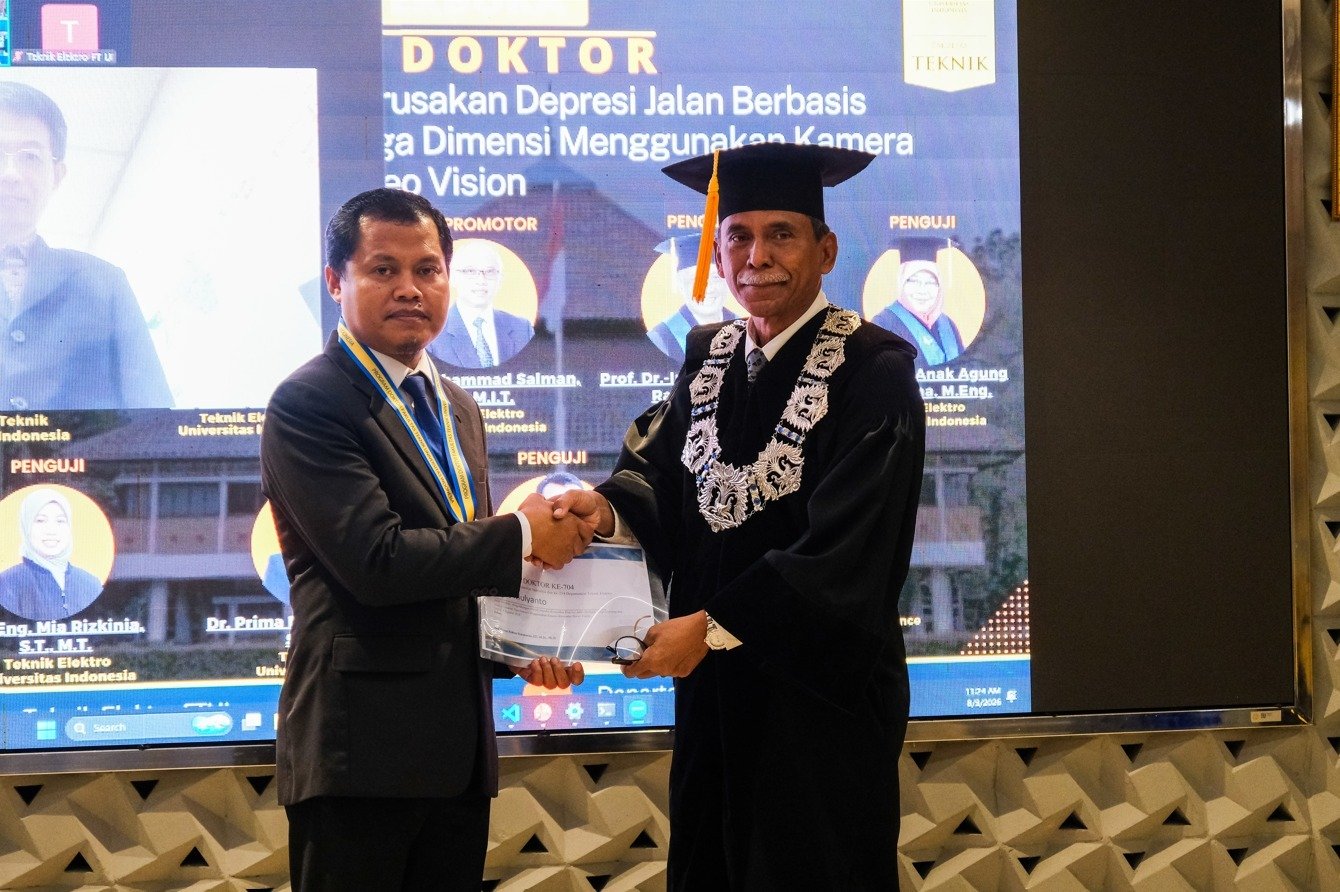
EduAsiaNews, Depok — With more than 47,000 kilometers of national road networks, Indonesia faces significant challenges in ensuring regular and high-quality infrastructure inspections. Addressing this challenge, Agus Mulyanto, a researcher at the Universitas Indonesia (UI) from the Electrical Engineering Study Program at the Faculty of Engineering (FTUI), has developed an AI-based method for inspecting road surface damage. He presented the innovation during his Open Doctoral Promotion Session on Tuesday (August 4).
In his dissertation, titled “Development of a Road Depression Inspection Method Based on Deep Learning and Three-Dimensional Geometric Analysis Using a Binocular Stereo Vision Camera,” Agus integrates deep learning, three-dimensional geometric analysis, and binocular stereo vision camera technology to automatically identify and measure road depressions and surface subsidence.
As a key innovation, the system developed by Agus is capable of capturing depth information from road surfaces, enabling more accurate damage detection. The use of a binocular stereo vision camera also allows the system to reconstruct road surfaces as three-dimensional models. By integrating this geometric information with AI, the system can analyze the characteristics of road surfaces in greater detail. This approach improves the objectivity of inspection results while reducing potential errors associated with conventional inspection methods.
The research findings demonstrate that AI-based methods combined with three-dimensional analysis have significant potential to support the transformation of road infrastructure maintenance systems in Indonesia. The technology could be utilized by policymakers, road operators, and the transportation industry to monitor road conditions more rapidly, accelerate damage detection, and help establish maintenance priorities based on more accurate data.
“I hope this research can contribute to the development of road inspection technology that utilizes artificial intelligence and three-dimensional analysis. Hopefully, this approach can support more effective infrastructure maintenance while contributing to the development of safer and more sustainable transportation systems,” Agus said, expressing his optimism about the potential impact of his research.
The research also received appreciation from FTUI Dean Prof. Kemas Ridwan Kurniawan, S.T., M.Sc., Ph.D., who said, “Agus Mulyanto’s research demonstrates how artificial intelligence can be harnessed to support the development of safer, more efficient, and more sustainable infrastructure. We hope the findings can be further developed to deliver broader benefits for national development.”
The doctoral promotion session was chaired by Prof. Dr.-Ing. Ir. Dalhar Susanto, with Prof. Dr. Ir. Riri Fitri Sari, M.M., M.Sc. serving as promoter and Dr. Ir. Muhammad Salman, S.T., M.I.T. as co-promoter. The examination panel comprised Prof. Dr.-Ing. Ir. Kalamullah Ramli, M.Eng.; Prof. Dr. Ir. Anak Agung Putri Ratna, M.Eng.; Dr. Prima Dewi Purnamasari, S.T., M.Sc.; Dr. Ruki Harwahyu, S.T., M.T., M.Sc.; and Prof. Ray Guang-Cheng of the National Taiwan University of Science and Technology, Taiwan.
Agus Mulyanto graduated with a Doctoral degree, achieving a perfect GPA of 4.00 and earning a very satisfactory distinction. His successful dissertation defense also made him the 214th graduate of the Department of Electrical Engineering and the 704th doctoral graduate of FTUI.
The research further underscores UI’s commitment to supporting academic contributions that produce innovative digital technology solutions to address national development challenges. By implementing an AI-based monitoring system, the research is expected not only to improve the efficiency of road inspection processes but also to contribute to safer, more reliable, and sustainable transportation infrastructure while accelerating the digital transformation of Indonesia’s transportation sector.