




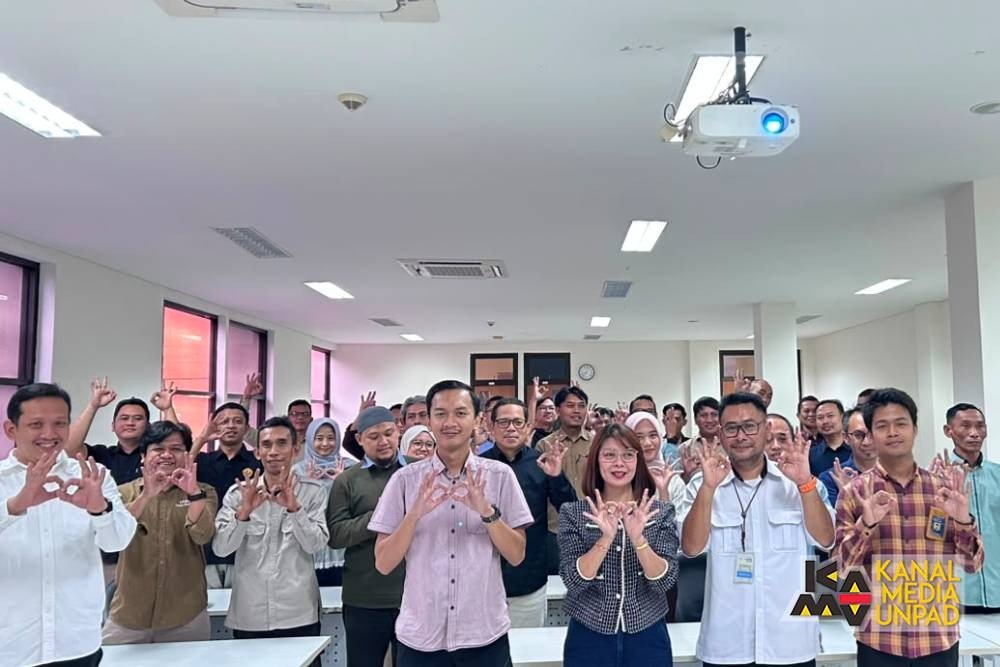
EduAsiaNews, Bandung — Universitas Padjadjaran (Unpad) is strengthening its commitment to delivering excellent, innovative, and inclusive education by enhancing the capacity of its education support staff. As part of its efforts to support digital transformation and the implementation of its micro-credential program, Unpad held Hybrid Classroom Management Training as part of the 2026 Information Technology Training Program (PBTI) at the Epsilon Building, Faculty of Economics and Business, Unpad Jatinangor Campus, on Tuesday (August 11, 2026).
“The training today is not simply another training session. It is a valuable opportunity for education support staff to engage in peer sharing, exchange experiences, and support one another in developing themselves and their organizations. We hope the sessions will generate discussions that lead to solutions and facilitate the sharing of best practices across work units,” said Rina Mariana, M.I.Kom., Head of Unpad’s Center for Knowledge and Skills Development for Education Support Staff.
Rina said the one-day training was attended by 38 participants from 18 faculties and schools and one directorate. Participants comprised hybrid classroom administrators and information technology teams who are being prepared to serve as champions, or key personnel, responsible for maintaining the quality and smooth delivery of hybrid learning within their respective units.
She added that the training also marked the launch of SOBAT (Solusi Bersama Unpad), a peer-learning and experience-sharing forum that will be held regularly under the principle of “from education support staff for education support staff.” The program is expected to provide a collaborative platform for addressing workplace challenges and improving service quality across Unpad.
Meanwhile, Dr. Imanudin Kudus, M.Si., Director of Human Resources and Career Development for Education Support Staff at Unpad, emphasized that digital transformation must continue to evolve adaptively in response to rapid technological developments.
He said hybrid learning and work systems have increasingly become essential, creating opportunities for collaboration with partners around the world.
“We cannot rely on just one tool. As an adaptive institution, we need to explore various alternatives to ensure that our institutional business processes continue to operate optimally and efficiently,” Imanudin said.
Imanudin also encouraged participants to become change agents within their respective work units by sharing technical knowledge related to digital application integration, configuration, and troubleshooting. He further emphasized the importance of cultivating a SOBAT workplace culture based on positive communication, collaboration, and a willingness to support one another in resolving workplace challenges.
The training forms part of Unpad’s efforts to support its micro-credential program, which seeks to expand access to high-quality global education through flexible and inclusive hybrid learning.
By strengthening the capacity of its education support staff, Unpad aims to establish hybrid classroom management that is increasingly independent, responsive, and aligned with international standards, supporting the university’s vision of building a sustainable future through excellent, innovative, and inclusive education.
(Released by: Directorate of Human Resources and Career Development for Education Support Staff, Unpad/R01)