




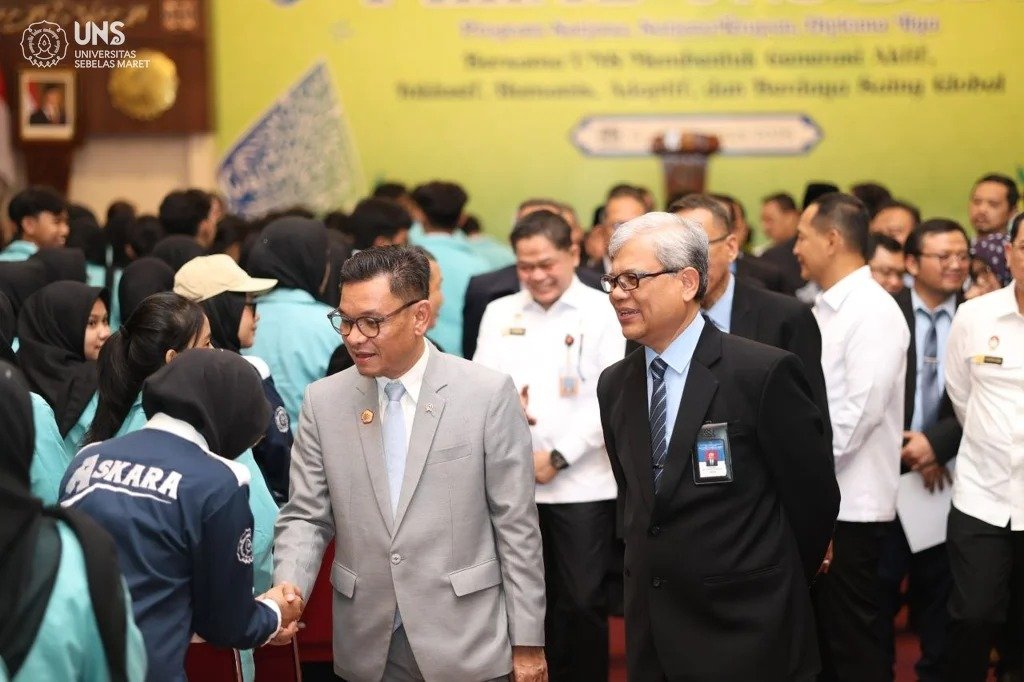
EduAsiaNews, Surakarta — Governor of the National Resilience Institute of the Republic of Indonesia (Lemhannas RI), Dr. H. TB. Ace Hasan Syadzily, M.Si., has emphasized the importance of strengthening nationalism, understanding geopolitical developments, developing digital literacy, and upholding integrity among new students of Universitas Sebelas Maret (UNS) Surakarta.
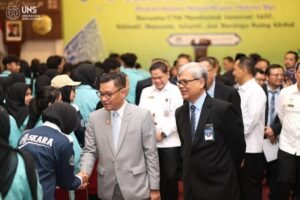
He delivered the message during a briefing session as part of UNS’s 2026 Campus Life Orientation Program for New Students (PKKMB), attended by 11,237 new students at the G.P.H. Haryo Mataram Auditorium, UNS, on Tuesday (August 11, 2026).
Ace Hasan Syadzily welcomed the new students and reminded them that entering university marks an important phase in their lives. Higher education, he said, should not be viewed merely as a means of obtaining knowledge and a degree, but also as an opportunity to build character, broaden perspectives, develop networks, and prepare for future leadership.
“University should be a space for developing critical thinking, reading skills, research capabilities, and the ability to analyze issues in depth,” he said.
He also urged students to understand global developments as the current strategic environment is becoming increasingly complex. Competition among countries now extends beyond geopolitics to include geoeconomics, technology, data control, cybersecurity, and influence in the digital sphere.
Regarding information technology and artificial intelligence (AI), he stressed that easier access to information must be accompanied by the ability to verify information and think critically.
“Technology should not make the depth of our thinking shallow. We must not surrender the entire thinking process to algorithms,” he said.
Understanding Indonesia’s Strategic Position
The Lemhannas governor also encouraged students to understand Indonesia’s strategic geographical position. Located between Asia and Australia and between the Indian and Pacific oceans, Indonesia has both significant opportunities and major responsibilities.
Indonesia’s abundant natural resources, he added, should be managed as a source of national strength capable of supporting development and strengthening the country’s position in global competition.
“If we want to understand and prevail in geopolitical competition, we must build national strength and confidence as a nation,” Ace Hasan Syadzily said.
He reminded students that history has shown how the wealth of the Indonesian archipelago attracted foreign powers. Therefore, young Indonesians must be able to understand global dynamics while ensuring that the country’s strategic resources generate maximum benefits for national interests.
He also highlighted Indonesia’s demographic bonus, emphasizing that today’s young generation will play a crucial role as the country approaches the centenary of its independence in 2045.
“A demographic bonus will only be a bonus if we are able to build the quality of our human resources. If we fail to do so, the demographic bonus could instead become a demographic burden,” he explained.
Students were therefore encouraged to use their university years to develop intellectual capacity, professionalism, networks, adaptability, and character.
He further reminded students that national resilience is not determined solely by military strength. Economic, technological, educational, health, energy, food, cultural, and information capabilities, as well as the quality of human resources, are equally important.
Globalization, he added, should not cause young people to lose their national identity. Students should develop global competencies while maintaining a strong sense of Indonesian identity.
Students as Future National Leaders
Ace Hasan Syadzily also encouraged students to become actively involved in student organizations, including student executive bodies, student associations, and other campus organizations. Such activities, he said, can serve as important spaces for learning leadership, resolving conflicts, building consensus, and collaborating with people from diverse backgrounds.
He also urged young people not to distance themselves from politics, which he described as an important arena in determining the nation’s direction.
“If politics is avoided by good people, the political space will be occupied by others,” he said.
Students were therefore encouraged to set ambitious goals and prepare themselves to become future leaders in various fields, including national leadership.
Five Messages for New Students
At the end of his briefing, the Lemhannas governor delivered five messages to the new UNS students:
Use the university years to build character, particularly national character, while broadening knowledge and networks.
Contribute to the nation from the beginning, without waiting until graduation to make an impact.
Become lifelong learners and remain open to acquiring new knowledge.
Develop critical thinking based on sound arguments, data, ethics, and responsibility.
Maintain integrity, because intelligence must be accompanied by integrity, nationalism, and moral courage.
“Intelligence without integrity can become a threat. But intelligence accompanied by integrity, nationalism, and moral courage can become a strength for the nation,” he stressed.
Ace Hasan Syadzily expressed hope that UNS would produce future Indonesian leaders who are intellectually capable, emotionally mature, strong in character, geopolitically aware, nationally minded, and equipped with the moral courage to help Indonesia become a developed, sovereign, and respected nation.
“Indonesia needs you. Indonesia’s future is in the hands of the younger generation. Let us prepare ourselves to realize Golden Indonesia 2045,” he concluded.
He also encouraged the new students to shift their perspective from simply asking “What will I gain from Indonesia?” to the more fundamental question: “What can I contribute to Indonesia?”