




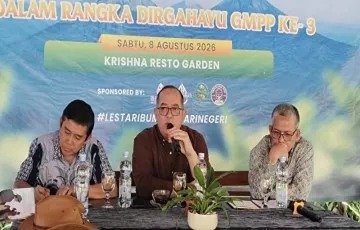
EduAsiaNews, Wonosobo – Rector of Universitas Pembangunan Nasional “Veteran” Jakarta (UPNVJ), Prof. Dr. Anter Venus, M.A., Comm., has stressed the importance of bridging the gap between elite-level policy concepts and public perceptions of the Merah Putih Village Cooperatives (Koperasi Desa Merah Putih/KDMP). He said the noble objective behind establishing KDMP as an instrument to build a strong and self-reliant village economy has yet to be fully understood by the public.
He made the remarks at the National Agriculture Workshop organized by the Gerakan Mantap Pilih Prabowo (GMPP) in collaboration with the Jaga Tunas Bumi (Jatubu) community organization at Krishna Garden Restaurant in Wonosobo, Central Java, on Saturday (August 8, 2026).
Held as part of GMPP’s third anniversary, the workshop discussed the implementation of the government’s priority programs, particularly the role of KDMP in strengthening the agricultural sector and the rural economy.
Prof. Anter Venus said the objectives of the Merah Putih Village Cooperatives were fundamentally ideal, as they are aligned with the nation’s vision of economic development oriented toward the interests of the people.
“The objectives of the Merah Putih Village Cooperatives are actually very ideal. They also represent the realization of the nation’s economic aspirations as stipulated in Article 33 of the 1945 Constitution,” Prof. Anter Venus said.
He noted that the key challenge is ensuring that the broader concept is fully understood by the public. The gap between policy-level ideas and public perceptions needs to be addressed so that communities understand the objectives, benefits, and strategic role of cooperatives in developing village economies.
The UPNVJ Rector explained that the establishment of the cooperatives is intended to create a strong, affordable, and self-reliant rural economic structure supported by adequate capital, sound governance, and strong networks.
“The establishment of these cooperatives is aimed at building a strong, affordable, and self-reliant village economy with strong capital, governance, and networks. This will certainly strengthen the people-centered economy in rural areas,” he said.
In the agricultural sector, strengthening cooperatives is also expected to improve the position of rural communities, including farmers, within the economic system. KDMP is encouraged to serve as a driver of the village economy while helping reduce farmers’ dependence on middlemen, who have often placed farmers in a weaker position in terms of financing and marketing their produce.
The strategic role of KDMP was also highlighted by Joao Mota, President Director of PT Agrinas Pangan Nusantara. He said the cooperatives should not be viewed merely as trading units similar to convenience stores.
According to Joao, the cooperatives represent a state instrument to support communities in developing the various economic potentials available in rural areas.
“These cooperatives represent the state’s presence in supporting rural communities in developing all sectors of the village economy—from agriculture, livestock and fisheries to MSMEs—so that they can become a self-reliant economic force for the welfare of the community,” Joao said.
He added that strengthening rural economies through cooperatives is also intended to create greater opportunities within rural economic spaces that have traditionally been dominated by large capital owners.
For Prof. Anter Venus, public understanding is an essential component of KDMP implementation. An ideal concept requires a shared understanding at the community level so that cooperatives are not perceived merely as places for commercial transactions, but rather as instruments for strengthening the people-centered economy in rural areas.
Therefore, efforts to bridge policy concepts and public perceptions are crucial to ensuring that the establishment of the Merah Putih Village Cooperatives can be translated into concrete efforts to strengthen self-reliant village economies with sound governance, strong networks, and tangible benefits for local communities.(www.upnvj.ac.id)