




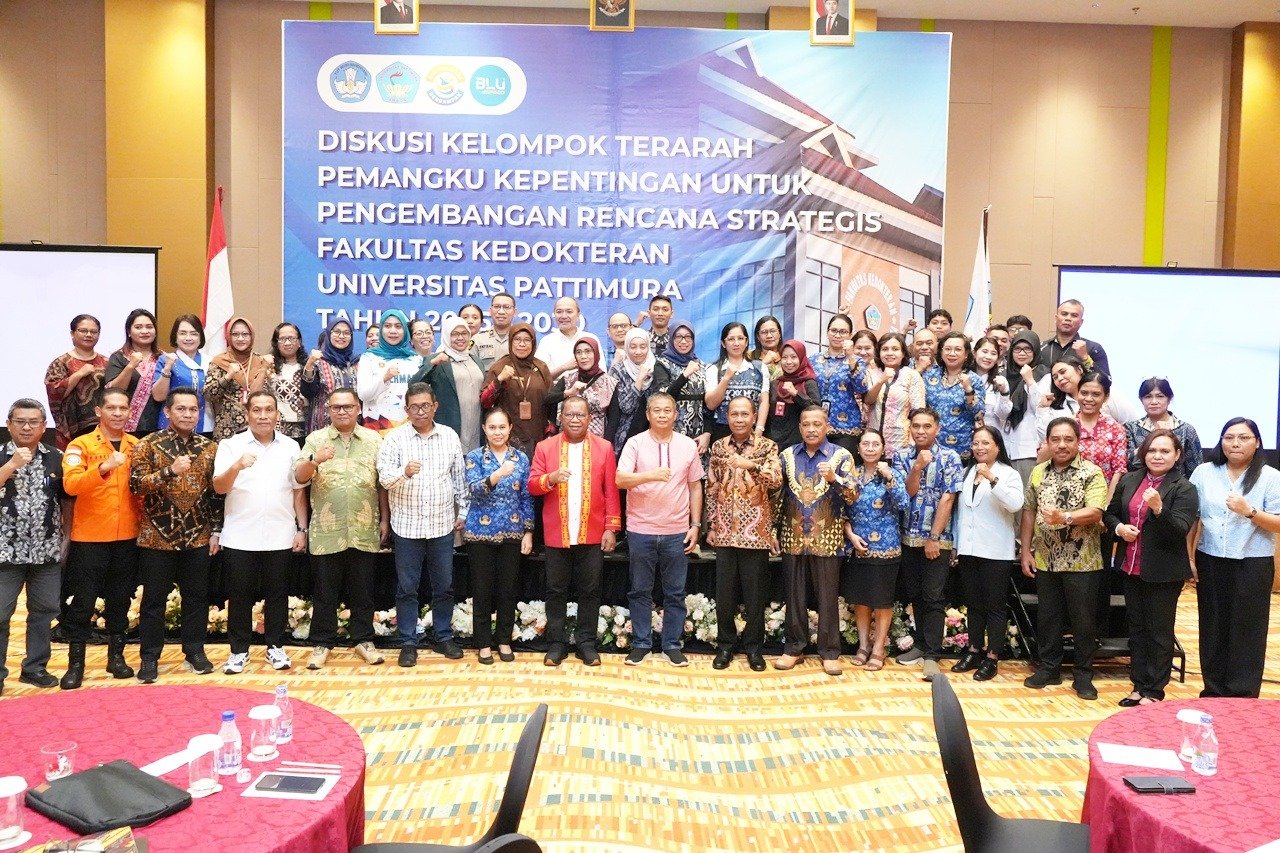
EduAsiaNews, Ambon – The Faculty of Medicine at Pattimura University held a Focus Group Discussion (FGD) titled “Stakeholder Focus Group Discussion for the Development of the 2026–2030 Strategic Plan of the Faculty of Medicine, Pattimura University” at Zest Hotel Ambon on Thursday (July 30). The event served as a strategic forum to gather input, ideas, and recommendations from a broad range of stakeholders in formulating the Faculty of Medicine’s development roadmap for the next five years.
The FGD was attended by Pattimura University Rector Prof. Dr. Fredy Leiwakabessy, M.Pd., university leaders, the Dean of the Faculty of Medicine and faculty administrators, representatives of provincial and district/city governments, health offices, hospitals and healthcare facilities, professional associations, alumni, faculty members, students, and partners of the Faculty of Medicine.
Opening the event, Prof. Dr. Fredy Leiwakabessy emphasized that the formulation of the 2026–2030 Strategic Plan represents a crucial opportunity for the Faculty of Medicine to evaluate its achievements while preparing its future direction amid the rapidly evolving landscape of medical education in Indonesia.
According to the Rector, the Indonesian government, through the Ministry of Health and the Ministry of Higher Education, Science, and Technology, continues to encourage an increase in the number of healthcare professionals by expanding medical schools at universities across the country. This development presents a significant challenge for all medical faculties to maintain educational quality amid the growing number of institutions offering medical education.
“The fundamental question is not only how to increase the number of graduates, but also how to ensure the quality of those graduates. Graduate quality is determined by the quality of student intake, the learning process, facilities and infrastructure, governance, as well as outcomes and their impact on society. These five aspects must become key considerations in formulating the Strategic Plan,” the Rector stated.
He also noted that the growing public interest in studying at the Faculty of Medicine has created additional challenges in maintaining educational quality. Although the ideal annual intake is approximately 150 students, the faculty has admitted between 175 and 200 students annually over the past five years. As a result, effective management is essential to preserve the quality of both academic instruction and professional medical training.
“This situation affects professional medical education. Limited teaching hospitals, clinical rotations, and specialist supervisors have extended students’ waiting periods before entering clinical training. Therefore, strengthening governance and strategic planning is essential to maintaining educational quality,” he added.
Meanwhile, the Dean of the Faculty of Medicine explained that the 2026–2030 Strategic Plan is being developed through a participatory approach involving a wide range of stakeholders.
“We organized this Focus Group Discussion to engage regional governments, health offices, healthcare providers, professional organizations, alumni, faculty members, students, and graduate employers. This forum enables us to reassess the Faculty’s achievements, both in terms of key performance indicators and flagship programs that have been implemented,” the Dean said.
According to the Dean, stakeholder participation is particularly important because the Faculty of Medicine at Pattimura University is the only public medical school in Maluku Province, producing the majority of physicians serving hospitals and community health centers across the province.
Through the FGD, the Faculty sought to evaluate how effectively its graduates address healthcare development challenges in Indonesia’s archipelagic regions. The evaluation focuses not only on the number of physicians produced but also on graduates’ contributions to improving healthcare services and public health outcomes.
The Dean also highlighted one of the Faculty’s flagship initiatives—the strengthening of an archipelagic-based Academic Health System through the development of a Rural Clinical School. The program is designed to provide students with clinical training experiences at regional hospitals and community health centers across various districts, better preparing them to serve remote island communities.
“We hope regional governments will strengthen collaboration by providing district hospitals as clinical training sites and offering opportunities for outstanding local students to pursue medical, dental, and specialist education at Pattimura University. Students from these regions are more likely to return and contribute to the development of their home communities,” the Dean explained.
The FGD began with a presentation of the draft 2026–2030 Strategic Plan by the Chair of the Strategic Planning Team, outlining the Faculty’s vision, mission, strategic objectives, performance indicators, and priority programs for the next five years.
The presentation was followed by an interactive discussion during which participants—including representatives from regional governments, health offices, hospitals, professional associations, alumni, faculty members, students, and graduate employers—provided feedback, suggestions, and recommendations on the draft.
The strategic recommendations generated during the discussion will be used to refine the document before the 2026–2030 Strategic Plan of the Faculty of Medicine, Pattimura University is finalized.
At the conclusion of the event, the Chair of the Strategic Planning Team formally presented the draft Strategic Plan to the Dean of the Faculty of Medicine.
Through this inclusive and collaborative planning process, the Faculty of Medicine at Pattimura University is optimistic that it will produce a strategic planning document that is adaptive to advances in science and technology while remaining responsive to the healthcare needs of the Maluku region.