




EduAsiaNews, Honolulu – Global scientists have identified signals indicating the development of the climate variability phenomenon known as El Niño, which is expected to bring prolonged dry conditions in 2026. However, the most critical issue is not merely whether El Niño will occur, but rather its type and intensity—factors that will determine its impact across the Indonesian archipelago.
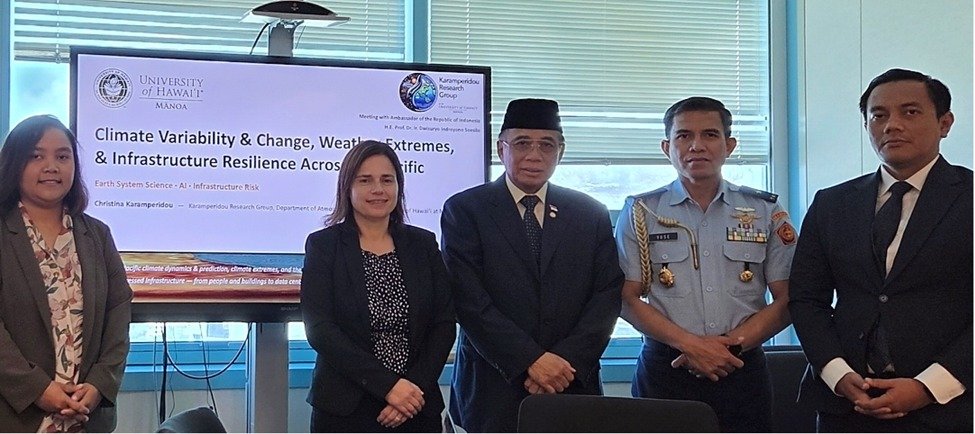
Researchers at the University of Hawaiʻi at Mānoa in Honolulu, United States, are currently focusing on studies of El Niño–Southern Oscillation (ENSO) variability, tropical–extratropical interactions, and the application of Artificial Intelligence (AI) to improve climate prediction. Their latest research findings were presented to the Ambassador of the Republic of Indonesia to the United States, Indroyono Soesilo, and the delegation from the Embassy of the Republic of Indonesia (KBRI) in Washington, D.C., during a meeting held on 8 July 2026 at the University of Hawaiʻi. The discussion also examined the relevance of these findings for Indonesia, a country highly vulnerable to fluctuations in rainfall and prolonged dry seasons.
For Indonesia, El Niño often translates into longer dry seasons and reduced rainfall, particularly across Java, Nusa Tenggara, and eastern Indonesia. Its practical consequences include crop failures that threaten food security, declining water supplies, increased risks of forest and land fires, and disruptions to energy availability—especially rising cooling demand in coastal urban areas. Because El Niño events differ in their characteristics, depending on whether ocean warming is concentrated in the central or eastern Pacific, regional climate responses also vary significantly. Consequently, climate projections capable of distinguishing between different “flavors” of ENSO are considerably more valuable than binary forecasts that simply predict the occurrence or absence of El Niño.
During a meeting with Professor Charles Fletcher, Dean of the School of Ocean and Earth Science and Technology, accompanied by Professor Christina Karamperidou from the Department of Atmospheric Sciences, researchers presented preliminary forecasts indicating that El Niño is expected to emerge between September and October 2026 and intensify through December 2026.
During the meeting with Ambassador Indroyono Soesilo, experts from the University of Hawaiʻi invited Indonesian scientists to collaborate in advancing research on ENSO mechanisms and the application of machine learning to improve climate forecasting and address gaps in historical climate records. Potential applications include the development of drought early warning systems that integrate diverse ENSO signals with AI-based models, the prediction of extreme flood events, and the reconstruction of local paleoclimate records to validate climate models. These methods are also well suited to analyzing the influence of volcanic eruptions on monsoon systems and ENSO variability—an area of particular importance for an archipelagic country with high volcanic activity such as Indonesia.
The meeting also explored opportunities for research collaboration between the University of Hawaiʻi and Indonesian institutions, including the Meteorology, Climatology, and Geophysics Agency (BMKG) for the integration of climate observations and forecasting products; the National Research and Innovation Agency (BRIN) for paleoclimate research and satellite data processing; the Ministry of Agriculture for the development of climate adaptation strategies for cropping systems; and leading Indonesian universities—including the University of Indonesia, IPB University, Bandung Institute of Technology (ITB), and Universitas Gadjah Mada (UGM)—for localized climate studies and AI technology transfer. Collaboration with the National Disaster Management Agency (BNPB) was also discussed to strengthen disaster risk reduction efforts. These partnerships could lead to the development of prototype early warning systems, joint scientific publications, and capacity-building programs for Indonesia’s next generation of climate scientists.
Ambassador Indroyono Soesilo welcomed the proposed research collaboration and invited the University of Hawaiʻi expert team to deliver an online presentation via Zoom in the near future to update Indonesian scientists and experts on the latest developments regarding the 2026 El Niño climate variability.
By combining the University of Hawaiʻi at Mānoa’s expertise in the physical processes governing ENSO with Indonesia’s field observations and local knowledge in climate risk management, this collaboration represents a highly strategic partnership. It has the potential to enhance the accuracy of climate projections, provide a stronger scientific foundation for climate adaptation policies, and mitigate the socio-economic impacts of the 2026 El Niño event as well as future ENSO-related climate variability.