




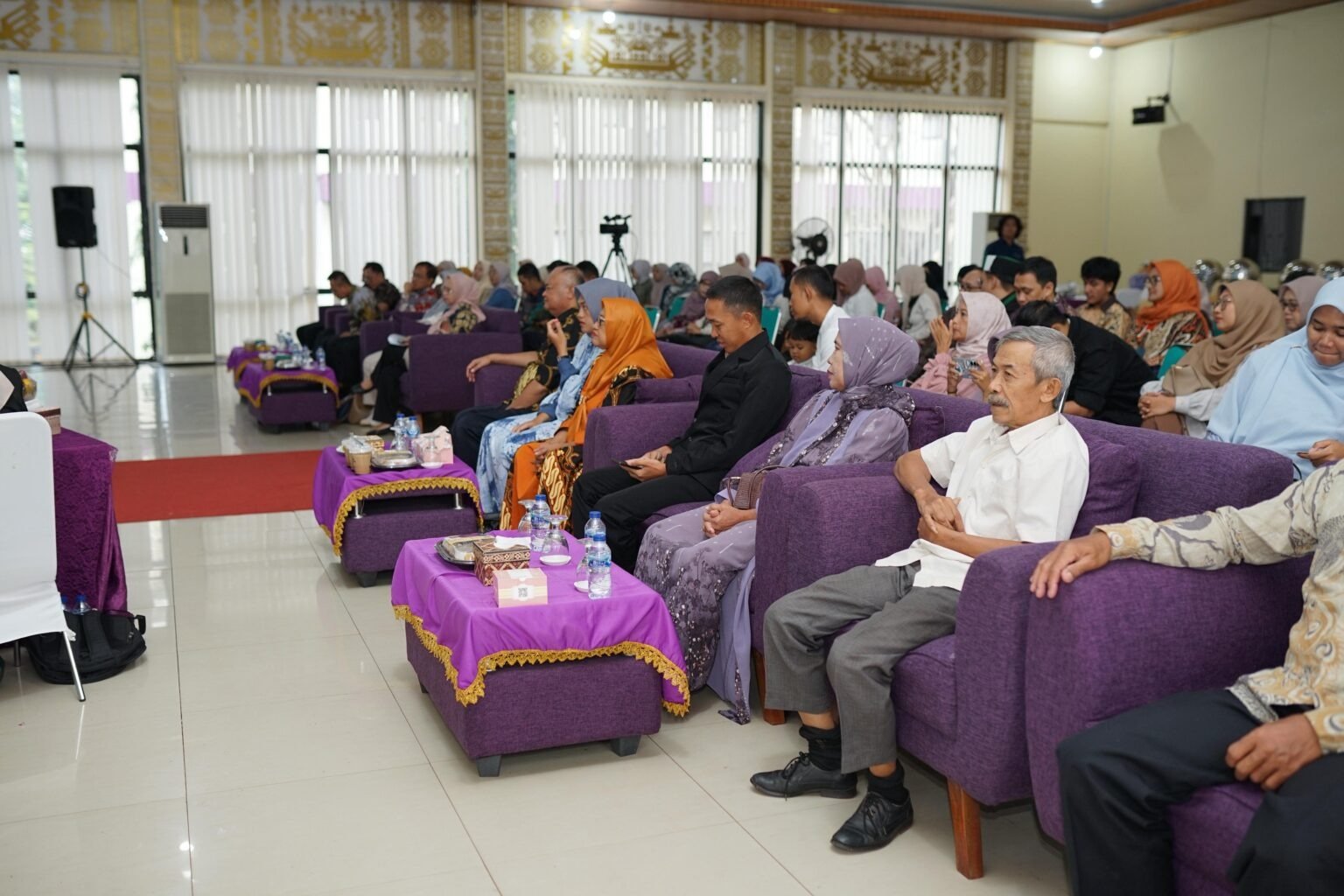
EduAsiaNews, Bandar Lampung – The Faculty of Teacher Training and Education (FKIP) at the University of Lampung (Unila) held an open doctoral dissertation defense on Friday, June 26, 2026, at the K Hall of the FKIP Building.
The doctoral promotion session was officially opened by Prof. Dr. Sunyono, M.Si., Vice Rector for Student Affairs and Alumni, representing the Chair of the Board of Examiners. The examination committee also included Prof. Hasan Hariri, S.Pd., M.B.A., Ph.D., as Secretary of the Board of Examiners, Prof. Dr. Herpratiwi, M.Pd., as Promoter, and Dr. Albet Maydiantoro, S.Pd., M.Pd., as Co-Promoter.
Also serving on the examination panel were Dr. Riswandi, M.Pd., Internal Examiner; Dr. Muhammad Nurwahidin, M.Ag., M.Si., Examiner; and Prof. Dr. Dewi Kusuma Wardani, M.Si., External Examiner from Sebelas Maret University.
During the session, Widya successfully defended her dissertation entitled “The Pentahelix Edupreneurship Model in Higher Education.” The research was motivated by the observation that entrepreneurship education in higher education institutions continues to focus predominantly on cognitive learning and theoretical knowledge.
Meanwhile, the business and industrial sectors require graduates who not only understand entrepreneurial concepts but also possess practical entrepreneurial skills. This gap has highlighted the need for an instructional model capable of integrating knowledge and practical competencies through collaborative and application-oriented learning.
“Entrepreneurship education should provide authentic learning experiences that enable students to learn through practice, collaboration, and interaction with various stakeholders, including academia, government, industry, communities, and the media. Entrepreneurial skills should not merely be understood—they must be experienced,” she explained.
The study aimed to develop a pentahelix edupreneurship model to enhance university students’ entrepreneurial competencies. To achieve this objective, the research adopted a Research and Development (R&D) approach by integrating the instructional design model of Dick and Carey with the development framework of Borg and Gall.
The research was conducted in the Economic Education Study Program at the University of Lampung and the Biology Study Program at UIN Raden Intan Lampung, involving students enrolled in entrepreneurship courses. Data were collected through observations, interviews, questionnaires, tests, documentation, and portfolio assessments.
The findings revealed that the pentahelix edupreneurship model possesses creative, collaborative, and application-oriented characteristics and was deemed conceptually, structurally, and operationally valid based on expert evaluations.
The study also demonstrated the model’s effectiveness in improving students’ entrepreneurial competencies. This was evidenced by the higher average post-test scores achieved by students in the experimental group compared with those in the control group, as well as statistically significant differences between the two groups. These findings confirm that the pentahelix edupreneurship model is effective for entrepreneurship education in higher education institutions.
In addition to introducing a new instructional model, the research contributes theoretically by integrating the principles of social constructivism, connectivism, and experiential learning theory. Conceptually, the study also reconstructs the pentahelix framework—traditionally applied within business ecosystems—into a collaborative entrepreneurship learning ecosystem for higher education.
Prof. Sunyono expressed his appreciation for Widya Hestiningtyas’s academic achievement and expressed hope that the research would make a meaningful contribution to the advancement of entrepreneurship education, particularly in producing graduates equipped with the competencies, creativity, and adaptability required by both the labor market and the business sector.
Through the implementation of the pentahelix edupreneurship model, higher education institutions are expected to foster more collaborative entrepreneurship learning by strengthening synergy among universities, industry, government, communities, and the media, ultimately producing graduates who are well prepared to meet the challenges of the professional world and society.