




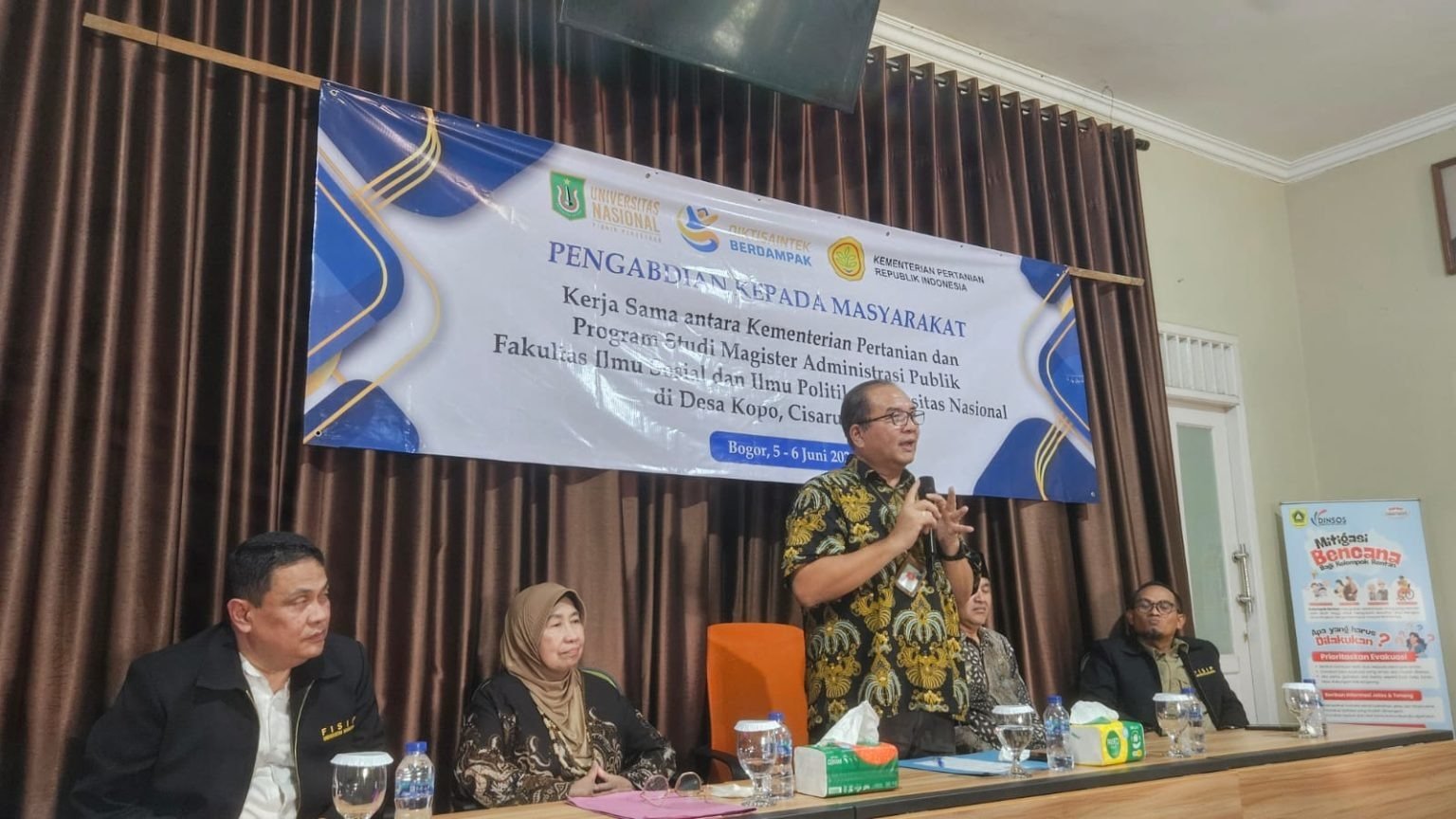
EduAsiaNews, Bogor – The Master of Public Administration Program at Universitas Nasional (UNAS) organized a Community Service Program (PKM) on 5–6 June 2026 in Kopo Village, Cisarua District, Bogor Regency, West Java. The initiative aimed to enhance community capacity through education, mentoring, and the strengthening of the agricultural sector as part of efforts to support village food security.
In addition to Kopo Village, the PKM activities were also conducted in Cipayung and Cilember Villages. The program represents the implementation of the Tri Dharma of Higher Education and serves as a tangible contribution by UNAS to community development and food security. Its implementation received support from the Ministry of Agriculture through the Directorate General of Horticulture.
Head of the Master of Public Administration Program at UNAS, Dr. Zulmasyhur, explained that this year’s PKM program was designed using different approaches in each village to ensure that the activities addressed the specific needs of local communities.
“We assigned students to three villages, each with a different approach. We hope that the programs implemented will effectively respond to the unique needs of each village. We also expect this initiative to continue sustainably and provide tangible benefits to the community,” he said.
During the event, the Secretary of the Directorate General of Horticulture at the Ministry of Agriculture, Hotman Fajar Simanjuntak, S.T., M.M., presented assistance in the form of various horticultural seed sachets and 1,000 copies of agricultural guidebooks to support PKM activities in Kopo Village.
According to Hotman, the assistance reflects the Ministry of Agriculture’s commitment to enhancing community capacity while strengthening household-based food security.
“Universities do not only carry out educational functions but also research and community service. We are providing horticultural seeds that can be planted directly by residents, along with agricultural guidebooks to support cultivation activities and encourage a reading culture among the people of Kopo Village,” he stated.
He added that the seed assistance aligns with the Nutritional Food Garden Program (P2B), which continues to be promoted by the Ministry of Agriculture to improve household food availability and nutritional quality.
“The provision of these seeds forms part of our support for the Nutritional Food Garden Program. We hope that communities will make productive use of their home gardens, thereby strengthening household and village food security,” he said.
Beyond cultivation practices, Hotman also emphasized the importance of downstream development and agricultural product marketing. He encouraged the Kopo Village Government to facilitate broader market access for local farmers.
“We hope the village government can encourage farmers to become more productive and reach wider markets. Agricultural products need to be properly recorded, certified, and promoted, including to restaurants and businesses in the Cisarua tourism area. This will increase product value and contribute to improving community welfare,” he explained.
Meanwhile, Kopo Village Head Wiwin Wildan expressed appreciation for the support provided by the Ministry of Agriculture and Universitas Nasional.
“We would like to thank the Ministry of Agriculture and Universitas Nasional for selecting Kopo Village as the location for this community service program. The knowledge, mentoring, and assistance provided are greatly needed to support village development, particularly in the agricultural and livestock sectors,” he said.
He further noted that the people of Kopo Village have shown strong enthusiasm for enhancing their capacity to support village food security.
“Many farmers and livestock breeders who attended today are eager to expand their knowledge and skills. We hope that initiatives such as this will not end after two days of implementation but will continue through sustained mentoring and evaluation,” he added.
On the same occasion, UNAS Vice Rector for Research, Community Service, and Cooperation, Prof. Dr. Ernawati Sinaga, M.S., Apt., expressed appreciation for the Ministry of Agriculture’s support for the PKM program.
“We would like to thank the Ministry of Agriculture for its support. We believe that collaboration among higher education institutions, government agencies, and communities will generate greater impact in improving the quality of life in rural areas,” she said.
Prof. Ernawati also revealed UNAS’s commitment to designating Kopo Village as a partner village to support sustainable educational, research, and community service activities.
“By establishing Kopo Village as a partner village, all study programs at Universitas Nasional can contribute through research and community empowerment initiatives, including those related to agriculture and food security,” she emphasized.
Similarly, the Dean of the Faculty of Social and Political Sciences (FISIP) at UNAS, Dr. Aos Yuli Firdaus, S.IP., M.Si., stressed that community service is an essential component of students’ learning process.
“The community service program conducted by UNAS Master of Public Administration students is a concrete example of applying theories learned in the classroom to real-world situations. This activity provides students with an opportunity to test and strengthen their academic understanding through direct engagement with the community,” he said.
Through the collaboration between the Ministry of Agriculture and Universitas Nasional, the Community Service Program in Cisarua District is expected to strengthen village community capacity, enhance agricultural productivity, and support the realization of sustainable food security at the local level.