




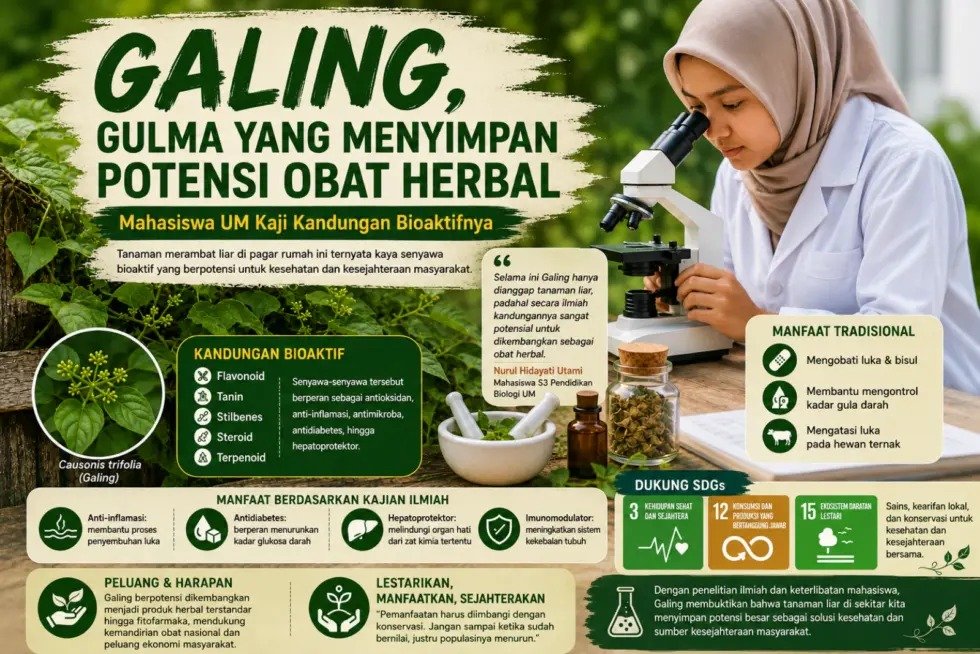
EduAsiaNews, Malang – Once quietly growing along household fences and often dismissed as a weed, the Galing plant (Causonis trifolia) is now attracting academic attention. Students from Universitas Negeri Malang have discovered that the wild climbing plant contains bioactive compounds with significant potential for development into modern herbal medicine.
A scientific study conducted by Nurul Hidayati Utami, a doctoral (Ph.D.) student in Biology Education at UM, highlighted the presence of flavonoids, tannins, stilbenes, steroids, and terpenoids in Galing. These compounds are known to possess antioxidant, anti-inflammatory, antimicrobial, and antidiabetic properties beneficial to human health. According to Nurul, Galing has not been optimally utilized because it has long been regarded as an ordinary wild plant.
“For years, Galing has only been considered a wild plant, even though scientifically its compounds show tremendous potential for development as herbal medicine,” she said during an interview with the UM Public Relations Team on Monday (May 4).
Traditionally, local communities have long used Galing to treat wounds, boils, and help regulate blood sugar levels. The plant is also frequently used by livestock farmers to aid wound healing in animals.
The research findings indicate that these traditional uses have a strong scientific basis. The anti-inflammatory compounds in Galing help accelerate wound healing, while its antidiabetic activity contributes to lowering blood glucose levels. In addition, the plant possesses hepatoprotective properties that may help protect the liver from exposure to certain chemicals.
Furthermore, Nurul discovered that Galing also has potential as an immunomodulator capable of enhancing the body’s immune system.
“This potential opens opportunities for developing Galing not only as a traditional remedy, but also into standardized herbal products and even phytopharmaceuticals,” she added.
The development of this local plant is considered capable of supporting national independence in medicinal raw materials while simultaneously creating economic opportunities for communities through the cultivation of herbal plants based on local resources. However, Nurul emphasized that the utilization of Galing must be accompanied by conservation efforts to ensure its population remains sustainable.
“Utilization must go hand in hand with conservation. We should not allow its population to decline once it gains economic value,” she stressed.
This research conducted by UM students aligns with the Sustainable Development Goals (SDGs), particularly Goal 3 on good health and well-being, Goal 12 on responsible consumption and production, and Goal 15 on the preservation of terrestrial ecosystems.
Through a research-based scientific approach, Galing demonstrates that wild plants found in the surrounding environment hold enormous potential as future healthcare solutions and as a source of community prosperity.