



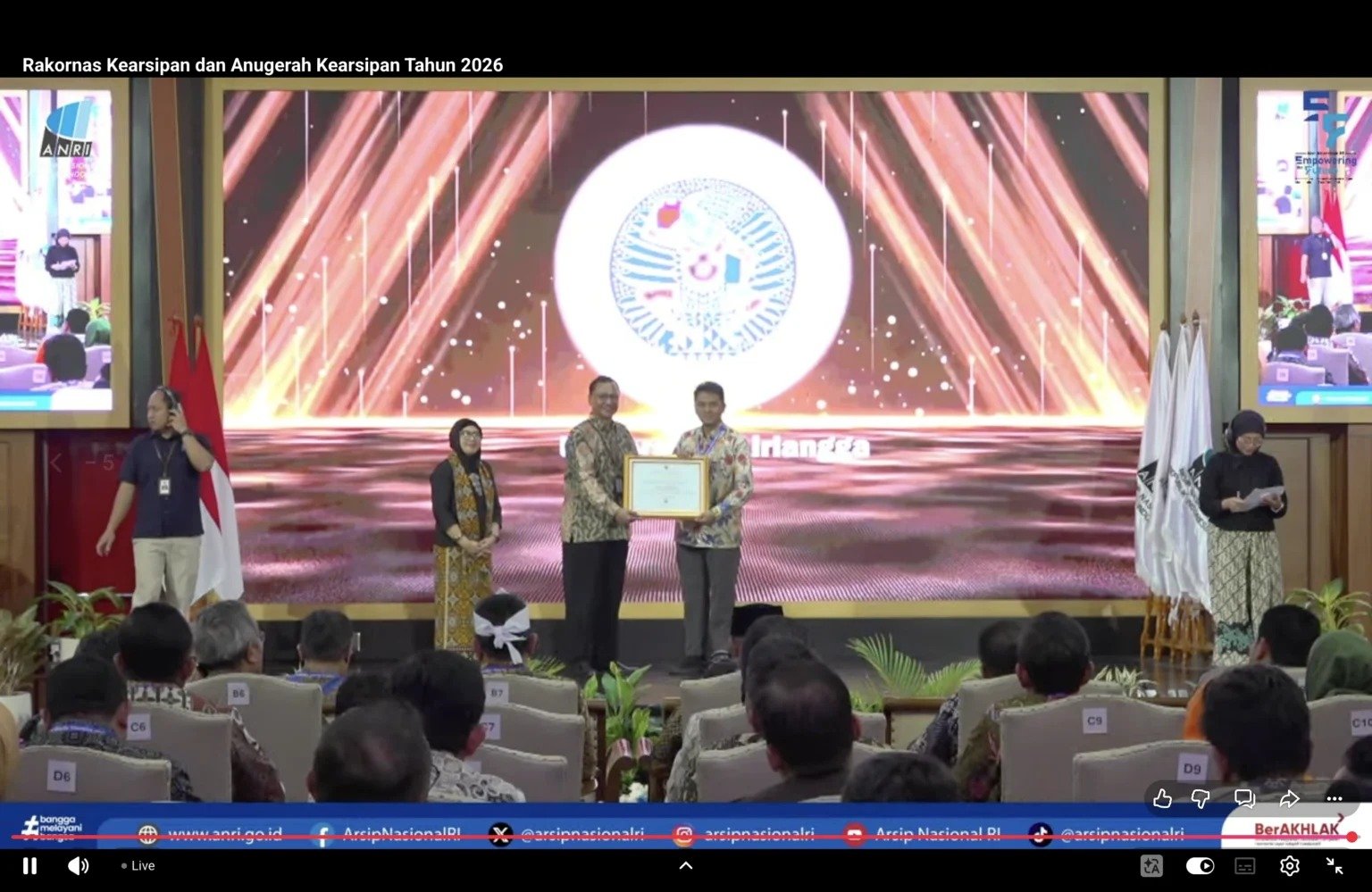
EduAsiaNews, Surabaya – Airlangga University received the 2026 National Best Network Node Award in the Higher Education Category from the National Archives of the Republic of Indonesia (ANRI). The award was presented in recognition of UNAIR’s success in implementing the National Archival Information System (SIKN), which was assessed as outstanding and compliant with national standards.
The award announcement was received directly by the Director of Human Resources, Talent Management, and Organizational Development, Prof. Dr. Radian Salman, on Wednesday (May 20, 2026) at the ANRI Office in Jakarta.
Responding to this achievement, the Secretary of Airlangga University, Prof. Dr. Dwi Setyawan, emphasized that for UNAIR, the award is not the ultimate goal. Rather, it serves as tangible recognition of the dedication and contributions of the entire academic community in carrying out archival responsibilities to the highest standard.
“The award is not the end goal; rather, it is an appreciation given by ANRI to UNAIR for carrying out archival duties in the best possible manner. This achievement motivates UNAIR to further improve the university’s archival management. We must also properly manage both static and dynamic archives,” he stated.
More than simply storing documents, Prof. Dwi highlighted the importance of public accountability. According to him, the essence of proper archival management lies in the ability to account for all activities recorded in archives to the public and to ensure easy access to information for society.
Digital Innovation and Excellence in Information Access
In recent years, UNAIR has continuously promoted archival innovation. One of the flagship programs supporting this achievement is archive digitalization and document categorization. The primary initiative focuses on integrating scattered archives into a unified and interconnected data system.
According to Prof. Dwi, the strength of UNAIR’s archival governance is supported by a solid ecosystem, including strong regulations, well-prepared human resources in every work unit and faculty, adequate facilities and infrastructure, as well as consistent policy and budgetary support.
As a concrete manifestation of information transparency, UNAIR has also established a Digital Archive Museum located in the Airlangga Sharia & Entrepreneurship Education Center (ASEEC) building.
“Through this program, the public can directly access various historical and important administrative information they may need,” he explained.
Addressing Challenges in Archival Governance
The journey toward achieving this national award was not without challenges. Prof. Dwi explained that the university’s operational dynamics, including several office relocations, had at times become obstacles that resulted in the loss of certain original archives. Another challenge involved the complexity of digitalizing archives and building a truly integrated archival system across all units.
However, thanks to the full commitment of the university leadership and the cooperation of all parties involved, these challenges were gradually overcome. Today, a collective movement continues to be strengthened across work units, faculties, and archival divisions within UNAIR to foster shared awareness of the importance of preserving document authenticity and ensuring that documents remain easily accessible whenever needed.
Furthermore, he noted that the objective assessment conducted by ANRI reinforces the view that proper archival management has now become a fundamental necessity for UNAIR, rather than merely an administrative obligation. Moving forward, every work program designed by UNAIR is expected to be directly connected to and supportive of strengthening the national archival system.
“In line with the vision of ‘Impactful UNAIR,’ the ability to provide valid and trustworthy archival information to the public is regarded as one of the tangible indicators of the university’s contribution and benefit to society at large,” he concluded.
Author: Khefti Al Mawalia