




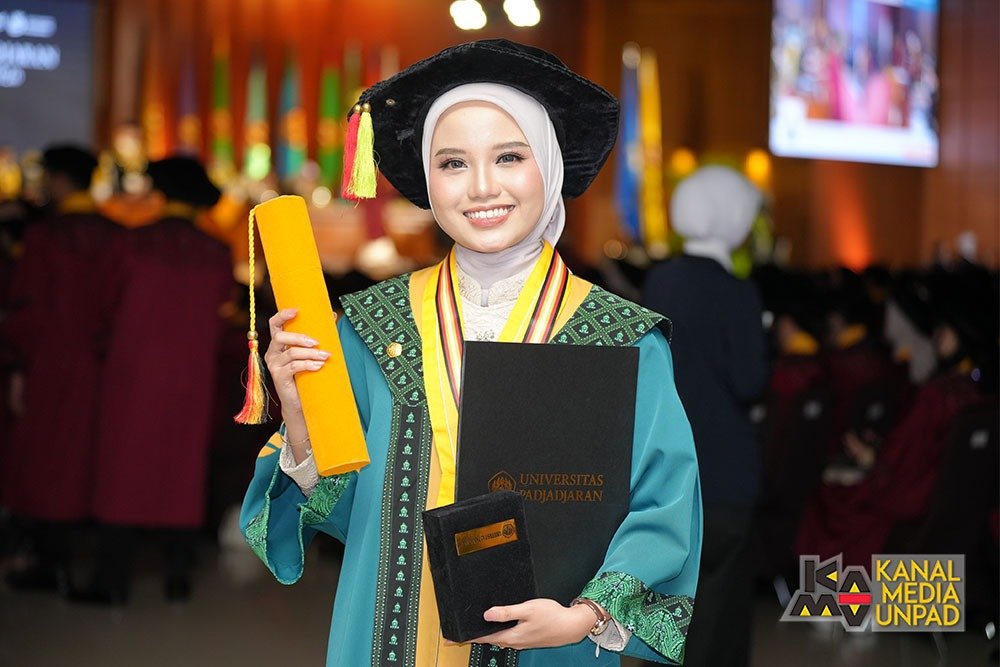
EduAsiaNews, Bandung – Interest in the field of research led Launa Silky Karenindra Rokhmat, a graduate of the Chemistry Study Program at the Faculty of Mathematics and Natural Sciences, Universitas Padjadjaran (Unpad), to earn the title of Best Graduate in the Master’s Program. Through the fast-track program, Launa successfully completed both her undergraduate and master’s degrees within a relatively short period while also publishing scientific papers in internationally reputable Q1 journals.
Launa was officially conferred as a graduate during the Third Graduation Ceremony of the 2025/2026 Academic Year, held at Graha Sanusi Hardjadinata, Iwa Koesoemasoemantri Campus of Unpad, Jl. Dipati Ukur No. 35, Bandung, on Tuesday, 5 May 2026.
Launa admitted that the adaptation process during the early stages of her studies was not easy. However, the support from her environment and friends gradually helped her enjoy the learning process and eventually complete her studies successfully. She stated that her achievement as the best graduate in the Master’s Program was the result of support from many individuals who accompanied her throughout her academic and research journey.
“For me, this achievement is not solely the result of my own efforts, but also because of the support from the people around me,” said Launa.
Launa explained that during her master’s studies, she focused primarily on academics and research, while also serving as a laboratory assistant for practical sessions. During her undergraduate years, she actively participated in organizations and committees to develop teamwork skills and organizational experience.
Her aspiration to become a researcher since undergraduate study became her greatest motivation for joining the fast-track program, as it provided an opportunity to maintain her academic momentum while broadening her research experience. In addition, opportunities for research funding and grants available to master’s students further encouraged her to pursue the accelerated academic pathway.
Nevertheless, undertaking the fast-track program was not without challenges. She had to transition from undergraduate to master’s studies within a short period while maintaining the progress of her research according to schedule. One of the greatest challenges she faced emerged during her research on the development of Molecularly Imprinted Polymer materials for an HbA1c sensor as a diabetes biomarker. During the process, experiments had to be repeated multiple times because the synthesized material did not yet produce the expected sensor response.
“In several experiments, the polymers I synthesized were not properly formed or the sensor response did not meet expectations, so the experiments had to be repeated many times. From this experience, I learned that research is a long process that requires evaluation and perseverance,” she explained.
In addition to actively conducting research, Launa also succeeded in publishing scientific articles in internationally reputable Q1 journals. The publication process began with identifying research topics that were both relevant and novel. According to her, the greatest challenge in scientific publication is ensuring that research data are truly strong and consistent. Furthermore, the revision process from reviewers requires meticulous attention, as every comment must be addressed with arguments supported by research data.
“Sometimes we also need to recheck research findings or add certain analytical data to make the explanations more comprehensive,” Launa added.
Launa stated that Unpad’s support in providing research facilities and publication funding was extremely helpful throughout the process. Moving forward, she hopes that Unpad will continue to strengthen support for students, particularly in research and scientific publication, through improved research facilities, access to international journals, comfortable learning spaces, and academic development programs such as scientific writing workshops and conferences.
Furthermore, Launa encouraged other students not to be afraid of trying new things and to remain consistent throughout their learning journey, as every individual has their own path and timing, making comparisons with others unnecessary.
“Trust the process, because every experience will certainly bring lessons for us,” she concluded.
List of Publications
Hydrogel Molecularly Imprinted Polymer-Based Electrochemical Sensor on Gold Modified Screen-Printed Carbon Electrodes for Stable and Selective HbA1c Detection (Q1)
Molecularly Imprinted Polymer Technology for Electrochemical Detection of Diabetes-Related Biomarkers (Q1)
Advances in Molecularly Imprinted Polymers with Catalytic Activity for Healthcare and Environmental Application (Q1)
Determination of Folic Acid Levels in Silane-Modified Folate Conjugates Using UV Spectrophotometry (e-ISSN Journal)
Molecularly Imprinted Polymers Based Electrochemical Sensor Detection of Epithelial Sodium Channel Protein as a Biomarker of Salt-Sensitive Hypertension (Q1)
Recent Advances in Molecularly Imprinted Polymer-Based Sensors for Porcine Protein and DNA Detection (Q1)