




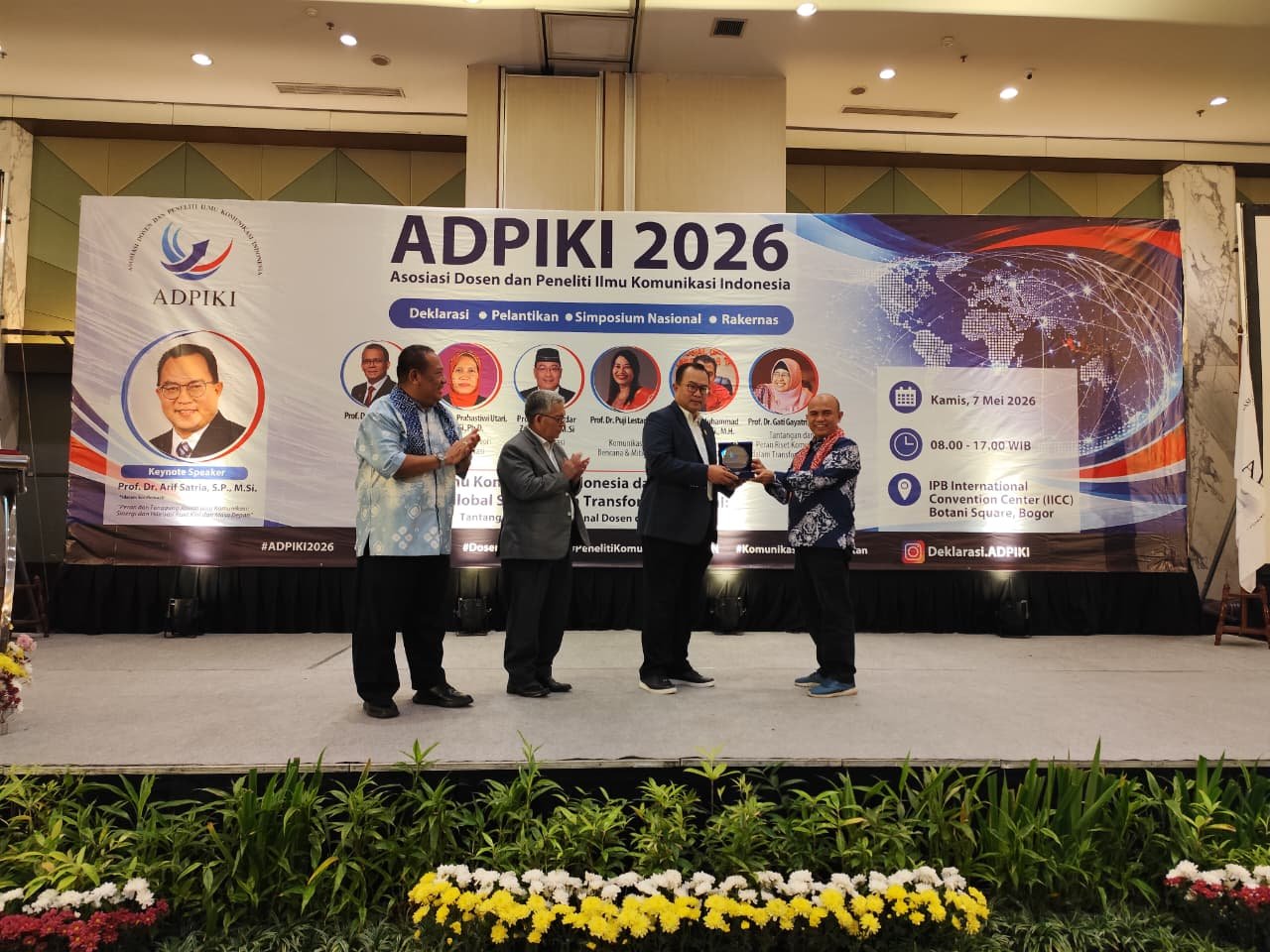
EduAsiaNews, Bogor – The Indonesian Association of Communication Science Lecturers and Researchers (ADPIKI) emphasized the importance of strengthening the role of communication science in supporting research synergy, innovation downstreaming, and national development amid ongoing digital transformation. This was highlighted during the National Symposium, Declaration, and Inauguration of the Central Executive Board of ADPIKI held at the IPB International Convention Center on Thursday (May 7, 2026).
The event featured the Head of the National Research and Innovation Agency (BRIN), Prof. Dr. Arif Satria, S.P., M.Si., as the keynote speaker, delivering a presentation themed “The Role and Responsibility of Communication Science: Research Synergy and Downstreaming for the Present and the Future.”
Prof. Dr. Arif Satria, S.P., M.Si. stated that the rapid development of digital technology has fundamentally transformed the landscape of public communication, where mainstream media is no longer the sole source of information, as every individual can now become both a producer and distributor of news through digital platforms. According to him, contemporary communication patterns increasingly depend on social media algorithms that shape information flows, public preferences, and societal perceptions.
“Today, everyone can become a source of news, and algorithms have enormous influence in determining what the public sees and believes. As a result, communication is often no longer oriented toward substance, but toward virality,” said Arif Satria.
He further explained that communication in the digital era is no longer entirely neutral, as it is frequently utilized to shape public opinion and build trust toward individuals and institutions. Therefore, the greatest challenge today lies in establishing credibility amid the overwhelming flow of information and competing narratives in digital spaces. According to Arif, strengthening social bonds and healthy networks is essential to maintaining the quality of public communication and reinforcing public trust.
“Ultimately, communication is not merely about technology, but about building social relationships and creating credibility that society can trust,” he added.
Meanwhile, Chairman of the Advisory Board of ADPIKI, Prof. Dr. Anter Venus, M.A. Comm, stated that the rise of the digital era and artificial intelligence has generated a phenomenon of information overload, creating new societal challenges ranging from misinformation and disinformation to infodemics. According to him, communication science bears significant responsibility in ensuring the dissemination of accurate, science-based information capable of fostering a critical and ethical society in digital spaces.
“In the era of digital technology and AI, communication is no longer merely a process of delivering messages, but has become an arena for constructing social reality. Therefore, communication science must ensure that circulating information remains factual, ethical, and enlightening for society,” said Anter Venus.
He also emphasized that a communicological approach is necessary to address the dominance of algorithms and digital information flows that may influence public thinking patterns and decision-making processes.
Anter Venus added that communication in the digital era has become increasingly egalitarian, participatory, personal, and interactively connected, thereby requiring flexibility in communication practices and stronger public digital literacy. He underscored the importance of science communication accompanied by critical thinking skills, information verification, AI ethics, personal data protection, and responsible digital information consumption to prevent society from falling into the traps of information overload and digital fatigue.
At the same event, Chairman of ADPIKI, Dr. Heri Budianto, M.Si., stated that the establishment of ADPIKI represents a consolidative step to strengthen the position of communication science lecturers and researchers as a solid epistemic community in supporting the transformation of higher education, research, and national innovation.
According to him, until now there has been no national platform specifically representing communication science lecturers and researchers within the framework of higher education and national research policymaking.
“ADPIKI was established to build collective representation for communication science lecturers and researchers, strengthen professional legitimacy, and integrate national research networks in order to enhance the competitiveness of publications, innovation, and the downstreaming of communication science,” said Heri Budianto.
He explained that ADPIKI is expected to encourage improvements in the quality of communication science education and research that are innovative, collaborative, and relevant to the advancement of digital technology and AI. Furthermore, ADPIKI is envisioned as a platform for synergy among academics, government institutions, industry stakeholders, and communication practitioners in addressing national challenges, including strengthening public literacy, national information governance, digital democracy, and the development of the creative industry.
“We aspire for ADPIKI to become a platform capable of uniting ideas, strengthening collaboration, and delivering tangible contributions of communication science to society, the nation, and the international community,” he concluded.
The event also brought together a number of academics, national communication professional organizations, and international partners from the University of British Columbia (UBC). In addition to the national symposium, the agenda included the official declaration of ADPIKI’s establishment, the inauguration of the central executive board for the 2026–2031 period, and the first National Working Meeting as an initial step toward strengthening the network of communication science lecturers and researchers in Indonesia.