




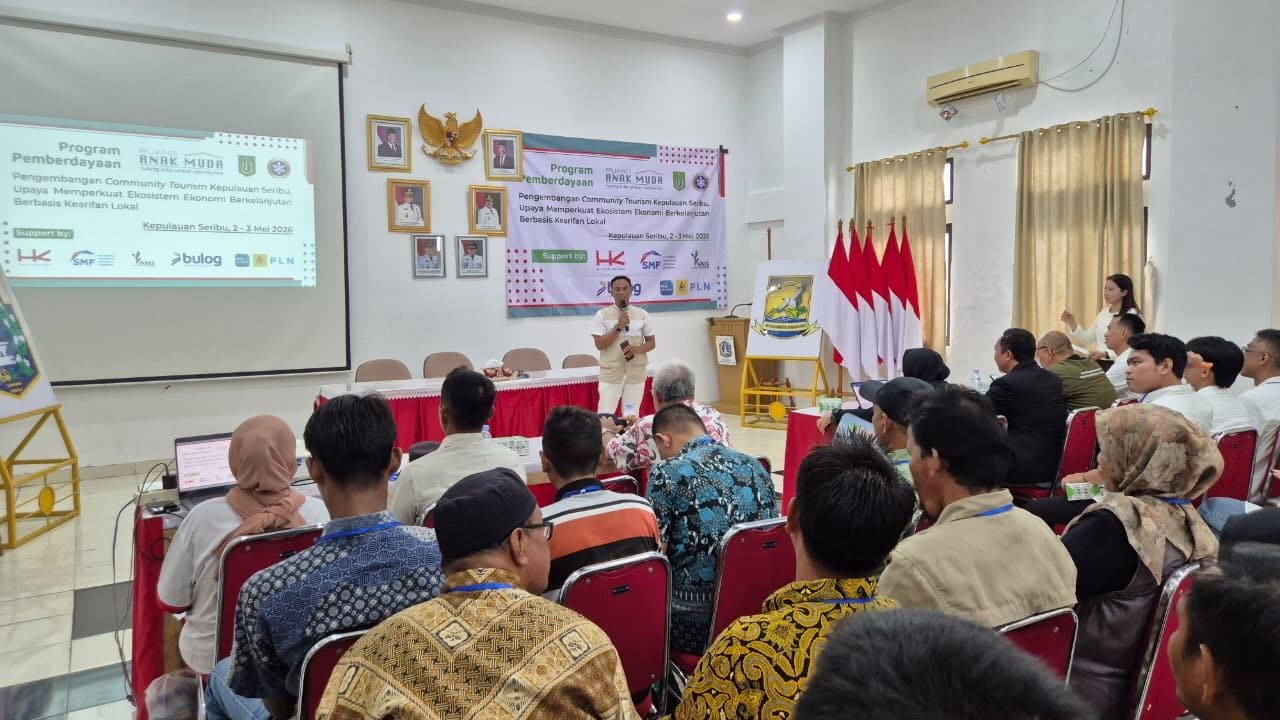
EduAsiaNews, Jakarta – The Graduate Program in Communication Science at Universitas Nasional (UNAS), in collaboration with Ruang Anak Muda, conducted a Community Service Program (PKM) on Pulau Panggang, Thousand Islands Administrative Regency, under the theme “Developing Community Tourism in the Thousand Islands: Strengthening a Sustainable Economic Ecosystem Based on Local Wisdom,” on Saturday and Sunday, May 2–3, 2026.
The Secretary of the Master’s Program in Communication Science at UNAS, Dr. Drs. Adi Prakosa, M.Si., explained that the PKM activity is part of the implementation of the Tri Dharma of Higher Education, which encourages universities to engage directly with societal challenges and deliver tangible, constructive impacts.
“The PKM activity is part of the Tri Dharma of Higher Education, where academics are not only responsible for the development of knowledge and research but must also be present within society and provide real impact,” Adi stated to UNAS Public Relations on Sunday, May 3, 2026.
Regarding the development of community tourism in the Thousand Islands, Adi noted that it requires more than just the natural beauty of tourist destinations; it also necessitates effective communication across stakeholders.
“Community tourism does not grow solely from the beauty of destinations, but also from communication that unites communities, government, and tourists toward a shared goal,” he remarked.
Meanwhile, a Master’s student in the Communication Program at UNAS, Dadangsah Manjalib, stated that community tourism based on local wisdom is part of a sustainable creative economy. He emphasized that this sector should be encouraged to provide broader welfare benefits.
“We emphasize that this sector should create space for broad community involvement, rather than being capitalized by only a small group of investors. With wider community participation, it is expected that economic circulation can reach lower- and middle-income groups. In this way, it aligns with sustainability principles, as it incorporates elements of equitable prosperity,” said Dadangsah.
(Dimas Wijaksono)