




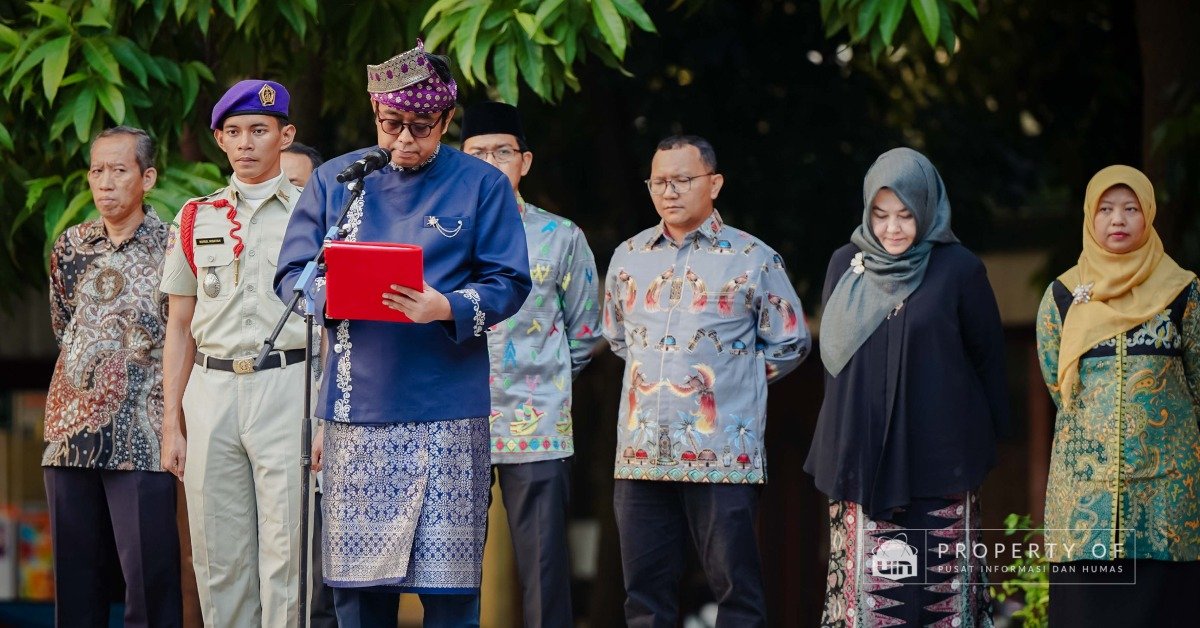
EduAsiaNews, Ciputat — The commemoration of National Education Day (Hardiknas) is observed annually on May 2. A Professor and Vice Rector for Academic Affairs at UIN Syarif Hidayatullah Jakarta, Ahmad Tholabi Kharlie, stated that this occasion serves as a reflective moment for the Indonesian nation to reassess the direction and strategy of human resource development.
The 2026 Hardiknas theme, “Strengthening Collective Participation to Realize Quality Education for All,” underscores that education can no longer rest solely on the responsibility of the state or formal institutions, but must instead become a shared commitment of all elements of society.
Prof. Tholabi emphasized that this year’s theme reflects the urgent need for cross-sector collaboration in addressing the complexities of education in the global era. “Collective participation is not merely a normative slogan. It must be translated into policy designs that enable meaningful engagement—from families and communities to the private sector and religious groups,” he stated in Jakarta on Friday (May 1, 2026).
From Access to Quality
According to Prof. Tholabi, one of the most pressing issues in Indonesia’s education sector is the shift in focus from expanding access to ensuring equitable quality. Over the past two decades, access to education has shown significant progress; however, the challenge of quality remains unresolved at a systemic level.
He stressed that educational quality should not be reduced solely to cognitive achievement, but must also encompass character, ethics, and adaptability. In this regard, the educational philosophy pioneered by Ki Hajar Dewantara remains highly relevant.
“Liberating education is not merely about the transfer of knowledge, but about shaping whole individuals—those who possess intellectual capacity, emotional depth, and creativity,” he remarked.
Challenges of Disruption and Inequality
Prof. Tholabi identified several key challenges facing Indonesia’s education system. First is rapid technological disruption. While digitalization of learning—one of the government’s priorities—offers significant opportunities for expanding access and innovation, it also creates new inequalities, particularly in regions lacking adequate infrastructure.
Second is the persistent disparity in quality across regions. Schools in urban areas tend to be more prepared to adapt to change, while those in underdeveloped regions still face fundamental challenges such as limited facilities and shortages of qualified educators.
Third is the relevance of curricula in responding to contemporary dynamics. Prof. Tholabi cautioned against an overly short-term orientation driven solely by labor market demands, emphasizing the need to maintain a balance between applied and fundamental sciences.
“If education is directed only toward producing job-ready workers, we risk losing our capacity as a nation of creators. Innovation emerges from strong academic foundations, including basic sciences and the humanities,” he explained.
The Strategic Role of Higher Education
In a broader context, higher education institutions play a strategic role as centers of knowledge production and intellectual leadership. Prof. Tholabi emphasized that universities must not merely serve as extensions of market forces, but must preserve academic autonomy.
He encouraged universities to strengthen integrative research ecosystems that connect knowledge with societal needs while maintaining academic independence.
“Universities must become spaces for dialogue between tradition and modernity, between values and technology. This is where their crucial role lies in preparing human resources who are not only competent but also possess integrity,” he stated.
Toward Indonesia Emas 2045
In pursuit of the vision of Indonesia Emas 2045, human resource development is a non-negotiable priority. Prof. Tholabi noted that Indonesia’s demographic bonus will only be advantageous if managed through a high-quality education system.
He outlined three key priorities: strengthening teacher quality as the central pillar of education; transforming curricula to be adaptive while rooted in national values; and ensuring inclusive and equitable access to educational technology.
He further stressed that Indonesia’s education system must produce individuals who are not only intellectually capable but also socially and spiritually aware.
“Indonesia Emas cannot be built solely by intelligent individuals, but by those guided by values. Without this, progress risks losing its direction,” he asserted.
Hardiknas as a Reflective Momentum
Prof. Tholabi concluded that the commemoration of Hardiknas should not be limited to annual ceremonies, but must serve as a moment of reflection to evaluate achievements and formulate future strategies.
In the spirit of collective participation, he called on all segments of society to take an active role in advancing education.
“Education is a civilizational endeavor. It cannot be completed within a single generation, but must be sustained as a cross-generational commitment,” he said.
Despite the existing challenges, he emphasized that optimism remains essential—but it must be accompanied by concrete actions and consistent policies.
“Our hope is simple yet fundamental: that Indonesian education will produce independent individuals who are globally competitive, without losing their national identity,” he concluded.