




EduAsiaNews, Jakarta – The Rector of Universitas Pembangunan Nasional “Veteran” Jakarta (UPNVJ), Prof. Dr. Anter Venus, MA, Comm, reviewed the development of campus parking facilities as part of efforts to strengthen supporting services for the academic community. This review underscores UPNVJ’s commitment to providing parking facilities that are more spacious, comfortable, safe, orderly, and integrated with an increasingly enhanced non-cash (cashless) payment system.
This initiative also forms part of a broader transformation in campus facility governance toward a more modern approach oriented to user comfort.
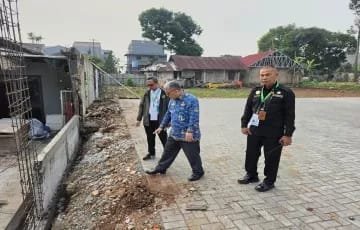
Currently, UPNVJ is preparing two new parking areas. The first area, APU 2 on Jalan Rangu, covers approximately 2,000 square meters and has a capacity of around 600 motorcycles. The second area is located at the rear gate, spanning approximately 5,000 square meters and designed to accommodate around 1,500 motorcycles and 50 cars. Both areas are targeted to begin operations in mid-May to support the growing demand for parking within the campus environment.
This development continues UPNVJ’s efforts to expand parking capacity and modernize the campus parking system. Previously, the university had also emphasized a more organized parking management approach supported by technology, including the implementation of automated gate mechanisms as part of its campus service transformation.
In the APU 2 area, the facilities being developed will not only function as a parking space but will also include a café, a garden, and a three-on-three basketball court. Meanwhile, the rear parking area will be supported by internal road access connected to the University’s Walk concept. In the future, this area is also planned to feature a food court to support campus community activities.
This concept aligns with UPNVJ’s broader campus land development plan, which envisions multifunctional public spaces. In official university publications, the development area has indeed been designed not only to address parking needs but also to provide supporting facilities such as interaction spaces, sports areas, and more representative public spaces for students, lecturers, and administrative staff.
With the availability of these two additional parking areas, reorganizing parking within the campus will become more manageable. Going forward, parking points along internal campus roads will be gradually restricted and relocated to these new parking areas. This policy is expected to reduce vehicle congestion along the campus’s main corridors while creating a more orderly and safer environment.
This arrangement will also support the development of the University’s Walk, a pedestrian-friendly campus corridor extending from the Faculty of Economics and Business area to the rear exit gate. The presence of this corridor is expected to reinforce a more human-centered, healthy, and comfortable campus environment for the entire academic community.
Previously, the Rector of UPNVJ, Prof. Dr. Anter Venus, MA, Comm, emphasized that campus infrastructure development must genuinely address the real needs of the academic community. According to him, facilities are not merely about capacity, but also about delivering quality service experiences, environmental order, and support for the university’s tridharma activities. Therefore, UPNVJ continues to gradually strengthen its supporting infrastructure to ensure that institutional development focuses not only on academic achievements but also on the quality of essential services directly experienced by the campus community.
The development of these two new parking areas represents a strategic step toward comprehensively reorganizing campus mobility. Through a more orderly parking system, expanded vehicle capacity, strengthened cashless services, and the development of pedestrian-friendly corridors, UPNVJ reaffirms its commitment to building a modern, effective, and increasingly comfortable campus environment for its entire academic community. (www.upnvj.ac.id)