




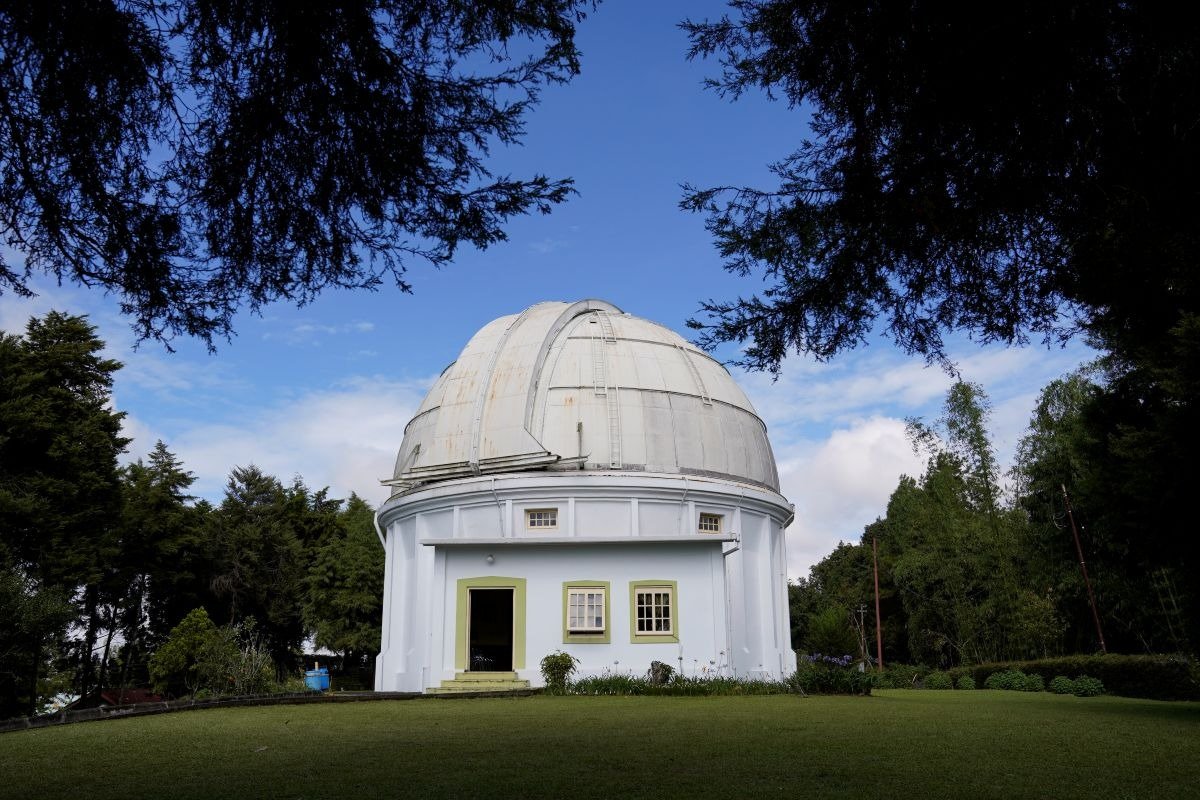
EduAsiaNews, Bandung — The Bosscha Observatory has released astronomical information regarding the position of the crescent moon (hilal) on Thursday, March 19, 2026, which corresponds to the 29th of Ramadan 1447 AH. At sunset, the crescent is located very close to the Sun in the western sky.
As an educational and research institution in the field of astronomy, the Bosscha Observatory conducts observations of the young lunar crescent almost every month. Each year, it also serves as one of the key references for determining the beginning of Hijri months, including Shawwal, for the Ministry of Religious Affairs of the Republic of Indonesia and the general public.
Based on calculations by the Bosscha Observatory, the astronomical data for March 19, 2026 (29 Ramadan 1447 AH) indicate that the Moon’s position is very close to the Sun in the western sky at sunset. Geometric parameters show that the geocentric elongation (the angular distance between the Moon and the Sun as seen from the center of the Earth) across Indonesia ranges from approximately 4.6° to 6.2°, from eastern to western regions. Meanwhile, the topocentric elongation (the angular distance as observed from the Earth’s surface) ranges between approximately 4.0° and 5.5°.
The Moon’s altitude at sunset is also relatively low. Altitude maps indicate that the hilal’s elevation in Indonesia ranges from 0° to 3° above the horizon in western regions. These conditions suggest that the Moon is positioned close to the Sun in the western sky and remains at a low altitude above the horizon.
Yatny Yulianty, M.Si., a researcher at the Bosscha Observatory, explained that, astronomically, such conditions place the hilal at a challenging threshold for observation. “The success of the observation will be highly dependent on atmospheric conditions, sky transparency, as well as the experience and methods employed,” she stated on Monday (March 16, 2026).
Astronomical Observations at Two Locations
To document the visibility conditions of the hilal, astronomers from the Bosscha Observatory will conduct observations using telescopes and imaging instruments at two locations: the Bosscha Observatory in Lembang and the Lhok Nga Observatory in Aceh, supported by the Ministry of Religious Affairs of the Republic of Indonesia.
Yatny, who also serves as Coordinator of Public Activities in the Education and Public Outreach Division of the Bosscha Observatory, noted that the Lhok Nga Observatory was selected because the Moon’s positional parameters in the Aceh region lie near the current criteria threshold for hilal visibility. Observations at this site are therefore important for verifying the constraints of these criteria through direct observation. This activity is also part of the observatory’s long-term research on hilal visibility, aimed at enriching the database of young crescent observations across Indonesia.
Determination of 1 Shawwal 1447 AH
Yatny emphasized that the official determination of the beginning of Hijri months, including Shawwal, remains the authority of the Government of the Republic of Indonesia through the Ministry of Religious Affairs, to be decided during the sidang isbat (official deliberation session) on March 19, 2026. However, the Bosscha Observatory contributes by providing calculations, observations, and research findings on the hilal as scientific input to support the decision-making process.