




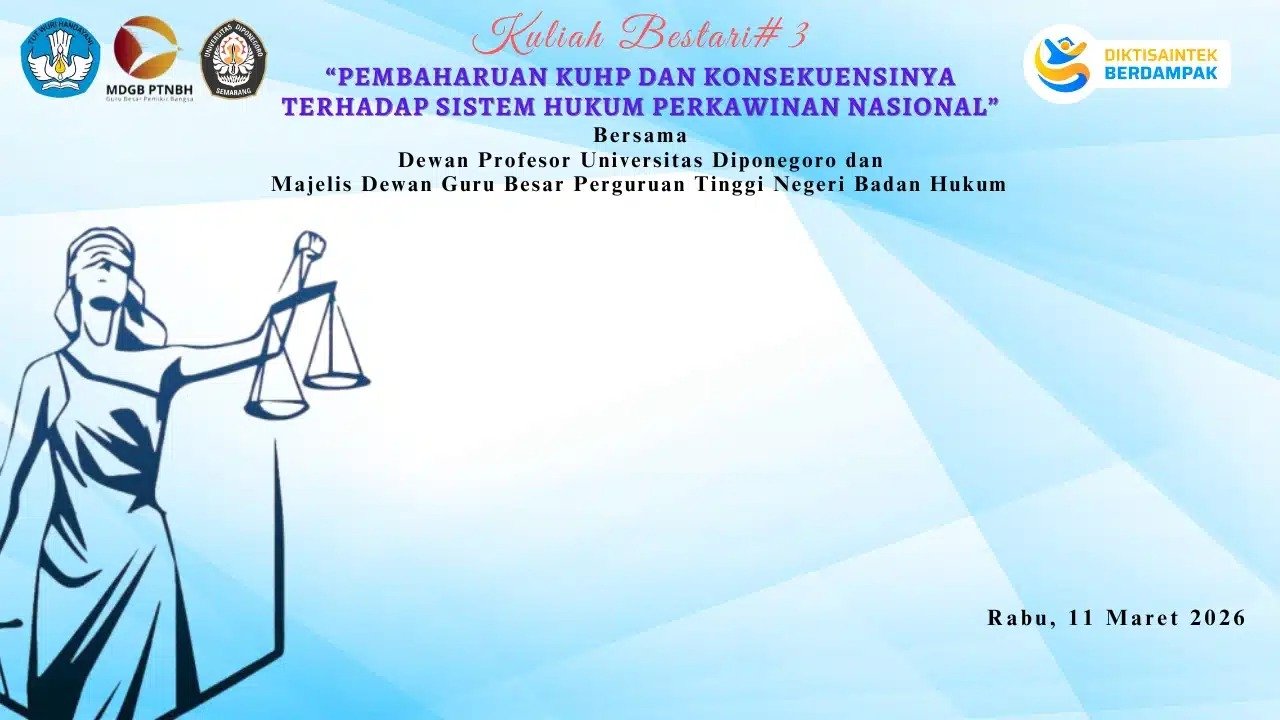
EduAsiaNews, Semarang – The Council of Professors of the Academic Senate of Universitas Diponegoro (UNDIP), in collaboration with the Majelis Dewan Guru Besar Perguruan Tinggi Negeri Badan Hukum (MDGB PTNBH), organized the 3rd Bestari Lecture held online via Zoom Meeting and broadcast live through the official UNDIPTV YouTube channel on Wednesday, 11 March 2026. On this occasion, UNDIP served as the host institution, presenting a scientific discussion entitled “The Reform of the Criminal Code and Its Consequences for the National Marriage Law System.”
In his opening remarks, the Chair of the Council of Professors of Universitas Diponegoro, Imam Buchori, explained that the Bestari Lecture is a regular program of the Majelis Dewan Guru Besar Perguruan Tinggi Negeri Badan Hukum conducted monthly by member universities on a rotating basis. On this occasion, the program was organized by the Council of Professors of the Academic Senate of UNDIP in collaboration with MDGB PTNBH.
He further noted that the Council of Professors of Universitas Diponegoro is an organ within the Academic Senate that plays a role in advancing scholarship, upholding academic ethics, and strengthening academic culture within the university. In its institutional governance, UNDIP refers to three main pillars: the Rectorate, the Board of Trustees, and the Academic Senate.
Prof. Imam also emphasized that the organization of the Bestari Lecture forms part of the Council of Professors’ efforts to fulfill its mandate in advancing academic knowledge while examining various strategic issues facing the nation. The event also constitutes one of the work programs of Commission A of the UNDIP Council of Professors, which focuses on the study of national strategic issues.
According to him, the theme concerning the reform of the Criminal Code remains highly relevant, as the implementation of the new Criminal Code continues to raise various questions within society.
“The implementation of the new Criminal Code has generated many questions among the public, and therefore this forum is expected to serve as a platform for discussion on the issue,” Prof. Imam stated.
“Through this discussion forum, we hope that various ideas and perspectives will emerge as an academic contribution from Universitas Diponegoro to society. It is hoped that this activity will provide tangible benefits and impact, thereby continuing to realize the spirit of UNDIP Bermartabat, UNDIP Bermanfaat (UNDIP with Dignity, UNDIP for Society),” he added.
On the same occasion, the Chair of the Majelis Dewan Guru Besar Perguruan Tinggi Negeri Badan Hukum, Mindriany Syafila, stated that the reform of the Criminal Code has been effectively implemented since January 2026 through Law Number 1 of 2023 on the Criminal Code. The new regulation introduces a number of changes, including stricter provisions regarding aspects of marriage, such as adultery offenses, cohabitation without a legally recognized marriage, as well as criminal provisions related to the practices of polygamy and unregistered marriages.
She added that these changes underscore the importance of strengthening marriage registration as a means of protecting family members, while also preventing violations of marriage administrative regulations that may result in criminal sanctions.
Nevertheless, several provisions within the reformed Criminal Code have generated public debate. Therefore, academic forums are necessary to examine more deeply the consequences of these changes for the national marriage law system as a whole.
“Through this Bestari Lecture forum, we learn together from the speakers about various perspectives regarding the reform of the Criminal Code. Hopefully, this discussion will enrich our understanding and provide benefits for society and the Indonesian nation,” Prof. Mindriany remarked.
The webinar, moderated by Ani Purwanti, featured three speakers: Pujiyono (Professor at the Faculty of Law, UNDIP); Harkristuti Harkrisnowo (Professor Emerita of the Faculty of Law, Universitas Indonesia); and Ro’fah Setyowati (Professor at the Faculty of Law and member of Commission A of the UNDIP Council of Professors).
In his presentation entitled “The Reform of National Criminal Law and National Moral Values,” Prof. Pujiyono explained that the reform of Indonesia’s Criminal Code is based on a combination of two approaches: a rational approach and a value-based approach. The rational approach emphasizes legal logic and the system of norms, while the value-based approach places morality, culture, and societal values as the foundation for the development of national criminal law.
The new Criminal Code introduces several important reforms, including provisions concerning the objectives of punishment, sentencing guidelines, judicial pardon, prioritizing lighter principal penalties, the filtering and substitution of imprisonment sanctions, recognition of living law in society, the use of both criminal sanctions and measures, conditional capital punishment, regulation of the principle of fault alongside strict liability and vicarious liability, as well as new criminalization reflecting national moral values, such as the offense of cohabitation outside marriage.
The second speaker, Prof. Harkristuti Harkrisnowo, delivered a presentation entitled “Reform of Criminal Sanctions Related to Morality and Marriage and Their Legal Consequences.” She explained that the reform of provisions on morality and marriage in the new Criminal Code reflects a shift in Indonesia’s criminal law orientation from colonial legacies toward an approach more responsive to social values within society. This reform is marked by the expansion of morality-related offenses, stronger protection for the institution of marriage, and the application of complaint-based offenses to limit potential excessive criminalization.
However, this reorientation also presents several challenges, particularly regarding the protection of privacy rights, the potential for moral criminalization, and its compatibility with the principle of ultimum remedium in modern criminal law. Therefore, the success of its implementation will largely depend on proportional judicial interpretation and prudent prosecutorial policies to prevent over-criminalization.
The third speaker, Prof. Ro’fah Setyowati, presented a paper entitled “The Convergence of the New Criminal Code and Marriage Law from the Perspective of Islamic Law.” She explained that the new Criminal Code and Islamic marriage law share common ground in aiming to promote public welfare through justice, legal protection, and respect for the institution of marriage.
From the perspective of Islamic law, criminal sanctions related to marriage should be understood through a framework of spiritual wisdom that views law as an educational and preventive instrument aimed at safeguarding human dignity. This approach positions criminal law as a last resort after efforts to strengthen guidance and administrative mechanisms have been optimized. It also encourages the application of proportional administrative sanctions.
In the context of polygamy, the assessment should not merely focus on the fulfillment of administrative requirements but should also consider moral, economic, and social readiness to ensure the protection of the rights of all parties. Thus, the objective of punishment should be directed toward genuine protection and substantive justice, with spiritual wisdom serving as a guiding principle for law enforcers in interpreting the different meanings of the legal validity of marriage.
The 3rd Bestari Lecture was attended by professors from various universities, lecturers, students, and legal practitioners from numerous institutions, including prosecutors’ offices, judicial institutions, law firms, the police, and other professional communities. The high level of participation reflects the significant attention from both academics and practitioners toward the dynamics of criminal law reform in Indonesia, particularly regarding regulations governing family life and the institution of marriage.