




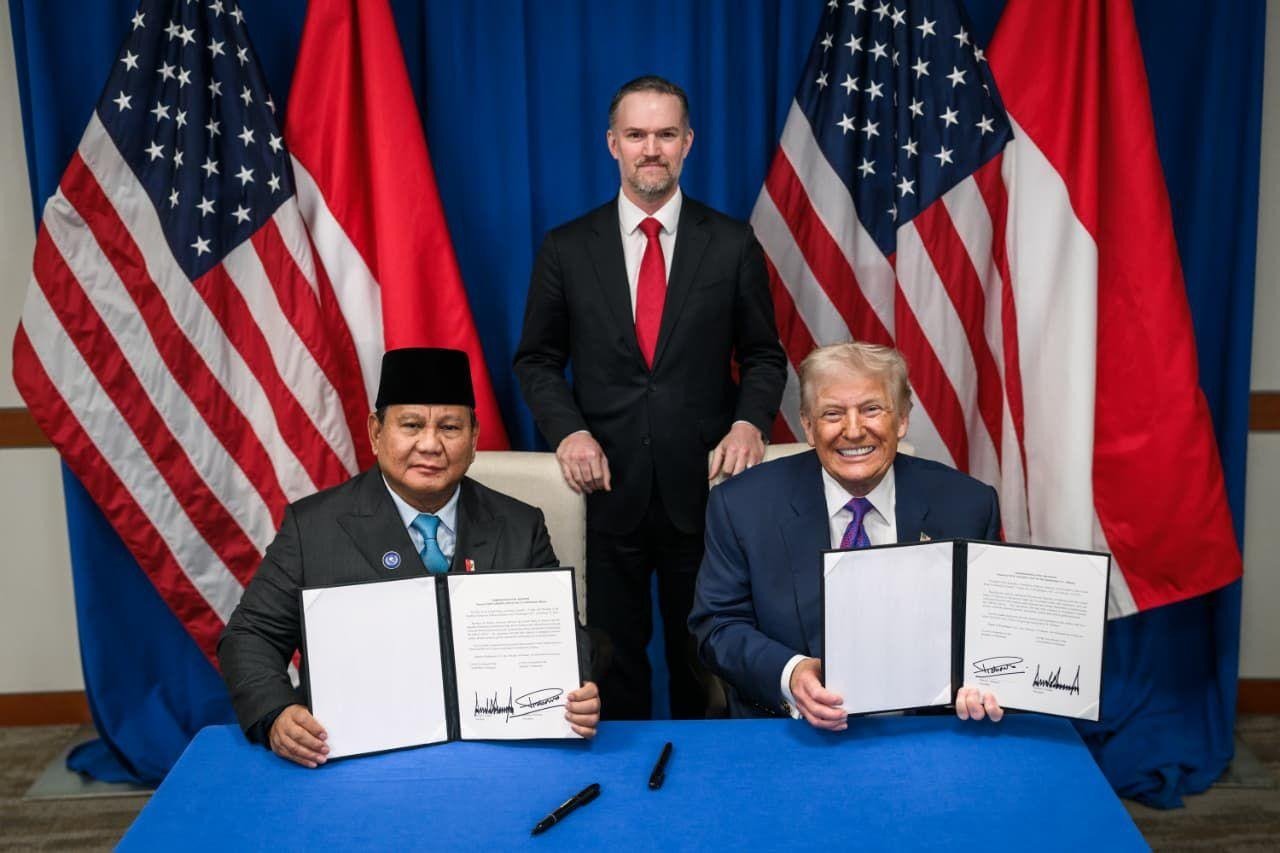
EduAsiaNews, Yogyakarta — Hundreds of professors, academics, and members of the academic community at Gadjah Mada University (UGM) have expressed deep concern over the bilateral trade agreement known as the Agreement on Reciprocal Trade (ART), signed by President Prabowo Subianto and United States President Donald Trump in Washington, D.C., on February 19, 2026. In a statement of position issued in Yogyakarta on Monday (03/02/2026), they argued that the agreement potentially violates the constitution and threatens the sovereignty of the Republic of Indonesia.
The ART covers 1,965 industrial products and 124 agricultural products exported from Indonesia to the United States, subject to an average tariff of 19 percent. However, UGM academics assessed the agreement as asymmetrical — delivering the greatest benefits to the U.S. side while leaving Indonesia to bear the majority of the obligations.
Constitutional Violations
In their statement, UGM’s academic community asserted that the process of signing the ART allegedly violates Article 11 of the 1945 Constitution, as it bypassed consultation with the House of Representatives (DPR) and was not ratified through legislation. The agreement was also deemed contrary to Law Number 24 of 2000, Law Number 7 of 2014, and Constitutional Court Decision Number 13/PUU-XVI/2018.
“At least eight provisions of the agreement are in conflict with the fundamental articles of the 1945 Constitution,” the statement read.
Complications were further compounded by a ruling issued by the U.S. Supreme Court on February 20, 2026, declaring that President Trump’s international tariff policies had exceeded executive authority. As a result, the 19 percent tariff rate agreed upon by Indonesia is actually higher than the 15 percent rate applied to countries that did not sign a similar agreement.
The academics also highlighted the significant regulatory burden that would arise from implementing the ART. The Indonesian government is expected to amend dozens of laws, government regulations, presidential decrees, presidential regulations, and ministerial regulations, while simultaneously drafting scores of entirely new ones.
Several clauses in the ART were also found to contain elements that erode national policy sovereignty, including compliance obligations for policies that do not yet exist, unilateral policy determinations by the United States, and the transmission of U.S. policies toward third countries through Indonesia, as stipulated in Articles 2.12, 3.3, 5.1, 5.2, and 5.3 of the agreement.
UGM’s academic community called on the government and the DPR to immediately conduct a thorough, evidence-based review of the ART’s content. They also urged the Ministry of Foreign Affairs to actively assist in making corrections so that the President is not placed in a position of violating the constitution.
Should the ratification of the ART fail to accommodate the objectives enshrined in existing legislation and the 1945 Constitution, the government was urged to renegotiate, postpone, or even cancel its implementation.
“The government must make decisions wisely, prioritizing the welfare of the people and national sovereignty in both the short and long term,” the statement firmly declared.
UGM academics expressed their readiness to support every effort to strengthen and uphold Indonesia’s sovereignty across all fields and walks of life. (**)