




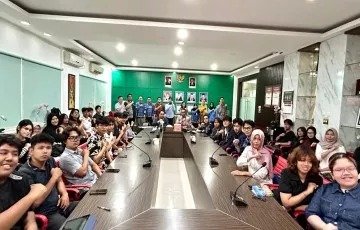
EduAsiaNews, Jakarta – Universitas Pembangunan Nasional Veteran Jakarta, through the Undergraduate Business Law Program of the Faculty of Law, held a public lecture on sustainable finance and banking law challenges on Wednesday, 26 February 2026, at the 2nd Floor Meeting Room of the Faculty of Law. The event featured banking practitioner Sapta Krida Negara, S.H., M.H., as the speaker, who discussed the dynamics of the financial services sector and their implications for business law practice.
The lecture was organized in response to the increasingly complex and digitalized banking industry. The Faculty of Law at UPNVJ emphasized the need for students to understand how sustainable finance concepts, banking regulations, and corporate governance principles affect legal practice in the financial services sector.
In his remarks, the Dean of the Faculty of Law highlighted the importance of collaboration between higher education institutions and industry practitioners to broaden students’ perspectives. He noted that the dynamic nature of the financial services sector requires law graduates not only to master theoretical knowledge but also to understand business transformation trends and rapidly evolving regulations.
During the event, an Implementation Agreement was also signed to strengthen cooperation between the Faculty of Law and industry partners. This collaboration aims to support education, research, and the enhancement of students’ competence in business law through internships, applied research, and professional discussion forums.
In his presentation, Sapta Krida Negara explained that modern banks are expected not only to focus on profit growth but also to consider social, environmental, and governance aspects. The Environmental, Social, and Governance (ESG) framework has become an integral part of banks’ business strategy to ensure long-term sustainability.
He also emphasized the importance of prudential principles, risk management, legal and compliance functions, and consumer protection in maintaining financial system stability. According to him, customer trust is the cornerstone of the banking industry and must be safeguarded through regulatory compliance and transparent governance.
The session included interactive discussions, with students raising questions about legal practice challenges in financial services, including sustainable financing, credit restructuring, and the implications of regulatory policies on bank operations.(www.upnvj.ac.id)